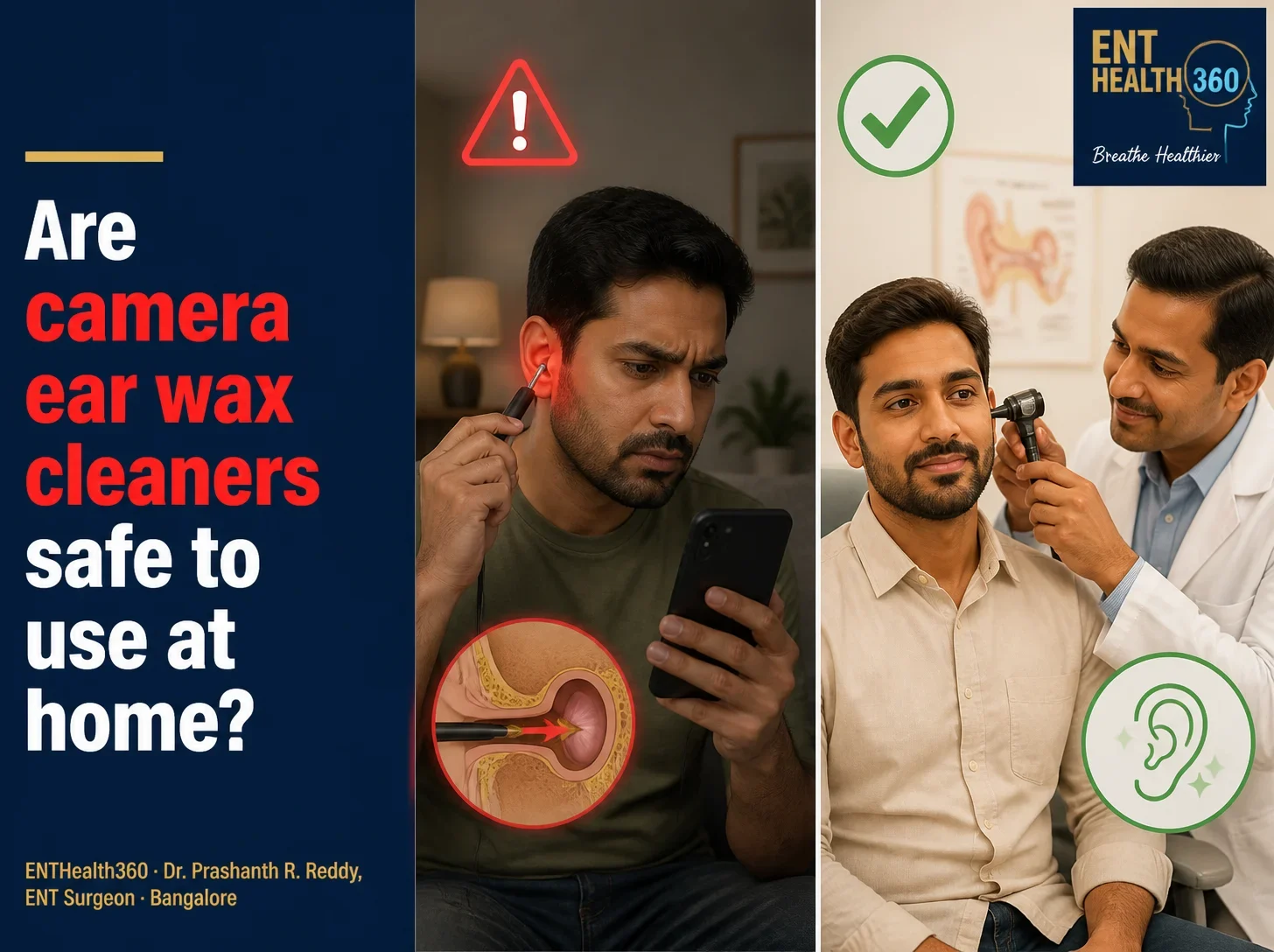
Short answer: Partly true. A camera ear cleaner lets you see inside your ear, but seeing is not the same as removing wax safely. Ears are self-cleaning, and the AAO-HNS earwax guideline advises against putting objects into the ear canal. Softening drops are the safer first step; wax that stays blocked needs an examination.
Key takeaways
- Most ears never need cleaning inside the canal. Wax moves outward on its own and protects the skin.
- Camera scoops still go inside the canal, so they carry the same risks as other tools: scratches, infection, wax pushed deeper, and rarely eardrum injury.
- There are no good-quality studies showing that home camera ear cleaners are safe or effective.
- A Cochrane review found softening ear drops may help clear wax, although no single type has been shown to be better than the others.
- Blockage that lasts beyond about five days of drops, pain, discharge, ringing or a sudden drop in hearing needs an ENT check.
What is ear wax, and why does it build up?
Ear wax (cerumen) is a natural mix of oils, sweat-gland secretions and dead skin made in the outer part of the ear canal. It traps dust, keeps the canal skin moisturised and has mild antibacterial properties. Jaw movement from chewing and talking slowly carries it outward. Wax becomes a problem, called cerumen impaction, when it collects enough to cause symptoms or blocks the doctor's view of the eardrum. The AAO-HNS guideline estimates this affects roughly 1 in 10 children, 1 in 20 adults and more than a third of older adults and people with developmental disabilities. Common reasons include narrow or hairy canals, hearing aids or earphones worn for long hours, and repeated cleaning with cotton buds, which pushes wax back in.
Is the “camera ear cleaner” claim true?
Viral videos and product ads describe camera ear-scoops as the “smartest” or “safest” way to clean your ears. The camera part does help: you can see whether there is wax at all. The trouble is the tool. The skin of the inner ear canal is very thin and lies directly over bone, and the eardrum sits only about 2.5 cm inside. A small phone camera gives a flat, magnified picture with no depth, so it is easy to misjudge distance. Doctors who remove wax use a microscope or endoscope, with suction and proper instruments, and they are trained to work in a moving, sensitive space.
The AAO-HNS Clinical Practice Guideline on earwax (2017) says clinicians should explain that ears are self-cleaning and that cotton buds and other objects should not be put into the canal. It also advises against ear candling. No guideline recommends home camera scoops, and we could find no clinical trials testing them. So our verdict is partly true: the visibility is real, the safety claim is not supported.
The cotton-bud data show what tools in the ear can do. A 2017 study from Nationwide Children's Hospital, published in the Journal of Pediatrics, estimated that cotton-tip applicators sent about 34 children a day to US emergency departments with ear injuries.
Symptoms and self-check: is it wax or something else?
Wax that is causing a problem usually gives one or more of these:
- A blocked or full feeling in one ear
- Muffled hearing
- Ringing or buzzing (tinnitus)
- Itching, mild ache, or cough when the ear is touched
The same symptoms can come from an infection of the ear canal (otitis externa), fluid behind the eardrum after a cold, or a problem in the inner ear. Pain, discharge, a bad smell, dizziness or a sudden drop in hearing point away from simple wax.
Safe vs unsafe home ear care
| Method | What the evidence says | Our view |
|---|---|---|
| Leave it alone, wipe the outer ear with a cloth | Ears are self-cleaning (AAO-HNS 2017) | Right for most people |
| Softening drops (olive oil, sodium bicarbonate, pharmacy drops) for a few days | May help clear wax; no type clearly better than another (Cochrane 2018) | Reasonable first step if no pain, discharge or past eardrum problems |
| Cotton buds, hairpins, keys, matchsticks | Linked to canal and eardrum injuries; push wax deeper | Avoid |
| Camera ear-scoops | No good-quality safety studies | Avoid inserting the scoop; looking only is lower risk |
| Ear candles | Ineffective; burn risk (AAO-HNS, BJGP 2023) | Avoid |
| Roadside ear cleaners | Unsterile reused tools; infection and injury risk | Avoid |
In my OPD in Bengaluru, a common pattern is a patient who has been scraping one ear every day with a new gadget or a bud, and arrives with a sore, swollen canal and wax packed even deeper. Most of the time the wax would have been far easier to clear before the digging began.
When should you see an ENT?
- Your ear is still blocked after about five days of softening drops.
- You have pain, discharge, bleeding or a bad smell.
- You notice sudden hearing loss, new ringing or dizziness. Sudden hearing loss should be seen urgently.
- You have had a perforated eardrum, ear surgery or grommets, or you hear well in only one ear.
- You wear hearing aids and wax keeps building up.
How does an ENT diagnose and remove ear wax?
An ENT evaluation starts with your history: how long the ear has been blocked, any pain, discharge or hearing change, and past ear problems. The ear is then examined with an otoscope or an endoscope, which shows the wax, the canal skin and, once visible, the eardrum. If symptoms suggest more than wax, a hearing test may be advised.
Treatment options for impacted ear wax
Treatment depends on your ear. According to a 2023 British Journal of General Practice review summarising NICE guideline NG98, options include softening drops followed by electronic low-pressure irrigation, or microsuction, with manual removal using fine instruments as an alternative. Old-style manual syringing is no longer recommended in the UK. Irrigation is avoided when there is a perforation, grommet, infection or only one hearing ear. Microsuction, done under a microscope, is the usual method in ENT clinics. Each method has small risks, such as discomfort or minor bleeding, which your doctor will discuss with you. If an ear canal infection is found, it is treated first.
Ear wax and ear care in Bengaluru
Bengaluru's dust, long commutes with earphones and the habit of “cleaning” ears after every bath all add to wax problems. Roadside ear cleaning is still seen in parts of the city and carries a real infection risk. Dr. Prashanth R. Reddy sees patients with blocked ears, ear canal infections and hearing concerns at Sakra World Hospital, Marathahalli and at his Koramangala clinic.
Frequently asked questions
Are camera ear wax cleaners safe? The camera itself is low risk if you only look near the opening. Using the attached scoop inside the canal carries the same risks as other tools, and there are no good studies showing it is safe.
Do ears really clean themselves? Yes. In most people wax moves outward on its own with jaw movement. Wiping the outer ear is usually enough.
Can I use olive oil for ear wax? A few drops of plain olive oil for a few days is a common softening method. Avoid drops if you have ear pain, discharge or a known perforated eardrum.
Is hydrogen peroxide safe for ear wax? Diluted peroxide-based drops are sold for wax, but they can irritate some ears. Use them only as labelled, and not if you may have an eardrum problem.
Why do cotton buds make wax worse? They tend to push wax deeper and pack it against the eardrum, and they can scratch the canal skin.
How often should ear wax be removed by a doctor? Only when it causes symptoms or blocks the view of the eardrum. Some people with narrow canals or hearing aids need periodic checks.
Can ear wax cause ringing in the ears? Yes, wax pressing on the eardrum can cause tinnitus. Ringing that persists after wax is cleared should be checked.
References
- Schwartz SR, et al. Clinical Practice Guideline (Update): Earwax (Cerumen Impaction). Otolaryngology–Head and Neck Surgery, 2017.
- Aaron K, et al. Ear drops for the removal of ear wax. Cochrane Database of Systematic Reviews, 2018.
- Munro KJ, et al. Ear wax management in primary care: what the busy GP needs to know. British Journal of General Practice, 2023.
- Nationwide Children's Hospital. Cotton tip applicators are sending 34 kids to the emergency department each day. 2017.
About the author
Dr. Prashanth R Reddy is an ENT surgeon at ENTHealth360, Bangalore (MS ENT; MBA, IIM Bangalore; Seoul Rhinoplasty Fellowship), seeing patients at Sakra World Hospital, Marathahalli and in Koramangala. He has more than 20 years of experience in ear, nose, throat, sinus and sleep-breathing care.
Related reading
Ear still blocked after a few days of drops? You're welcome to arrange an ENT evaluation with Dr. Prashanth R. Reddy at Sakra World Hospital, Marathahalli or in Koramangala through enthealth360.com.
For educational purposes only. Not a substitute for medical advice. Please consult a qualified ENT specialist.
General patient education. An individual consultation is needed to assess your symptoms and treatment options.