By Dr. Prashanth R Reddy, ENT Surgeon, ENTHealth360, Bangalore. Medically reviewed. Last reviewed: 24 November 2026.
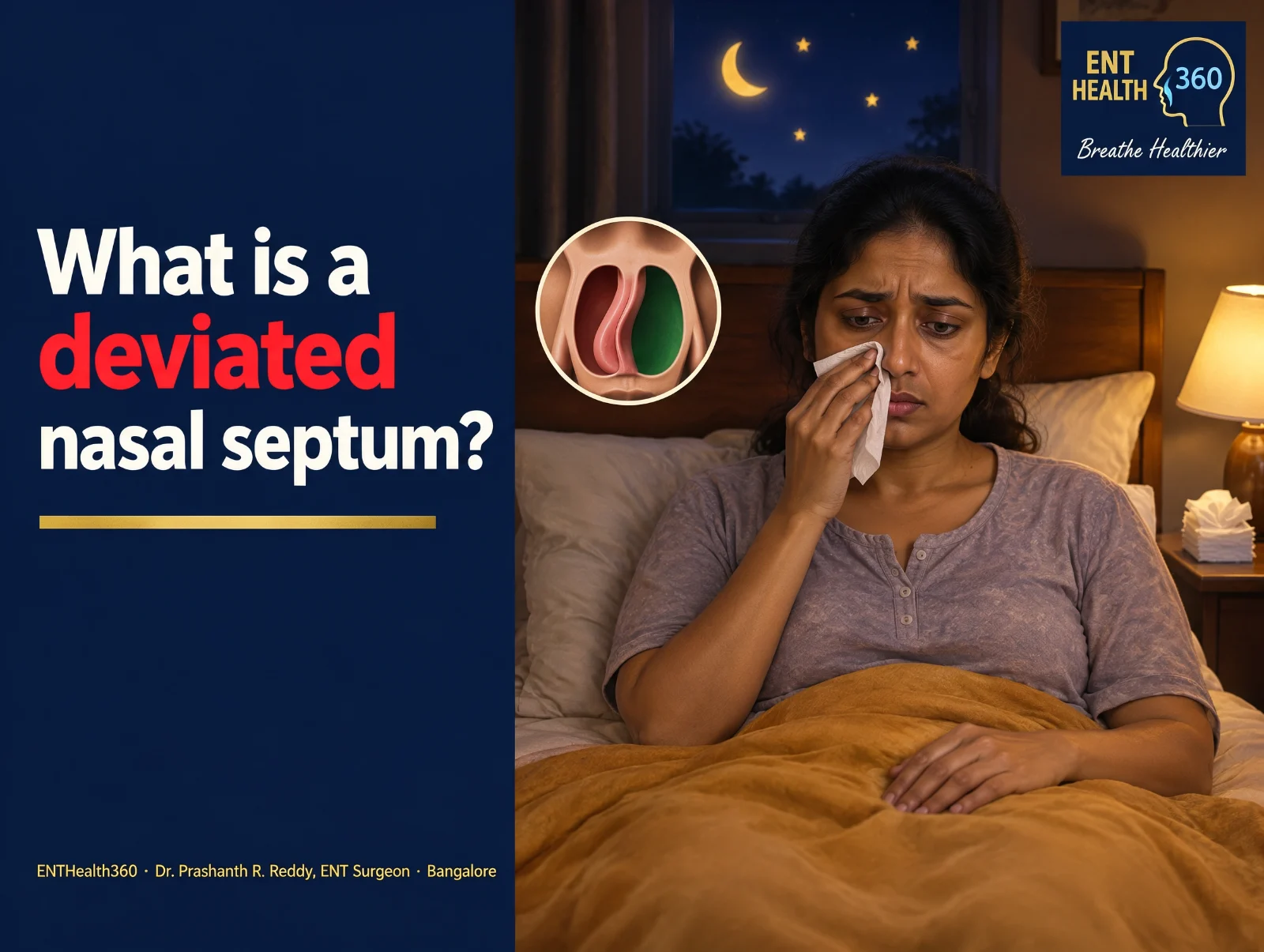
Short answer: A deviated septum means the wall of cartilage and bone between the two nostrils is bent or off-centre. Mild deviation is extremely common and usually harmless. A significant bend can block airflow and cause one-sided stuffiness, snoring, nosebleeds or recurrent sinus problems. It is diagnosed by examining the inside of the nose, often with an endoscope.
Key takeaways
- The septum divides the nose into two passages and is made of cartilage at the front and bone further back.
- Most people have some deviation; it needs attention only when it causes symptoms.
- A deviated septum cannot be judged from the outside of the nose.
- Sprays can reduce surrounding swelling but cannot straighten the septum itself.
What exactly is the septum, and how does it become deviated?
The septum is the central wall inside your nose, and it becomes deviated when it bends to one side.
The front part of the septum is flexible cartilage; the back part is thin bone. Together they divide the nose into two airways and support the shape of the nose.
A septum can be bent from birth, can grow unevenly during childhood and adolescence, or can shift after an injury, such as a fall, a sports knock or a road accident. Sometimes a small ridge called a septal spur sticks out towards one side. Many people have no memory of an injury at all.
What symptoms can a deviated septum cause?
A deviated septum causes symptoms only when the bend narrows the airway or disturbs normal drainage.
- Steady blockage on one side, often worse during a cold or allergy
- Mouth breathing, snoring or noisy sleep
- Nosebleeds, because air flowing over a bend can dry the lining
- Recurrent sinusitis, if sinus openings are crowded
- Facial pressure or headache in some people, when a spur touches the side wall
The opposite turbinate, the curved shelf inside the nose, often enlarges to fill the wider side, which is why both sides can feel blocked.
What can you do at home if you have a deviated septum?
Home care cannot change the shape of the septum, but it can reduce the swelling that makes it feel worse.
- Use saline rinses to keep the lining moist and clear.
- Control allergy triggers such as dust mites, pollen and smoke. Bangalore's pollen seasons and traffic dust can make a mild bend feel much worse.
- Keep the air moderately humid to reduce dryness and nosebleeds.
- Use a prescribed steroid spray if your doctor advises it.
- Avoid long-term decongestant spray use. If you have used one for more than a week, speak to an ENT about a safe way to stop.
How are breathing, sleep and energy connected here?
A significantly deviated septum can tip the balance from nasal breathing to mouth breathing, especially at night.
When one passage is narrow, normal night-time swelling can block the nose enough to make you breathe through your mouth. This may increase snoring and lead to lighter, more fragmented sleep.
For many people, that shows up as tiredness, reduced concentration and lower workout stamina. If a deviated septum is affecting your breathing, addressing it may help sleep and energy, although results vary.
How does nose breathing support energy and BMR?
Your basal metabolic rate (BMR) is the energy your body burns at rest to keep the heart beating, the brain working and cells repairing. Your cells make that energy using oxygen, so how well you breathe matters.
Nose breathing helps in two ways:
- Warm, moist, filtered air. The nose warms, humidifies and filters each breath before it reaches the lungs. Conditioned air is gentler on the airway lining, which matters in Bangalore's air-conditioned offices and traffic dust. Mouth breathing skips this step and can leave the throat and airways dry.
- Nitric oxide from the sinuses. The paranasal sinuses continuously make nitric oxide (NO), a natural gas. When you breathe in through your nose, small amounts of this NO travel to the lungs, where studies suggest it may help widen tiny blood vessels and improve oxygen uptake. Mouth breathing largely bypasses it.
Nose breathing does not "boost" your BMR. That is set mainly by muscle mass, age, body size and hormones such as thyroid. But comfortable nasal breathing by day, and undisturbed breathing at night, support efficient oxygen supply and deeper sleep, which your body needs to use energy well and recover.
A simple check: sit quietly and breathe through your nose with your mouth closed for two minutes. If that feels difficult, or one side is always blocked, it is worth having your nose examined.
When should you see an ENT?
See an ENT if you think your nose is narrower on one side and it affects daily life.
- Steady one-sided blockage lasting weeks
- Snoring, mouth breathing or unrefreshing sleep
- Recurrent nosebleeds or sinus infections
- Breathing difficulty during exercise
- A change in nasal breathing after an injury
Seek prompt medical care after a nose injury with a new blockage, swelling inside the nose or a crooked appearance, as a blood collection on the septum needs early treatment.
Seek urgent care for a nosebleed that does not stop after 20 minutes of firm pressure, or clear watery discharge after a head injury.
How does an ENT evaluate and treat a deviated septum?
An ENT diagnoses a deviated septum by examining the inside of the nose, not by its outside shape.
The examination uses a light and usually a nasal endoscopy, a thin camera passed gently into the nose after a numbing spray. This shows the position of the septum, any spurs, the turbinates and the sinus openings. A CT scan is usually only needed if sinus disease is also suspected or surgery is being planned.
If symptoms are mild, saline, a steroid spray and allergy control may be enough. If blockage still affects breathing, sleep or sinus health despite consistent treatment, septoplasty, surgery through the nostrils to straighten the septum, may be discussed, sometimes with turbinate reduction. The right option depends on the cause.
Frequently asked questions
Does nose breathing give me more energy? It does not add energy by itself, but it delivers warm, humidified air and sinus nitric oxide to the lungs, which may help oxygen uptake. Together with better sleep, that supports the energy your body uses at rest (BMR) and during activity.
Is a deviated septum common? Yes, some degree of septal deviation is found in a large proportion of adults. Most cause no symptoms and need no treatment.
Can a deviated septum correct itself? No, the bend does not straighten on its own. Symptoms, however, can often be reduced with medical treatment.
Is septoplasty the same as rhinoplasty? No. Septoplasty straightens the inside wall to improve breathing; rhinoplasty changes the outer shape. They are sometimes combined.
References
- Lundberg JO, Farkas-Szallasi T, Weitzberg E, et al. High nitric oxide production in human paranasal sinuses. Nature Medicine. 1995;1(4):370-373.
- Lundberg JO, Settergren G, Gelinder S, et al. Inhalation of nasally derived nitric oxide modulates pulmonary function in humans. Acta Physiologica Scandinavica. 1996;158(4):343-347.
- Keck T, Leiacker R, Heinrich A, Kühnemann S, Rettinger G. Humidity and temperature profile in the nasal cavity. Rhinology. 2000;38(4):167-171.
About the author
Dr. Prashanth R Reddy is an ENT surgeon at ENTHealth360, Bangalore (MS ENT; MBA, IIM Bangalore; Seoul Rhinoplasty Fellowship), seeing patients at Sakra World Hospital, Marathahalli and in Koramangala. His practice focuses on how breathing affects sleep, energy and everyday performance.
Related reading: Why Is My Nose Always Blocked? Deviated Septum, Turbinates & Nosebleeds Explained
For educational purposes only. Not a substitute for medical advice. Please consult a qualified ENT specialist.
General patient education. An individual consultation is needed to assess your symptoms and treatment options.