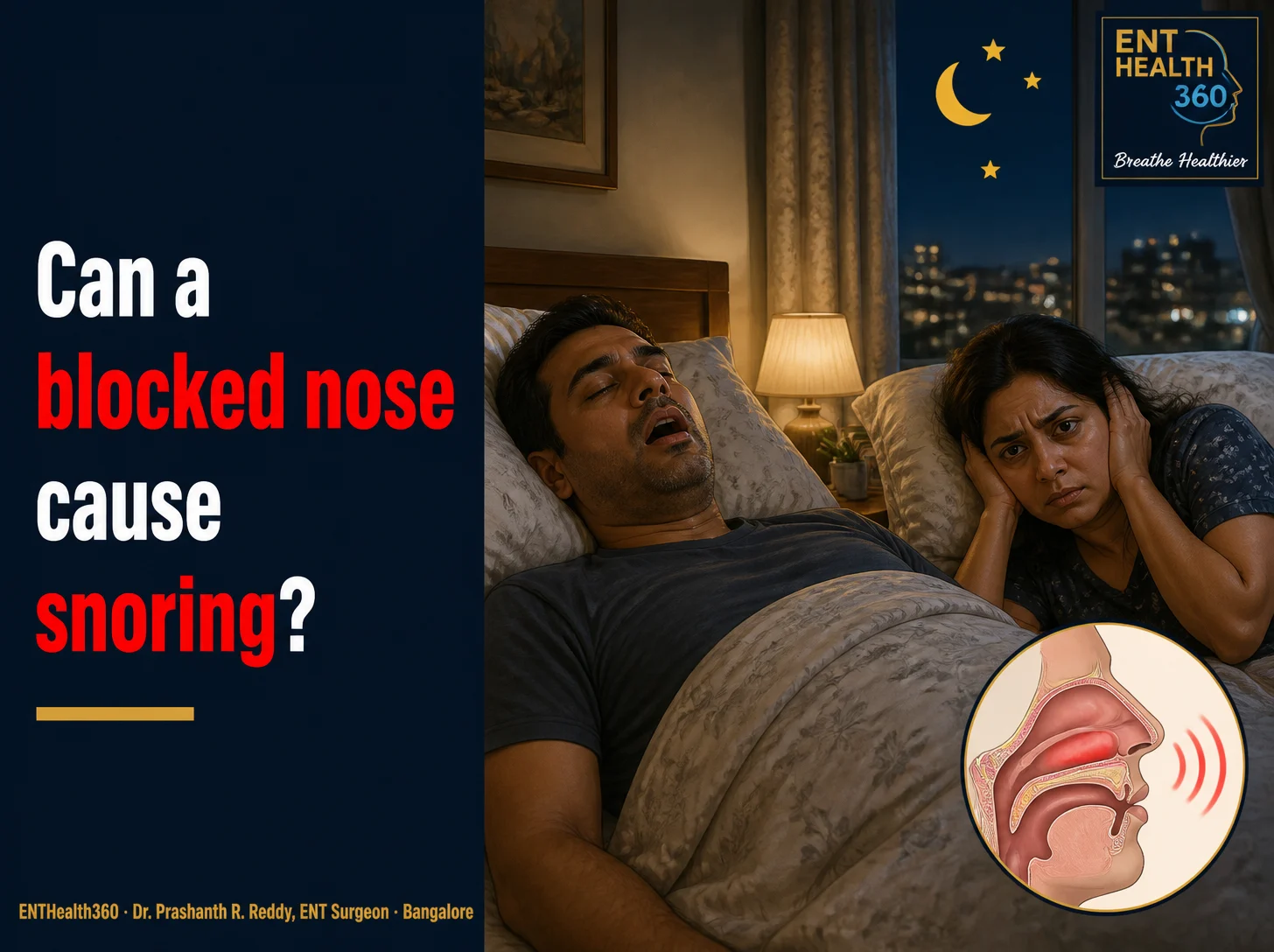
Short answer: Yes. A blocked nose from allergy, a deviated septum or swollen turbinates makes you breathe harder and often switch to mouth breathing. This increases suction on the throat tissues and lets the tongue fall back, which can cause or worsen snoring. Treating the nose may help, but snoring often has more than one source.
Key takeaways
- Nasal blockage increases suction on the throat and encourages mouth breathing.
- Common causes are allergy, a deviated septum, swollen turbinates, polyps and sinusitis.
- Treating the nose may reduce snoring for some people and helps CPAP users.
- A full airway examination is useful because several levels are often involved.
Dr. Prashanth's perspective
In my OPD, a nasal problem such as a DNS, enlarged or pneumatised turbinates, or adenoids is very often part of the picture. A blocked nose drives mouth breathing, which adds negative pressure in the throat and can worsen snoring and sleep apnea.
— Dr. Prashanth R. Reddy, ENT Surgeon, ENTHealth360
How does a blocked nose lead to snoring?
A blocked nose makes breathing harder work, which increases suction on the soft throat tissues and makes them more likely to vibrate.
Think of drinking through a pinched straw. You have to suck harder, and the straw tends to collapse. Similarly, when the nose is narrowed, the chest pulls harder to draw air in, creating more negative pressure in the throat. The soft palate and throat walls are drawn inward and flutter.
A blocked nose also pushes you to breathe through your mouth. When the mouth opens during sleep, the jaw drops and the tongue slides back, narrowing the airway further.
What are the common nasal causes?
Several conditions can block the nose, and some people have more than one.
- Allergic rhinitis: Swelling of the nasal lining from dust mites, pollen, mould or pet dander. Common in Bangalore during the monsoon and pollen seasons.
- Deviated septum: The septum is the central wall dividing the two nostrils. When it bends to one side, it narrows airflow.
- Turbinate hypertrophy: Turbinates are ridges inside the nose that warm and humidify air. When swollen, they block it.
- Nasal polyps and chronic sinusitis: Soft swellings or long-term inflammation that block the nasal passages.
- Enlarged adenoids: A common cause of mouth breathing and snoring in children.
- Overuse of decongestant sprays: Using them for more than a few days can cause rebound blockage.
Signs that the nose is involved include mouth breathing, a dry mouth on waking, snoring that worsens with colds, and one or both sides feeling stuffy.
What can you do at home?
Gentle, regular nasal care can reduce night-time blockage for many people.
- Use saline rinses or sprays before bed to clear mucus and allergens.
- Wash pillow covers and bedsheets weekly in hot water to reduce dust mites.
- Avoid sleeping with AC air blowing directly onto your face; keep the room comfortably cool, not cold.
- Limit exposure to smoke, incense and strong fumes.
- Avoid over-the-counter decongestant sprays beyond a few days unless advised.
- Ask your doctor whether a steroid nasal spray or antihistamine suits you.
How are breathing, sleep and energy connected here?
Comfortable nasal breathing is one of the foundations of good sleep.
Breathing through the nose filters, warms and humidifies air, and it helps keep the jaw and tongue in a better position. When the nose is blocked, sleep can become lighter, with more snoring, dry mouth and awakenings.
Many people report that once nasal blockage is treated, they sleep more deeply and wake fresher. That can translate into steadier energy for work, exercise and studies, and fewer afternoon slumps.
How does nose breathing support energy and BMR?
Your basal metabolic rate (BMR) is the energy your body burns at rest to keep the heart beating, the brain working and cells repairing. Your cells make that energy using oxygen, so how well you breathe matters.
Nose breathing helps in two ways:
- Warm, moist, filtered air. The nose warms, humidifies and filters each breath before it reaches the lungs. Conditioned air is gentler on the airway lining, which matters in Bangalore's air-conditioned offices and traffic dust. Mouth breathing skips this step and can leave the throat and airways dry.
- Nitric oxide from the sinuses. The paranasal sinuses continuously make nitric oxide (NO), a natural gas. When you breathe in through your nose, small amounts of this NO travel to the lungs, where studies suggest it may help widen tiny blood vessels and improve oxygen uptake. Mouth breathing largely bypasses it.
Nose breathing does not "boost" your BMR. That is set mainly by muscle mass, age, body size and hormones such as thyroid. But comfortable nasal breathing by day, and undisturbed breathing at night, support efficient oxygen supply and deeper sleep, which your body needs to use energy well and recover.
A simple check: sit quietly and breathe through your nose with your mouth closed for two minutes. If that feels difficult, or one side is always blocked, it is worth having your nose examined.
When should you see an ENT?
See an ENT if nasal blockage is persistent, one-sided or comes with other symptoms.
- A nose blocked most days for more than a few weeks
- Blockage on one side only, or recurrent nosebleeds
- Loss of smell, facial pain or thick discoloured discharge
- Snoring with breathing pauses or daytime sleepiness
- A child who snores and breathes through the mouth
Seek urgent medical care for swelling around the eye, severe headache with fever, vision changes or heavy nosebleeds that do not stop.
How does an ENT evaluate and treat it?
An ENT examines the nose closely and checks the rest of the airway, because the right option depends on the cause.
A nasal endoscopy, using a thin camera, shows the septum, turbinates, sinuses and adenoids. Allergy tests or a CT scan may be advised in some cases. If sleep apnea is suspected, a sleep study may be suggested.
Treatment may include saline, steroid sprays and allergy control. If there is a structural problem, procedures such as septoplasty (straightening the septum), turbinate reduction or endoscopic sinus surgery may be considered. Improving the nose can also make CPAP more comfortable. Results vary, and other levels of the airway may need attention too.
Frequently asked questions
Does nose breathing give me more energy? It does not add energy by itself, but it delivers warm, humidified air and sinus nitric oxide to the lungs, which may help oxygen uptake. Together with better sleep, that supports the energy your body uses at rest (BMR) and during activity.
Will fixing a deviated septum stop my snoring? It may reduce snoring if the nose is the main cause, but many people have narrowing at other levels too. A full assessment helps set realistic expectations.
Can mouth taping help with snoring? Some people try it, but it is not safe if the nose is blocked or sleep apnea is present. Discuss it with a doctor first.
Why is my nose more blocked at night? Lying down increases blood flow to the nasal lining, and bedroom allergens add to it.
References
- Lundberg JO, Farkas-Szallasi T, Weitzberg E, et al. High nitric oxide production in human paranasal sinuses. Nature Medicine. 1995;1(4):370-373.
- Lundberg JO, Settergren G, Gelinder S, et al. Inhalation of nasally derived nitric oxide modulates pulmonary function in humans. Acta Physiologica Scandinavica. 1996;158(4):343-347.
- Keck T, Leiacker R, Heinrich A, Kühnemann S, Rettinger G. Humidity and temperature profile in the nasal cavity. Rhinology. 2000;38(4):167-171.
About the author
Dr. Prashanth R Reddy is an ENT surgeon at ENTHealth360, Bangalore (MS ENT; MBA, IIM Bangalore; Seoul Rhinoplasty Fellowship), seeing patients at Sakra World Hospital, Marathahalli and in Koramangala. His practice focuses on how breathing affects sleep, energy and everyday performance.
Related reading: Why am I always tired even after 8 hours of sleep? · Why do I wake up tired every morning?
Complete guide: Snoring and sleep apnea: evaluation, options and recovery
For educational purposes only. Not a substitute for medical advice. Please consult a qualified ENT specialist.
General patient education. An individual consultation is needed to assess your symptoms and treatment options.