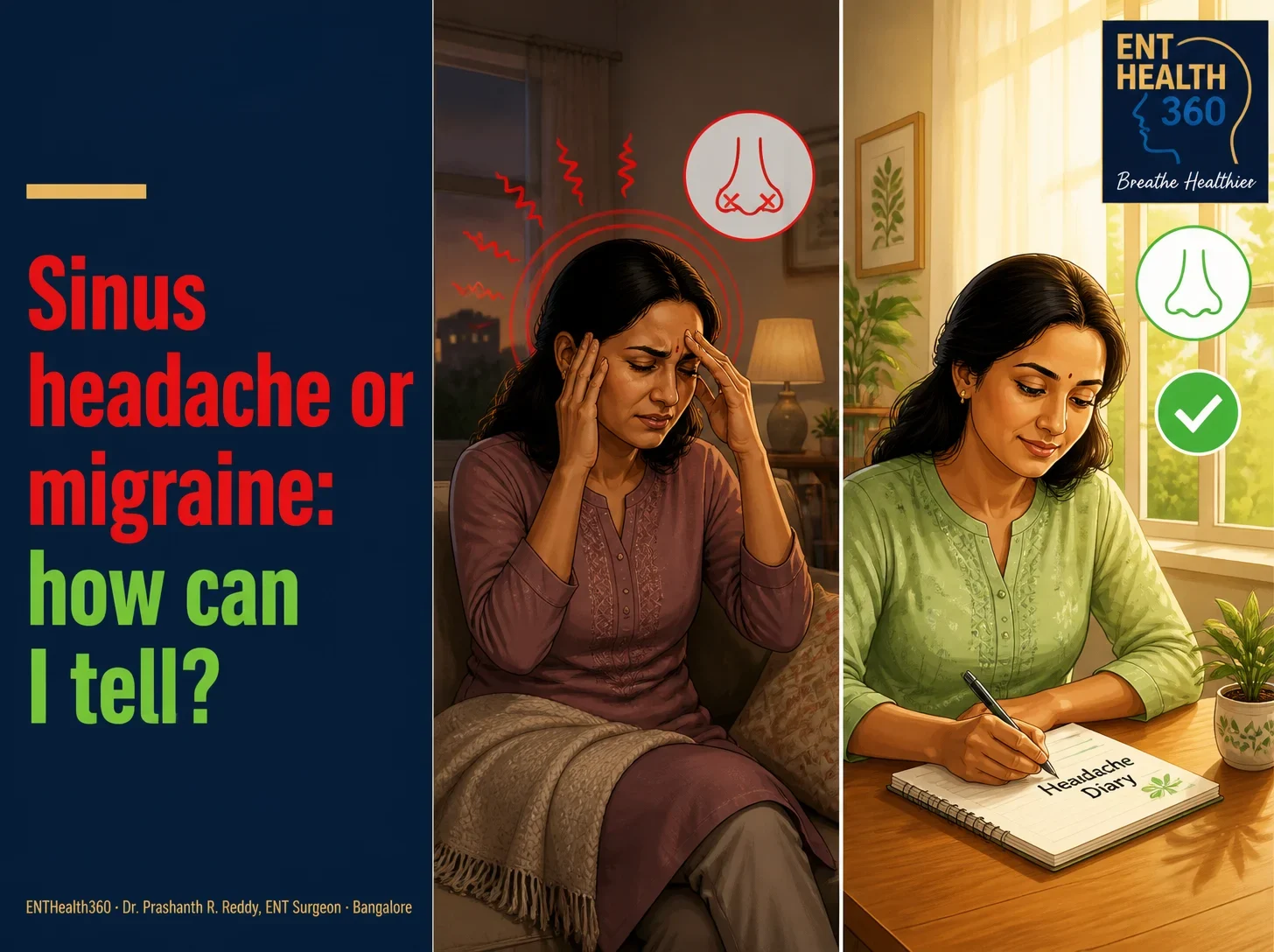
Short answer: Many headaches labelled "sinus" turn out to be migraine. Migraine is often throbbing, may come with nausea or sensitivity to light and sound, and can even cause a stuffy nose or watery eyes. A true sinus headache usually comes with thick discoloured discharge, a blocked nose and reduced smell, and often follows a cold. An ENT examination of the nose helps tell them apart.
Key takeaways
- In large studies, most people who believed they had "sinus headaches" actually met the criteria for migraine.
- Migraine can cause nasal stuffiness and watery eyes, which is why it is so often mistaken for sinusitis.
- A sinus headache usually comes with clear nasal signs: thick discharge, blockage, reduced smell and a recent cold.
- The reverse also happens: some sinus or nose-related headaches are treated as migraine for years.
- A two-week headache diary and a nasal endoscopy are the most useful first steps.
🧐 Myth Monday
❌ Myth: Every headache with a blocked nose is a 'sinus headache'.
✅ Fact: Many so-called sinus headaches turn out to be migraine, and some start from a nasal contact point (Sluder's neuralgia). An ENT examination with nasal endoscopy helps tell them apart.
Dr. Prashanth's perspective
Not every headache is sinus, and not every headache is migraine. In my clinic, a good number of patients with long-standing headaches turn out to have a contact point inside the nose, seen on nasal endoscopy or CT. The nose deserves a proper look.
— Dr. Prashanth R. Reddy, ENT Surgeon, ENTHealth360
Why are sinus headache and migraine so easily confused?
Both can cause pain over the forehead, around the eyes and in the cheeks, and both can come with nasal symptoms.
During a migraine attack, the same nerve network that carries head pain can also switch on the nose and eyes. This can make the nose feel stuffy or runny and the eyes water, usually on the side of the pain. Weather changes, a common migraine trigger, add to the confusion because people also link weather with "sinus".
In one large study of nearly 3,000 people with self-reported or doctor-diagnosed "sinus headache", close to nine in ten met the criteria for migraine. A separate clinic study found a similar pattern.
How do the symptoms differ?
No single symptom settles it, but the overall pattern is usually telling.
Features that point towards migraine:
- Throbbing or pulsing pain, often on one side, lasting from a few hours to up to three days.
- Nausea or vomiting, and wanting a dark, quiet room because light and sound feel uncomfortable.
- Pain that worsens with routine activity such as climbing stairs.
- Repeated attacks with clear triggers: missed meals, poor sleep, stress, bright screens or periods.
- Clear nasal discharge or watery eyes only during the headache, settling when it ends.
Features that point towards a sinus headache:
- Thick yellow or green discharge from the front of the nose or down the throat.
- A blocked nose and reduced sense of smell.
- Pressure or fullness over the cheeks, forehead or between the eyes, often heavier when you bend forward.
- Symptoms that begin during or after a cold, sometimes with fever.
- Pain that rises and falls with the nasal symptoms rather than coming in separate attacks.
Can the nose cause headache without an infection?
Yes, in a smaller group of people. Inside the nose, a bent septum or a bony spur can press on the side wall (a contact point (Sluder's neuralgia)). This pressure can irritate nerve endings and refer pain to the forehead, eye or temple, even when there is no infection.
These headaches are often on one side, may sit on the same side as a nose that always feels blocked, and may respond poorly to usual headache medicines. They are identified with nasal endoscopy and a CT scan, after other causes of headache have been considered. This is one reason a headache that has not settled with standard treatment deserves a look inside the nose.
What can you do at home?
The most useful first step is to record what happens, so the pattern becomes clear.
- Keep a two-week headache diary. Note the time, which side hurts, how long it lasts, possible triggers, and any nasal symptoms such as blockage or discharge.
- Watch your painkiller use. Taking headache tablets on many days of the month can itself make headaches more frequent. If you need them more than two or three days a week, see a doctor.
- Use a saline rinse once or twice a day if your nose is blocked, with boiled-and-cooled, distilled or sterile water.
- Avoid long-term decongestant sprays. Using them for more than three to five days can cause rebound blockage.
- Look after the basics: regular sleep, regular meals and enough water reduce migraine attacks for many people.
How are breathing, sleep and headache connected?
A blocked nose often changes how you breathe at night. Many people switch to mouth breathing, which can lead to snoring, a dry throat and lighter, more broken sleep.
Poor sleep is one of the commonest migraine triggers, and waking with a headache can also be a sign of disturbed breathing at night. So a nose problem can feed headaches in more than one way: directly through sinus or contact-point pressure, and indirectly through broken sleep.
How does nose breathing support energy and BMR?
Your basal metabolic rate (BMR) is the energy your body burns at rest to keep the heart beating, the brain working and cells repairing. Your cells make that energy using oxygen, so how well you breathe matters.
Nose breathing helps in two ways:
- Warm, moist, filtered air. The nose warms, humidifies and filters each breath before it reaches the lungs. Conditioned air is gentler on the airway lining, which matters in Bangalore's air-conditioned offices and traffic dust. Mouth breathing skips this step and can leave the throat and airways dry.
- Nitric oxide from the sinuses. The paranasal sinuses continuously make nitric oxide (NO), a natural gas. When you breathe in through your nose, small amounts of this NO travel to the lungs, where studies suggest it may help widen tiny blood vessels and improve oxygen uptake. Mouth breathing largely bypasses it.
Nose breathing does not "boost" your BMR. That is set mainly by muscle mass, age, body size and hormones such as thyroid. But comfortable nasal breathing by day, and undisturbed breathing at night, support efficient oxygen supply and deeper sleep, which your body needs to use energy well and recover.
A simple check: sit quietly and breathe through your nose with your mouth closed for two minutes. If that feels difficult, or one side is always blocked, it is worth having your nose examined.
When should you see a doctor?
See an ENT if headaches come with nasal symptoms, or if a "sinus headache" keeps returning despite treatment.
- Headaches with a blocked nose, thick discharge or reduced smell.
- Headaches on one side, with a nose that stays blocked on that same side.
- Repeated courses of antibiotics for "sinus" without lasting relief.
- Headaches that have not settled with usual migraine or headache treatment.
A physician or neurologist is the right first stop when the pattern clearly fits migraine with no nasal signs.
Seek urgent medical care for a sudden, severe "worst-ever" headache; headache with fever, a stiff neck or confusion; swelling or redness around the eye, double vision or reduced vision; weakness, numbness or difficulty speaking; or a headache after a head injury.
How an ENT evaluates it
An ENT's job here is to find out whether the nose is part of the picture.
The assessment starts with a detailed history, including your headache diary. A nasal endoscopy, a thin camera passed gently into the nose after a numbing spray, shows the drainage pathways, the septum, any polyps or discharge, and any contact points. A CT scan is advised when chronic sinusitis or a contact point is suspected, or when surgery is being considered.
If the nose is normal, the likely answer is migraine or another primary headache, and the right next step is a physician or neurologist. If sinusitis is found, treatment usually starts with saline, steroid sprays and allergy control. Surgery is considered only for selected people in whom examination and scans show a clear nasal cause and other treatment has not helped. The right option depends on the cause.
Frequently asked questions
Can migraine make my nose run or feel blocked? Yes. During an attack, migraine can cause a stuffy or runny nose and watery eyes, usually on the side of the pain, which is why it is often mistaken for sinus.
Does a headache when I bend forward mean it is sinus? It can suggest sinus pressure, but migraine pain also worsens with movement, so look at the whole pattern, including nasal symptoms.
Will antibiotics help a "sinus headache"? Only if there is a bacterial sinus infection. Most headaches labelled sinus are not infections, and repeated antibiotics will not help them.
Can I have both migraine and sinusitis? Yes. They are common, and some people have both, which is why a proper examination helps.
Does nose breathing give me more energy? It does not add energy by itself, but it delivers warm, humidified air and sinus nitric oxide to the lungs, which may help oxygen uptake. Together with better sleep, that supports the energy your body uses at rest (BMR) and during activity.
References
- Schreiber CP, Hutchinson S, Webster CJ, Ames M, Richardson MS, Powers C. Prevalence of migraine in patients with a history of self-reported or physician-diagnosed "sinus" headache. Archives of Internal Medicine. 2004;164(16):1769-1772.
- Eross E, Dodick D, Eross M. The Sinus, Allergy and Migraine Study (SAMS). Headache. 2007;47(2):213-224.
- Headache Classification Committee of the International Headache Society. The International Classification of Headache Disorders, 3rd edition. Cephalalgia. 2018;38(1):1-211.
- Fokkens WJ, Lund VJ, Hopkins C, et al. European Position Paper on Rhinosinusitis and Nasal Polyps 2020. Rhinology. 2020;58(Suppl S29):1-464.
- Lundberg JO, Farkas-Szallasi T, Weitzberg E, et al. High nitric oxide production in human paranasal sinuses. Nature Medicine. 1995;1(4):370-373.
About the author
Dr. Prashanth R Reddy is an ENT surgeon at ENTHealth360, Bangalore (MS ENT; MBA, IIM Bangalore; Seoul Rhinoplasty Fellowship), seeing patients at Sakra World Hospital, Marathahalli and in Koramangala. His practice focuses on how breathing affects sleep, headaches, energy and everyday performance.
Related reading: Why do I get nose blocks and headaches in AC? · Why does my sinus keep coming back every few months?
For educational purposes only. Not a substitute for medical advice. Please consult a qualified ENT specialist.
General patient education. An individual consultation is needed to assess your symptoms and treatment options.