Short answer: If you cannot tolerate CPAP, you still have options, and you should not wait. Depending on what is causing your sleep apnea, these may include fixing the mask or the nose first, positional therapy, an oral appliance, weight and lifestyle changes, nasal or throat surgery, and nerve stimulation in selected people. Many people struggle to use CPAP every night, so you are not alone. An ENT evaluation shows where your airway closes and which option you are most likely to stick with.
Key takeaways
- Reviews report that 46% to 83% of people with sleep apnea do not meet the usual CPAP adherence benchmark, so struggling is common.
- CPAP is the gold standard when used. If it is not working for you, the goal is a treatment you can use consistently.
- The right alternative depends on where and how your airway closes, not on a one-size-fits-all rule.
- Surgery and nerve stimulation are for selected people after an ENT evaluation.
- Do not simply stop treatment and carry on. Tell your doctor and look at the options.
Dr. Prashanth's perspective
Treating sleep apnea is not one fix for all. It needs a customised plan. Based on the point where your airway collapses, we advise the right alternative to CPAP. It ranges from lifestyle changes to a different type of CPAP mask, a mouth device, or surgery. CPAP and these devices are used only at night, but breathing difficulties happen in the day too, and a device worn at night cannot address those.
— Dr. Prashanth R. Reddy, ENT Surgeon, ENTHealth360
First: can the CPAP problem be fixed?
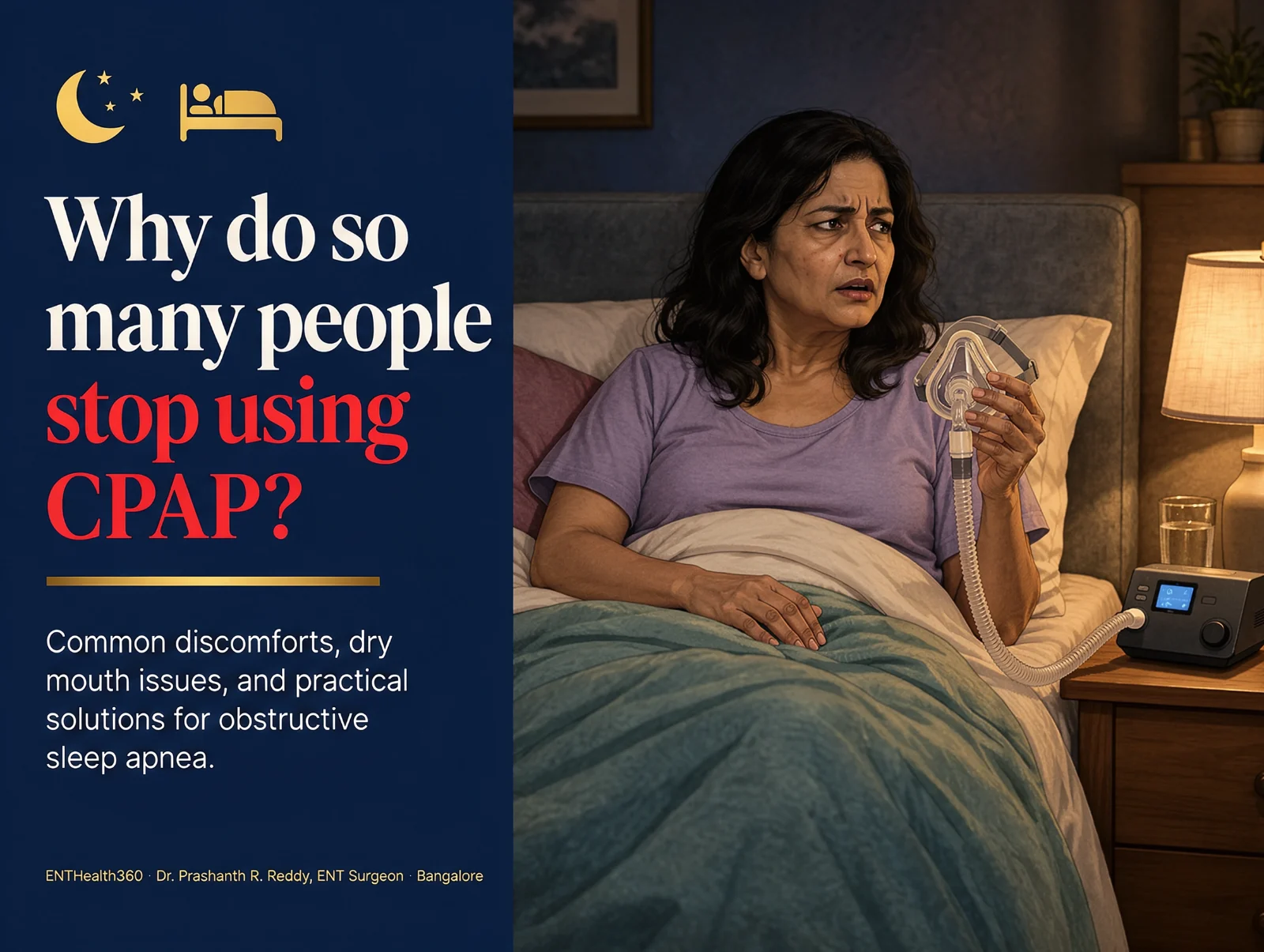
Before moving on, it is worth asking whether the problem has a fix. Common ones include a mask that does not fit, a leak, a dry mouth, a noisy machine, a pressure that feels too high and a blocked nose. A change of mask, a heated humidifier, a pressure adjustment or treating the nose may make CPAP workable. Weaver and Grunstein's review notes that behavioural support may also help, and that whether people continue is largely decided in the first few days.
If you have given it a fair, supported trial and it still is not working, move on rather than struggling for years.
What are the alternatives to CPAP?
Positional therapy
Some people have breathing pauses mainly when they sleep on their back. Keeping off the back with a positional device or pillow may help in selected people. It is simple and low risk, but it does not suit everyone.
An oral appliance
A custom-fitted device moves the lower jaw forward to open the airway. It is usually made by a dentist trained in sleep medicine and may suit selected people with mild to moderate sleep apnea, or those who cannot use CPAP. Jaw or tooth discomfort can occur.
Weight and lifestyle changes
Weight loss, reducing alcohol close to bedtime and treating allergies can lessen airway collapse for many people. They help, but rarely cure moderate to severe sleep apnea alone.
Nasal treatment
Medicines, allergy control or surgery for a bent septum or swollen turbinates can open the nose. This may improve breathing, make CPAP or an oral appliance easier to tolerate and reduce mouth breathing. Nasal treatment on its own does not always treat the sleep apnea.
Upper airway surgery
For selected people, surgery can widen the airway at the tonsils, soft palate, tongue base or nose. The choice depends on where the airway closes, your body weight, your anatomy and your general health. It is never right for everyone, and the plan is made after an ENT evaluation.
Nerve stimulation
In selected people who meet strict criteria, a small implanted device stimulates the nerve that moves the tongue forward during sleep. It is not suitable for everyone and is assessed carefully.
Which option fits you?
There is no ranking that fits everyone. The answer comes from three things: where your airway closes, how severe the problem is, and what you will realistically do every night. A treatment that is perfect on paper but that you use two nights a week is not the best treatment for you.
Studies of upper airway surgery compared with CPAP are observational and mixed. One US veterans study linked palate surgery with better survival than CPAP but could not adjust for severity or CPAP use. A Taiwan national cohort found no difference in heart attack or stroke. They cannot prove that surgery is biologically superior, and we do not claim that.
CPAP works only at night. What about breathing trouble during the day?
CPAP is used only at night. If your breathing is also difficult during the day, with a blocked nose, mouth breathing or a dry throat, a CPAP machine cannot treat that part of the problem.
When you review the alternatives to CPAP, ask which ones look at the nose and upper airway you use around the clock, not only the airway at night. An ENT evaluation can check the nose, throat and tongue base for a cause that is present day and night, and the right option depends on what is found.
How does nose breathing support energy and BMR?
Your basal metabolic rate (BMR) is the energy your body burns at rest, and your cells need oxygen to make it. The nose warms, humidifies and filters each breath, and the sinuses add nitric oxide (NO), which studies suggest may help the lungs take up oxygen. Mouth breathing largely bypasses both.
Nose breathing does not "boost" your BMR, which is set mainly by muscle mass, age, body size and hormones. But a clear nose by day and uninterrupted breathing at night support deeper sleep, and deeper sleep helps your body use energy and recover. In sleep apnea care a blocked nose also matters for another reason: it can make a CPAP mask harder to tolerate and push you towards mouth breathing, snoring and a dry mouth.
When should you see an ENT?
- You cannot use CPAP, or use it only a few hours or nights a week.
- You stopped CPAP and your snoring or tiredness has come back.
- You have a blocked nose, large tonsils or a narrow throat.
- You are not sure which alternative to choose.
- A partner sees you stop breathing in sleep.
How does an ENT evaluate your options?
The evaluation includes your history, an examination of the nose, mouth, tonsils and palate, and nasal endoscopy. A CT scan is added when the nose or sinuses need a closer look. Where needed, the ENT may assess how the airway collapses at several levels, sometimes with a short endoscopic assessment under light sedation. Any further breathing tests are arranged as part of the evaluation. Then we choose the option together, starting with the least invasive that suits you.
Frequently asked questions
What if I cannot use CPAP at all? Tell your doctor. There are alternatives, and the best one depends on your airway. Do not simply stop treatment and carry on.
Is an oral appliance as good as CPAP? CPAP is generally more effective at controlling breathing pauses. An oral appliance may be a good fit for selected people who will actually wear it.
Is surgery a cure? Surgery aims to reduce airway collapse. Results vary, and follow-up checks show how well it has worked. It is not promised to be a permanent cure.
Can I try CPAP again later? Yes, often. A different mask, a treated nose or better support can change the experience.
Know someone who gave up on CPAP? Send them this.
References
- Weaver TE, Grunstein RR. Adherence to continuous positive airway pressure therapy: the challenge to effective treatment. Proc Am Thorac Soc. 2008;5(2):173-178.
- McEvoy RD, Antic NA, Heeley E, et al. CPAP for prevention of cardiovascular events in obstructive sleep apnea. N Engl J Med. 2016;375(10):919-931.
- Weaver EM, et al. Survival of veterans with sleep apnea: continuous positive airway pressure versus surgery. Otolaryngol Head Neck Surg. 2004 (PMID 15195049).
- Yang KL, Lin PW, Chang CT, et al. OSA treatment on cardio- and cerebrovascular comorbidities: a long-term nationwide cohort study. Otolaryngol Head Neck Surg. 2022;167(3):600-606.
- Lundberg JO, Farkas-Szallasi T, Weitzberg E, et al. High nitric oxide production in human paranasal sinuses. Nature Medicine. 1995;1(4):370-373.
- Lundberg JO, Settergren G, Gelinder S, et al. Inhalation of nasally derived nitric oxide modulates pulmonary function in humans. Acta Physiologica Scandinavica. 1996;158(4):343-347.
About the author
Dr. Prashanth R Reddy is an ENT surgeon at ENTHealth360, Bangalore (MS ENT; MBA, IIM Bangalore; Seoul Rhinoplasty Fellowship), seeing patients at Sakra World Hospital, Marathahalli and in Koramangala. His practice focuses on how breathing affects sleep, energy and everyday performance.
Related reading: Snoring and Sleep Apnea: Your Questions Answered (Bangalore ENT Guide) · Can sleep apnea be treated without a CPAP machine? · Snoring and sleep apnea surgery in Bangalore
For educational purposes only. Not a substitute for medical advice. Please consult a qualified ENT specialist.
General patient education. An individual consultation is needed to assess your symptoms and treatment options.