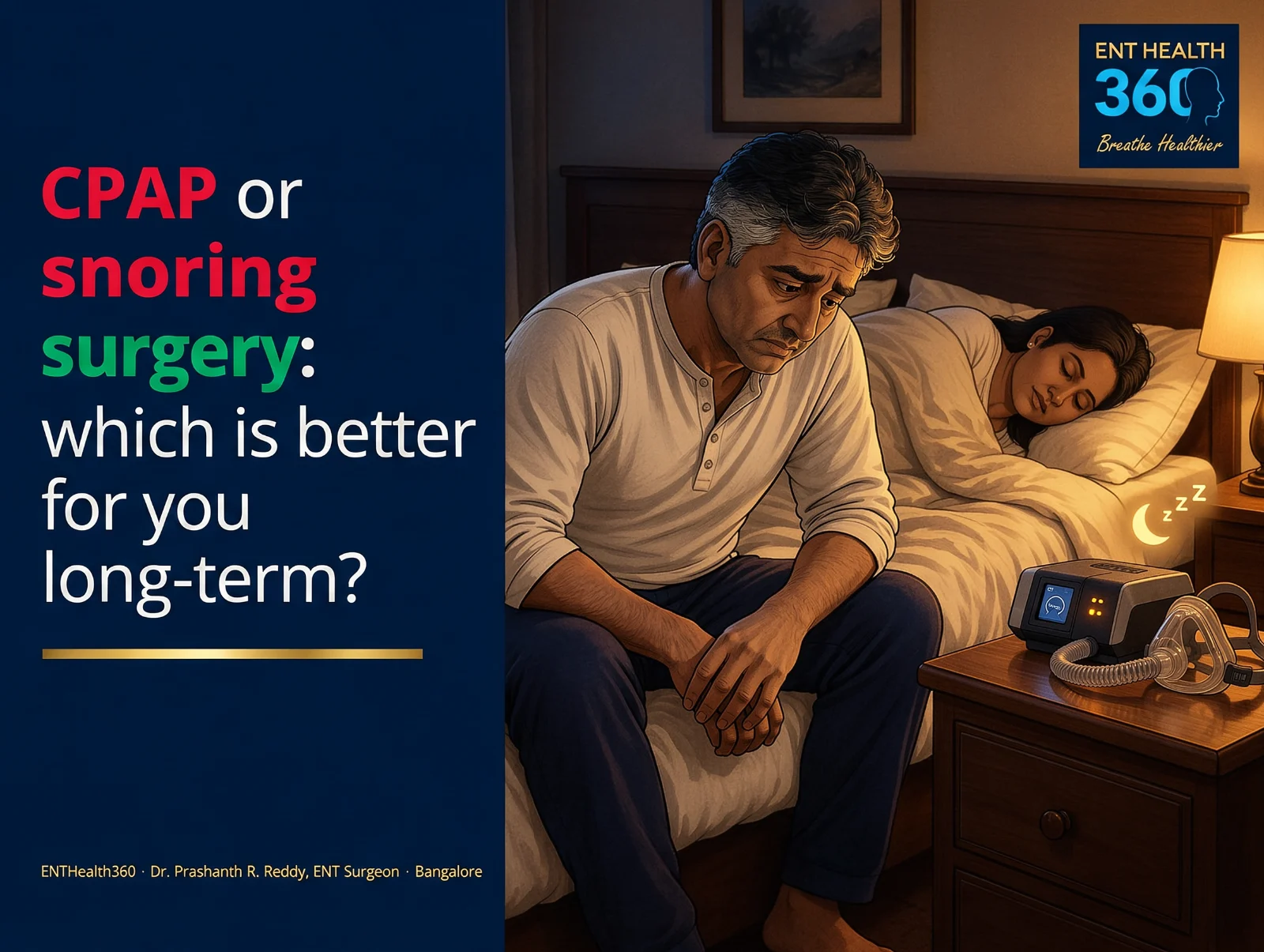
Short answer: Many people stop using CPAP, or use it for only a few hours, because of mask discomfort, leaks, a dry mouth, a blocked nose, noise, a closed-in feeling and the effort of using a device every night. Reviews report that 46% to 83% of patients do not meet the usual benchmark of more than four hours a night, and whether someone keeps going is largely decided in the first few days. Struggling with CPAP is common, not a personal failing. Most problems have fixes, and there are other treatments.
Key takeaways
- Low CPAP adherence is common: reviews report 46% to 83% of patients as nonadherent.
- The first few days of treatment largely decide whether someone keeps using it.
- The usual reasons are practical: mask fit, leaks, dry mouth, a blocked nose, noise and routine.
- A blocked nose is one of the most fixable reasons, and it is an ENT problem.
- If CPAP is not working for you, tell your doctor early. Do not wait.
Dr. Prashanth's perspective
Mask fitment is the root cause of people stopping CPAP. The continuous pressure leads to discomfort. Many a time the nasal obstruction is missed, and that leads to increased pressure from the CPAP regulator, which is a major cause of non-use. Another reason is tossing around in bed, which disconnects or loosens the CPAP mask. CPAP is used only at night, but breathing difficulties happen in the day too, and a CPAP machine cannot address those.
— Dr. Prashanth R. Reddy, ENT Surgeon, ENTHealth360
What does CPAP adherence look like in real life?
Adherence means how much you actually use the treatment. In sleep apnea research, a common benchmark is more than four hours a night. Weaver and Grunstein's review reports that 46% to 83% of patients with obstructive sleep apnea are nonadherent by this kind of definition. In the SAVE trial, one of the largest CPAP trials, participants used CPAP for an average of 3.3 hours a night over about 3.7 years.
These numbers do not describe lazy patients. They describe how hard it is to wear a mask, with a hose and a machine, every night for life.
Why do people stop using CPAP?
- The mask: a poor fit, pressure marks, leaks, or a closed-in feeling.
- A blocked nose: air does not flow comfortably, so people switch to the mouth and wake with a dry mouth and throat.
- A dry mouth or nose: often from mouth leak or low humidity.
- Noise and disturbed partners: from the machine or from leaks.
- Not feeling a difference: if sleepiness does not improve quickly, motivation drops.
- Life: travel, power cuts, cleaning, and the plain effort of the routine.
Why do the first few days matter so much?
The same review notes that whether a person continues CPAP is largely decided in the first few days of treatment. Early comfort, early support and early problem-solving seem to matter more than the severity of the apnea itself. How people perceive their symptoms and whether they feel better may matter more than the numbers on a report.
If the first nights are miserable and nobody helps, many people quietly stop, and often do not tell anyone.
What actually helps people keep using CPAP?
- A proper mask fit and a mask type that suits how you breathe.
- Heated humidification for a dry mouth or nose.
- Treating a blocked nose: sprays, allergy control, or surgery for a bent septum or swollen turbinates.
- Starting slowly, with short daytime practice sessions and gradual pressure.
- Early follow-up, in the first week or two, not three months later.
- Behavioural support: the review notes that behavioural interventions may help. It also notes that many marketed mask and machine features have little evidence behind them.
What if you have stopped using CPAP?
First, do not feel guilty. Second, do not simply live with the problem. Untreated sleep apnea does not go away because the machine is in the cupboard, and the sleepiness, snoring and broken sleep go on.
Tell your doctor that you have stopped and why. The reason matters: a blocked nose, a mouth leak, claustrophobia and a poor mask fit each lead to a different solution. If CPAP still cannot work for you, there are other options, including positional therapy, an oral appliance, nasal treatment, upper airway surgery or nerve stimulation in selected people. Our article on what to do if you cannot tolerate CPAP covers them.
CPAP works only at night. What about breathing trouble during the day?
One reason people struggle with CPAP is that a blocked nose makes the mask hard to tolerate. Air does not pass easily, the mouth opens, and the mask feels like a fight.
That same blockage is usually there in the day too. CPAP is used only at night, so it cannot treat a blocked nose, mouth breathing or breathing trouble during waking hours. If your nose is blocked all day, treating it is worth discussing, because it may help your daytime comfort and may also make CPAP easier to use.
If you stopped CPAP and still feel blocked or short of breath by day, that is useful information for an ENT evaluation.
How does nose breathing support energy and BMR?
Your basal metabolic rate (BMR) is the energy your body burns at rest, and your cells need oxygen to make it. The nose warms, humidifies and filters each breath, and the sinuses add nitric oxide (NO), which studies suggest may help the lungs take up oxygen. Mouth breathing largely bypasses both.
Nose breathing does not "boost" your BMR, which is set mainly by muscle mass, age, body size and hormones. But a clear nose by day and uninterrupted breathing at night support deeper sleep, and deeper sleep helps your body use energy and recover. In sleep apnea care a blocked nose also matters for another reason: it can make a CPAP mask harder to tolerate and push you towards mouth breathing, snoring and a dry mouth.
When should you see an ENT?
- You find it hard to breathe through your nose with the mask on.
- You wake with a dry mouth or throat on CPAP.
- You have tried more than one mask and still cannot manage.
- You use CPAP only a few hours a night, or only a few nights a week.
- You have stopped CPAP and your snoring or tiredness has returned.
How does an ENT evaluate CPAP problems?
An ENT looks for what is making the mask hard to live with. This includes your history, an examination of the nose, mouth, tonsils and palate, and nasal endoscopy to see the septum, turbinates and airway. A CT scan may be advised when the nose or sinuses need a closer look. Treating a nasal cause can make CPAP tolerable, and if CPAP is still not for you, the same evaluation shows whether another treatment may fit.
Frequently asked questions
Is it normal to find CPAP uncomfortable? Yes. Many people do, especially in the first days. It is worth getting help rather than quitting silently.
Why does CPAP dry out my mouth? Often because air escapes through the mouth when the nose is blocked or the mask leaks. Humidification and treating the nose can help.
Will I damage my health if I stop CPAP? Untreated sleep apnea can continue to affect sleep, energy and heart health. Do not stop without a plan: speak to your doctor about alternatives.
How long should I try before giving up? Give it a fair, supported trial of a few weeks with adjustments, then review. If it is still not working, do not wait.
Know someone who stopped using their CPAP? Send them this.
References
- Weaver TE, Grunstein RR. Adherence to continuous positive airway pressure therapy: the challenge to effective treatment. Proc Am Thorac Soc. 2008;5(2):173-178.
- McEvoy RD, Antic NA, Heeley E, et al. CPAP for prevention of cardiovascular events in obstructive sleep apnea. N Engl J Med. 2016;375(10):919-931.
- Lundberg JO, Farkas-Szallasi T, Weitzberg E, et al. High nitric oxide production in human paranasal sinuses. Nature Medicine. 1995;1(4):370-373.
- Lundberg JO, Settergren G, Gelinder S, et al. Inhalation of nasally derived nitric oxide modulates pulmonary function in humans. Acta Physiologica Scandinavica. 1996;158(4):343-347.
About the author
Dr. Prashanth R Reddy is an ENT surgeon at ENTHealth360, Bangalore (MS ENT; MBA, IIM Bangalore; Seoul Rhinoplasty Fellowship), seeing patients at Sakra World Hospital, Marathahalli and in Koramangala. His practice focuses on how breathing affects sleep, energy and everyday performance.
Related reading: Snoring and Sleep Apnea: Your Questions Answered (Bangalore ENT Guide) · What is a CPAP machine and do I need it for life? · Can sleep apnea be treated without a CPAP machine?
For educational purposes only. Not a substitute for medical advice. Please consult a qualified ENT specialist.
General patient education. An individual consultation is needed to assess your symptoms and treatment options.