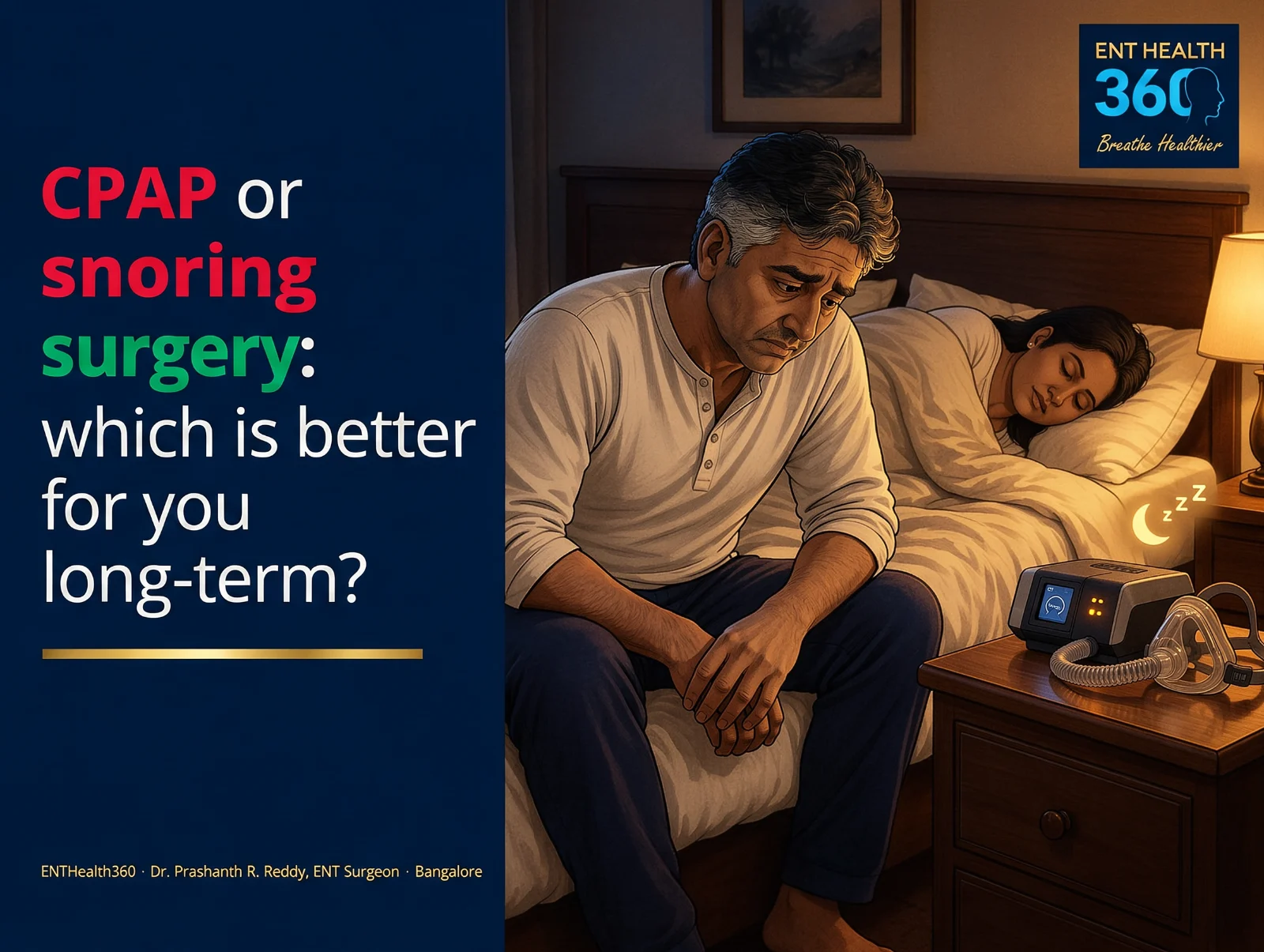
Short answer: CPAP is the gold standard treatment for obstructive sleep apnea, but only when it is used. Many people struggle to use it every night: reviews report that 46% to 83% of patients do not meet the usual adherence benchmark. The best treatment is not the one that looks best on paper. It is the one you will actually use, every night. If CPAP is hard for you, an ENT evaluation can show whether another option, including upper airway surgery in selected people, may be a better fit.
Key takeaways
- CPAP is highly effective when it is worn, but the benefit depends on use, and adherence is often low.
- In the large SAVE trial, people used CPAP for an average of 3.3 hours a night, well short of a full night's sleep.
- Surgery does not depend on nightly use, so adherence is not the problem there. It is not right for everyone and needs an ENT evaluation first.
- Studies of upper airway surgery are observational and mixed. They cannot prove that surgery is biologically better than CPAP.
- If CPAP is hard, do not wait. There are other options.
Dr. Prashanth's perspective
CPAP is considered the gold standard, but unfortunately the patients using it have low tolerance for it, because of the tight mask and the difficulty of getting the right fit. Tossing around in bed while sleeping makes usage difficult. If the nose is blocked, CPAP won't be very effective. Surgery that addresses the points where the upper airway collapses leads to a better outcome, without CPAP or even with CPAP. Surgery leads to better long-term reduction of the various risk factors of sleep apnea. CPAP is used only at night, but breathing difficulties happen in the day too, and a CPAP machine cannot address those.
— Dr. Prashanth R. Reddy, ENT Surgeon, ENTHealth360
Why is the best treatment on paper not always the best in real life?
CPAP works like an air splint. A gentle stream of air through a mask keeps the throat open while you sleep, and when it is worn it is very effective at stopping the airway from collapsing. That is why it is called the gold standard.
The catch is simple. CPAP only works on the nights you wear it, and for the hours you wear it. Doctors call this adherence, or compliance. A treatment that works well in a trial but stays in the cupboard at home cannot protect your sleep, your blood pressure or your heart.
This is not a question of willpower. Masks leak, noses block, mouths dry out, partners are disturbed and travel is awkward. Struggling with CPAP is common, and it is not your fault.
How many people actually use CPAP every night?
A widely cited review by Weaver and Grunstein notes that adherence is usually defined as more than four hours of use a night, and that 46% to 83% of people with obstructive sleep apnea are reported as nonadherent. Whether a person keeps using CPAP is largely decided in the first few days of treatment. The same review links using CPAP for more than six hours a night with less daytime sleepiness and better day-to-day functioning.
In plain terms, many people try CPAP and many do not manage it every night. If that is you, you are in very large company.
What did the largest CPAP trial find?
The SAVE trial followed 2,717 adults with obstructive sleep apnea and existing heart or blood-vessel disease for an average of 3.7 years. Average CPAP use was 3.3 hours a night. Cardiovascular events were not significantly lower in the CPAP group than with usual care (17.0% versus 15.4%; hazard ratio 1.10, 95% CI 0.91 to 1.32). Many experts read this result alongside the low average nightly use, which is exactly why adherence matters. Our article on CPAP and heart attack risk goes through the trial in detail.
What are your options if CPAP is hard to use?
- Fix what makes CPAP hard first: mask fit, leaks, a dry mouth, a blocked nose, pressure settings. Many problems have a simple fix.
- Positional therapy if breathing pauses happen mainly when you sleep on your back.
- An oral appliance that moves the lower jaw forward, fitted by a dentist trained in sleep medicine, for selected people.
- Nasal treatment with medicines or surgery when a blocked nose is part of the problem.
- Weight and lifestyle changes, which help many people but rarely work alone.
- Upper airway surgery in selected people, after an ENT evaluation.
- Nerve stimulation of the tongue muscle in selected people who meet strict criteria.
How do you decide which one you will actually use?
Ask yourself three plain questions.
- Have I given CPAP a fair trial, with the mask and settings properly adjusted?
- What exactly stops me: the mask, my nose, a dry mouth, noise, a closed-in feeling, or travel?
- Would a treatment that does not depend on nightly use suit my life better?
If you are using CPAP only a few hours, or only a few nights a week, treat that as useful information, not a failure. Tell your doctor. The goal is to do something consistently, every night.
Is surgery better than CPAP?
Not for everyone, and the evidence does not say it is biologically superior. Upper airway surgery is for selected people after an ENT evaluation, when the site of blockage and your general health suit it. Large observational studies have given mixed results. A US veterans database study linked palate surgery with better survival than CPAP, but it could not adjust for sleep apnea severity or how much CPAP was used. A Taiwan national cohort found no difference in heart attack or stroke between surgery and CPAP. These studies cannot prove cause, because people are chosen for, or choose, a treatment for reasons that also affect their health.
What surgery does offer is practical: it does not depend on you wearing anything each night.
CPAP works only at night. What about breathing trouble during the day?
CPAP is a night-time treatment. It delivers air pressure only while the mask is on, which is usually while you sleep. It does nothing for how you breathe at 3 PM.
Many people with snoring or sleep apnea also struggle with their breathing in the day: a nose that is blocked most days, mouth breathing, a dry throat, or getting breathless on stairs or while exercising. A CPAP machine cannot treat these, because the cause is often in the nose or upper airway itself and the mask is off.
- CPAP: supports the airway at night, only on the nights you wear it.
- Treating the nose or upper airway: where a blockage is found, the aim is easier breathing both day and night. This depends on the cause and is never guaranteed.
So the question is not only "which treatment will I use at night?" It is also "what is happening to my breathing the rest of the day?" An ENT evaluation can look at both.
How does nose breathing support energy and BMR?
Your basal metabolic rate (BMR) is the energy your body burns at rest, and your cells need oxygen to make it. The nose warms, humidifies and filters each breath, and the sinuses add nitric oxide (NO), which studies suggest may help the lungs take up oxygen. Mouth breathing largely bypasses both.
Nose breathing does not "boost" your BMR, which is set mainly by muscle mass, age, body size and hormones. But a clear nose by day and uninterrupted breathing at night support deeper sleep, and deeper sleep helps your body use energy and recover. In sleep apnea care a blocked nose also matters for another reason: it can make a CPAP mask harder to tolerate and push you towards mouth breathing, snoring and a dry mouth.
When should you see an ENT?
- You have tried CPAP and use it only a few hours a night or a few nights a week.
- You stopped CPAP because of the mask, a blocked nose or a dry mouth.
- You snore loudly, wake unrefreshed, or a partner sees you stop breathing in sleep.
- You have a blocked nose, large tonsils or a narrow jaw and have never had them assessed.
- You are not sure CPAP is right for you.
How does an ENT evaluate your options?
An ENT looks at where your airway narrows. The evaluation includes your history, an examination of the nose, mouth, tonsils and palate, nasal endoscopy (a thin camera passed gently into the nose in the clinic), and a CT scan when the nose or sinuses need a closer look. Any further breathing tests that are needed are arranged as part of the evaluation. Then we match the option to you: what is blocking, how severe it is, how you live and what you will actually stick with.
Frequently asked questions
Is CPAP still the gold standard? Yes, when it is used. It is the most effective treatment for moderate to severe obstructive sleep apnea. The challenge is using it consistently.
What counts as using CPAP enough? A common benchmark is more than four hours a night on most nights, but studies suggest that more hours bring more benefit.
Can I stop CPAP if I have surgery? Not on your own. Your ENT and sleep team will check how well the surgery has worked before changing treatment.
Is surgery safe? Every operation has risks, such as pain, bleeding and swallowing discomfort. Your ENT will go through them with you.
Know someone who has put their CPAP away in a cupboard? Send them this.
References
- McEvoy RD, Antic NA, Heeley E, et al. CPAP for prevention of cardiovascular events in obstructive sleep apnea. N Engl J Med. 2016;375(10):919-931.
- Weaver TE, Grunstein RR. Adherence to continuous positive airway pressure therapy: the challenge to effective treatment. Proc Am Thorac Soc. 2008;5(2):173-178.
- Weaver EM, et al. Survival of veterans with sleep apnea: continuous positive airway pressure versus surgery. Otolaryngol Head Neck Surg. 2004 (PMID 15195049).
- Yang KL, Lin PW, Chang CT, et al. OSA treatment on cardio- and cerebrovascular comorbidities: a long-term nationwide cohort study. Otolaryngol Head Neck Surg. 2022;167(3):600-606.
- Lundberg JO, Farkas-Szallasi T, Weitzberg E, et al. High nitric oxide production in human paranasal sinuses. Nature Medicine. 1995;1(4):370-373.
- Lundberg JO, Settergren G, Gelinder S, et al. Inhalation of nasally derived nitric oxide modulates pulmonary function in humans. Acta Physiologica Scandinavica. 1996;158(4):343-347.
About the author
Dr. Prashanth R Reddy is an ENT surgeon at ENTHealth360, Bangalore (MS ENT; MBA, IIM Bangalore; Seoul Rhinoplasty Fellowship), seeing patients at Sakra World Hospital, Marathahalli and in Koramangala. His practice focuses on how breathing affects sleep, energy and everyday performance.
Related reading: Snoring and Sleep Apnea: Your Questions Answered (Bangalore ENT Guide) · CPAP vs snoring surgery compared · Can sleep apnea be treated without a CPAP machine?
For educational purposes only. Not a substitute for medical advice. Please consult a qualified ENT specialist.
General patient education. An individual consultation is needed to assess your symptoms and treatment options.