
Short answer: A CT scan is not needed for every sinus problem. It is usually advised for chronic or recurrent sinusitis that does not respond to treatment, when complications are suspected, or when surgery is being planned. Most short-lived sinus infections are diagnosed from your symptoms and an examination alone.
Key takeaways
- A cold or a first sinus infection almost never needs a CT scan.
- A CT is most useful when symptoms last 12 weeks or more, keep coming back, or surgery is being considered.
- A nasal endoscopy in the clinic gives a lot of information first, with no radiation.
- A CT can look "abnormal" in people with no symptoms, so it is read together with your symptoms and examination.
- Swelling around the eye, double vision or a severe headache with fever need urgent care, and a scan may be done the same day.
When is a CT scan not needed?
For a typical sinus infection, a CT scan adds very little. Most acute sinus infections follow a cold, are caused by viruses and settle in about 7 to 10 days with rest, fluids, saline rinses and symptom relief. Your doctor makes the diagnosis from your history and an examination of the nose.
A scan is usually not needed when:
- This is your first or second episode and you are improving
- Symptoms have lasted less than 10 days
- There are no warning signs such as eye swelling or severe pain
A plain X-ray of the sinuses is not reliable and is rarely useful. If imaging is needed, a CT is the test of choice.
When is a CT scan advised?
A CT scan helps when your doctor needs a detailed map of the sinuses to make a treatment decision. It is commonly advised when:
- Symptoms last 12 weeks or more (chronic sinusitis) and medicines have not worked
- Infections keep coming back, for example several times in a year
- Endoscopic sinus surgery is being planned, as the CT acts as a road map for the surgeon
- A complication is suspected, such as swelling around the eye
- Symptoms are on one side only, or there is bleeding, a growth or a polyp that needs a closer look
- Facial pain or headache has no clear cause and the anatomy of the nose needs checking
What does a sinus CT show?
A CT scan shows bone and air spaces very clearly, which is why it suits the sinuses. It can show:
- Which sinuses are blocked or filled with fluid
- Whether the drainage pathways are narrowed
- Polyps or thickened lining
- A deviated septum or a bony spur
- Places where structures inside the nose touch the side wall, which can matter in some cases of facial pain and headache
- Variations in anatomy that the surgeon must know about before operating
The scan takes a few minutes, needs no injection in most cases and is not painful.
Is the radiation a concern?
A sinus CT uses a small dose of radiation, and modern low-dose protocols reduce it further. Even so, doctors do not order it casually. The rule is simple: scan when the result will change what we do. For repeated scans, especially in children, the need is weighed carefully each time. Tell your doctor if you are pregnant or may be pregnant.
What does an ENT do before a CT?
An ENT usually starts with your history and a nasal endoscopy, a quick clinic examination with a thin camera after a numbing spray. It often shows pus, swelling, polyps or a blocked drainage area directly, with no radiation. A CT is then added when the picture needs more detail, especially before surgery.
Why a CT report can mislead if read alone
Many people with no sinus complaints show some thickening of the sinus lining on a CT. A report that says "sinusitis" does not always explain your symptoms, and a clear CT does not always mean the nose is the source of a headache. That is why a CT is best read by an ENT, together with your symptoms and an endoscopy, rather than on its own.
What can you do while you wait?
- Use saline rinses once or twice a day, with boiled and cooled or distilled water.
- Stay well hydrated and rest.
- Do not repeat antibiotics or steroid sprays without a doctor's advice.
- Bring any earlier scans and a list of medicines to your visit. This can save a repeat scan.
How breathing, sleep and energy are connected here
Blocked sinuses often push you to breathe through your mouth at night. That can dry the throat, break up sleep and leave you foggy at work. Finding the actual cause of the blockage, with endoscopy and a CT when needed, lets treatment be targeted. Many people notice deeper sleep and steadier energy once they can breathe comfortably through the nose. Results vary from person to person.
How does nose breathing support energy and BMR?
Your basal metabolic rate (BMR) is the energy your body burns at rest to keep the heart beating, the brain working and cells repairing. Your cells make that energy using oxygen, so how well you breathe matters.
Nose breathing helps in two ways:
- Warm, moist, filtered air. The nose warms, humidifies and filters each breath before it reaches the lungs. Conditioned air is gentler on the airway lining, which matters in Bangalore's air-conditioned offices and traffic dust. Mouth breathing skips this step and can leave the throat and airways dry.
- Nitric oxide from the sinuses. The paranasal sinuses continuously make nitric oxide (NO), a natural gas. When you breathe in through your nose, small amounts of this NO travel to the lungs, where studies suggest it may help widen tiny blood vessels and improve oxygen uptake. Mouth breathing largely bypasses it.
Nose breathing does not "boost" your BMR. That is set mainly by muscle mass, age, body size and hormones such as thyroid. But comfortable nasal breathing by day, and undisturbed breathing at night, support efficient oxygen supply and deeper sleep, which your body needs to use energy well and recover.
A simple check: sit quietly and breathe through your nose with your mouth closed for two minutes. If that feels difficult, or one side is always blocked, it is worth having your nose examined.
When should you see an ENT?
See an ENT if nasal or sinus symptoms last more than a few weeks or keep returning. In particular:
- Blockage, discharge or facial pressure for 10 to 12 weeks or more
- Several sinus infections in a year
- Loss of smell, or blockage or bleeding on one side
- Facial pain or headache that medicines do not settle
Seek urgent medical care for swelling or redness around the eye, double vision, a severe headache with high fever, a stiff neck, confusion, or a swelling of the forehead or face. These can signal a complication and may need a scan the same day.
How an ENT evaluates and treats it
Evaluation starts with your history and a nasal endoscopy. If the findings suggest chronic disease or a structural problem, or if surgery is likely, a CT scan maps the anatomy. Treatment depends on the cause and may include saline irrigation, steroid sprays, allergy control and targeted medicines. If blockage or polyps persist despite this, procedures such as septoplasty, turbinate reduction or endoscopic sinus surgery may be discussed. The right option depends on the findings.
Frequently asked questions
Does nose breathing give me more energy? It does not add energy by itself, but it delivers warm, humidified air and sinus nitric oxide to the lungs, which may help oxygen uptake. Together with better sleep, that supports the energy your body uses at rest (BMR) and during activity.
Can a doctor diagnose sinusitis without a CT scan? Yes. Most sinus infections are diagnosed from symptoms and an examination. A CT is added for long-standing or recurrent problems, before surgery or when complications are suspected.
Is an X-ray enough for sinus? Usually not. A plain X-ray can miss important changes. A CT gives a far clearer picture when imaging is needed.
Is a sinus CT painful or risky? It is painless and takes a few minutes. It uses a small dose of radiation, so it is advised when the result will change treatment.
If my CT is normal, does that mean my sinuses are fine? A clear CT means there is no significant sinus blockage at that time. It does not rule out other causes of headache or facial pain, so your ENT will look at the full picture.
References
- Rosenfeld RM, Piccirillo JF, Chandrasekhar SS, et al. Clinical practice guideline (update): adult sinusitis. Otolaryngology-Head and Neck Surgery. 2015;152(2 Suppl):S1-S39.
- Fokkens WJ, Lund VJ, Hopkins C, et al. European Position Paper on Rhinosinusitis and Nasal Polyps 2020. Rhinology. 2020;58(Suppl S29):1-464.
- Lundberg JO, Farkas-Szallasi T, Weitzberg E, et al. High nitric oxide production in human paranasal sinuses. Nature Medicine. 1995;1(4):370-373.
- Lundberg JO, Settergren G, Gelinder S, et al. Inhalation of nasally derived nitric oxide modulates pulmonary function in humans. Acta Physiologica Scandinavica. 1996;158(4):343-347.
- Keck T, Leiacker R, Heinrich A, Kühnemann S, Rettinger G. Humidity and temperature profile in the nasal cavity. Rhinology. 2000;38(4):167-171.
About the author
Dr. Prashanth R Reddy is an ENT surgeon at ENTHealth360, Bangalore (MS ENT; MBA, IIM Bangalore; Seoul Rhinoplasty Fellowship), seeing patients at Sakra World Hospital, Marathahalli and in Koramangala. His practice focuses on how breathing affects sleep, energy and everyday performance.
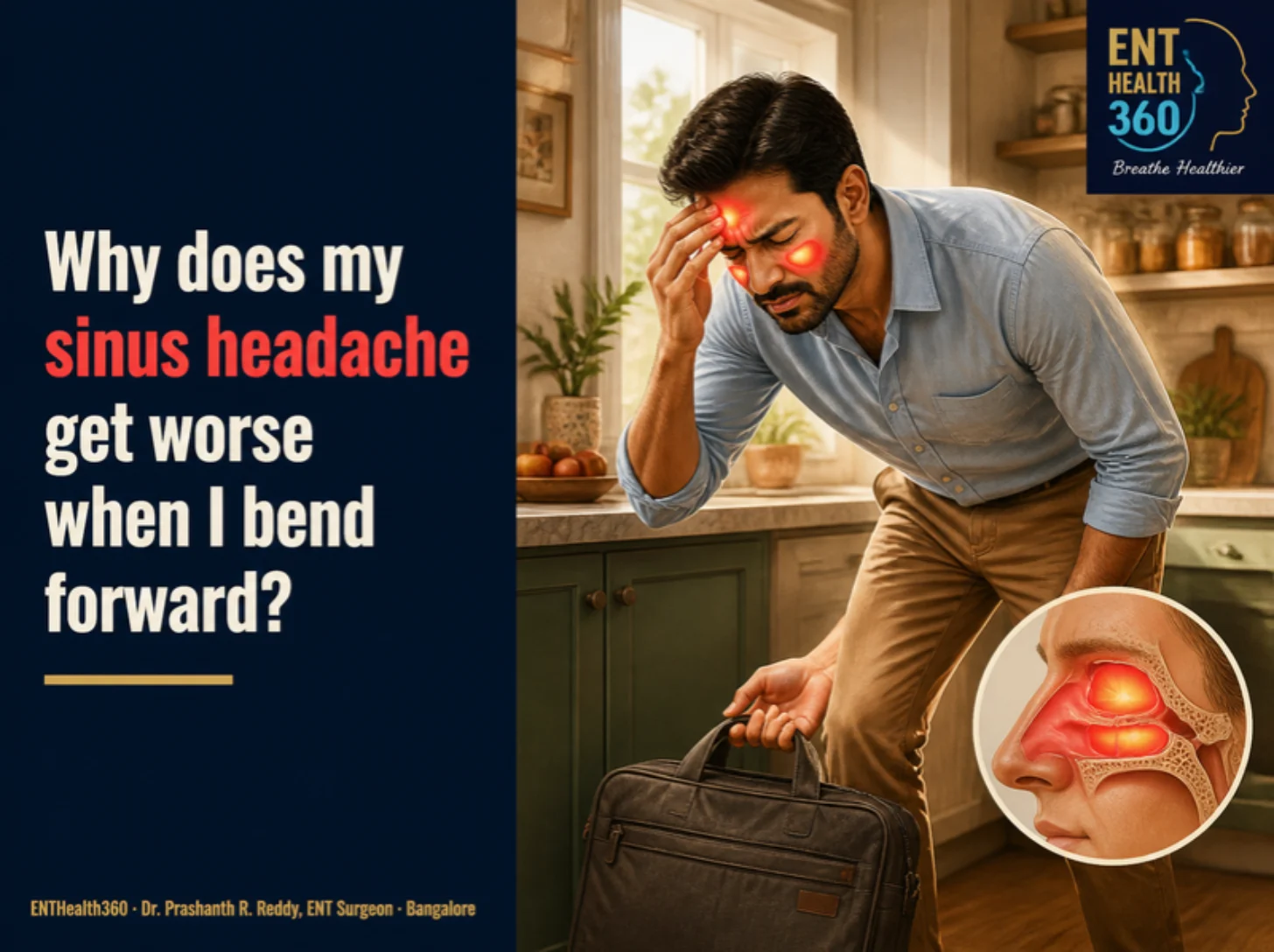
Related reading: What is nasal endoscopy and does it hurt? · What is FESS (functional endoscopic sinus surgery)? · Why does my sinus headache get worse when I bend forward?
Medically reviewed by Dr. Prashanth R. Reddy, ENT Surgeon. Last reviewed: 18 November 2026. For educational purposes only. Not a substitute for medical advice. Please consult a qualified ENT specialist.
General patient education. An individual consultation is needed to assess your symptoms and treatment options.