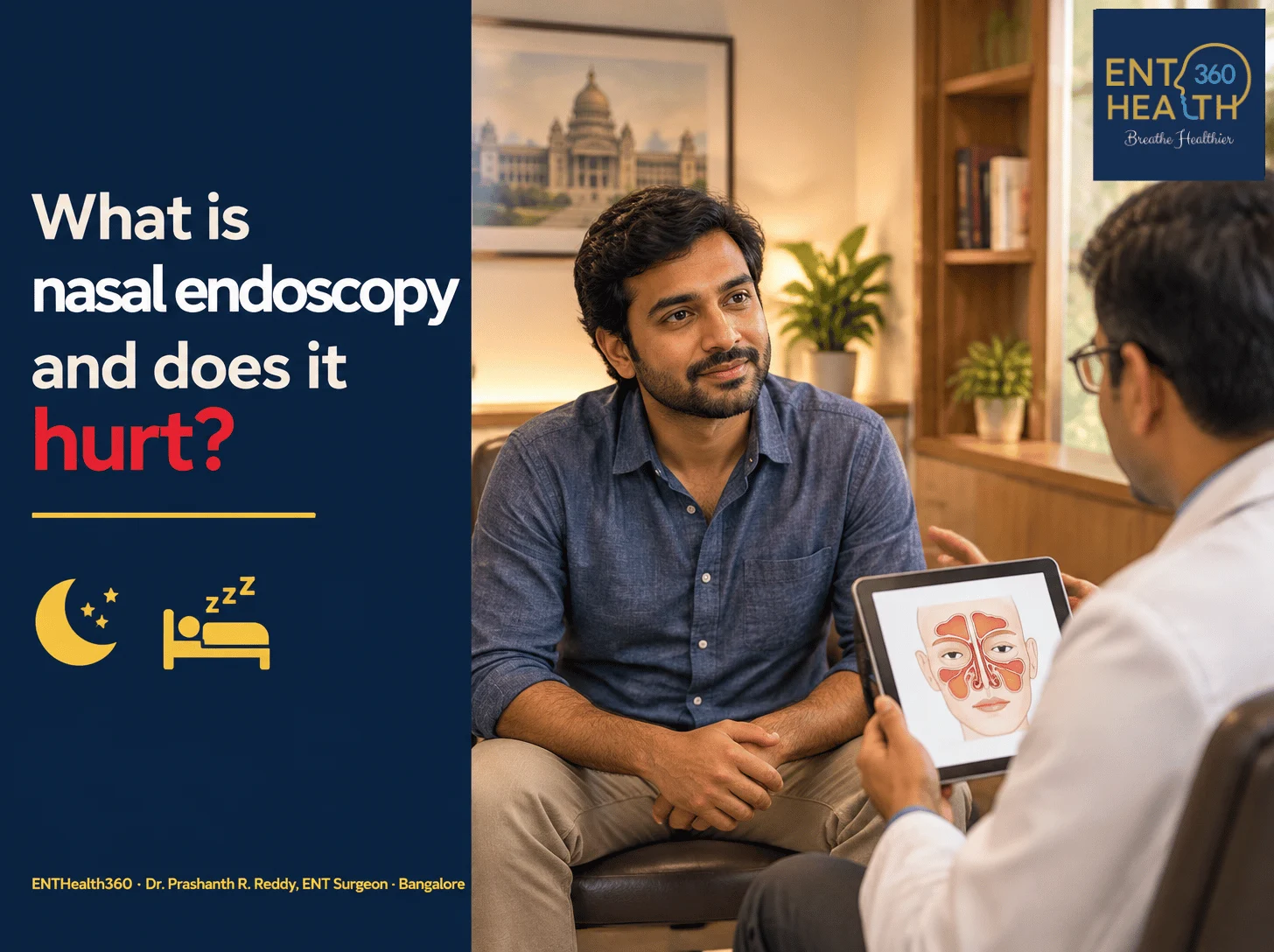
Short answer: Nasal endoscopy is a quick clinic examination in which a thin camera is gently passed into the nose to view the nasal passages and sinus openings. It is usually done after a numbing spray and takes a few minutes. Most people feel mild pressure, a tickle or watery eyes rather than pain, and can return to normal activities straight away.
Dr. Prashanth's perspective: Nasal endoscopy is a simple, quick check. A slim tube with a camera goes into the nose and shows the structures deep inside on a large screen. Most of these can't be seen on a regular headlight examination.
Key takeaways
- Nasal endoscopy shows far more than a torch examination of the nose.
- A numbing and decongestant spray makes it comfortable for most people.
- It helps identify polyps, pus, septal deviation, swollen turbinates and bleeding sources.
- It is one of the most useful tests for long-standing nasal or sinus complaints.
What is nasal endoscopy and why is it done?
Nasal endoscopy lets an ENT see deep inside the nose directly, which is often the key to understanding long-standing symptoms. An endoscope is a thin tube, a few millimetres wide, with a light and camera at its tip. The image appears on a screen, so you can often see it too.
A torch examination only shows the front of the nose. Endoscopy shows the back of the nose, the sinus drainage openings and the area behind the nose where it joins the throat. It is commonly used for:
- Long-standing blocked nose or post-nasal drip
- Recurrent or chronic sinusitis
- Reduced or lost sense of smell
- Repeated nosebleeds
- Symptoms on one side only
- Follow-up after sinus or nasal surgery
What happens during the test, and does it hurt?
For most people, nasal endoscopy feels like mild pressure rather than pain. Here is what usually happens:
- You sit upright in the examination chair.
- A spray containing a local anaesthetic (a numbing medicine) and a decongestant is applied to the nose. It may taste bitter and make the throat feel slightly numb.
- After a few minutes, the thin scope is passed gently along the nasal passages, one side at a time.
- The examination itself usually takes only a few minutes.
Some people notice a tickle, an urge to sneeze or watery eyes. Breathing slowly through the mouth helps you stay relaxed. A sensitive or narrow nose may feel more pressure, so tell your doctor if you are uncomfortable. Children can often have it done too, with extra reassurance.
How to prepare and what to do afterwards
Little preparation is needed, and you can usually return to normal activities straight away. Helpful tips:
- Avoid decongestant sprays on the day if possible, so the doctor sees your nose as it usually is.
- Tell the doctor if you take blood thinners, have a bleeding tendency or have reacted to local anaesthetics.
- Wait until the throat numbness wears off, usually 30 to 60 minutes, before eating or drinking hot liquids.
- Mild stuffiness or a slight streak of blood can occur and usually settles quickly.
- Bring past scans and a list of medicines so the findings can be interpreted together.
How breathing, sleep and energy are connected here
Endoscopy often answers a practical question: why is this person not breathing well through the nose? A blocked nose frequently leads to mouth breathing during sleep, snoring and lighter, broken sleep.
When the cause is clearly seen, whether swollen turbinates, polyps or a deviated septum, treatment can be targeted. Patients often report that once nasal breathing improves, they sleep more deeply and feel steadier at work, in workouts and with family. Results vary, but seeing the problem is usually the first step.
How does nose breathing support energy and BMR?
Your basal metabolic rate (BMR) is the energy your body burns at rest to keep the heart beating, the brain working and cells repairing. Your cells make that energy using oxygen, so how well you breathe matters.
Nose breathing helps in two ways:
- Warm, moist, filtered air. The nose warms, humidifies and filters each breath before it reaches the lungs. Conditioned air is gentler on the airway lining, which matters in Bangalore's air-conditioned offices and traffic dust. Mouth breathing skips this step and can leave the throat and airways dry.
- Nitric oxide from the sinuses. The paranasal sinuses continuously make nitric oxide (NO), a natural gas. When you breathe in through your nose, small amounts of this NO travel to the lungs, where studies suggest it may help widen tiny blood vessels and improve oxygen uptake. Mouth breathing largely bypasses it.
Nose breathing does not "boost" your BMR. That is set mainly by muscle mass, age, body size and hormones such as thyroid. But comfortable nasal breathing by day, and undisturbed breathing at night, support efficient oxygen supply and deeper sleep, which your body needs to use energy well and recover.
A simple check: sit quietly and breathe through your nose with your mouth closed for two minutes. If that feels difficult, or one side is always blocked, it is worth having your nose examined.
When should you see an ENT?
See an ENT for nasal symptoms that last more than a few weeks or keep coming back. In particular:
- Blockage, discharge or facial pressure for over 10 to 12 weeks
- Loss of smell, or blockage or bleeding on one side
- Frequent nosebleeds
Seek urgent medical care for a nosebleed that does not stop after 20 minutes of firm pressure, swelling around the eye, double vision, severe headache with fever, or black crusts in the nose with facial numbness.
How an ENT evaluates and treats it
Endoscopy is usually part of a wider assessment that starts with your history. The ENT combines what you describe with what the camera shows. If chronic sinus disease or a structural problem is found, a CT scan may be advised to map the anatomy. For snoring concerns, an ENT evaluation may also be suggested.
Treatment depends on the findings and may include saline irrigation, steroid sprays, allergy control or targeted medicines. If structural blockage or polyps persist despite this, procedures such as septoplasty, turbinate reduction or endoscopic sinus surgery may be discussed. The right option depends on the cause.
Frequently asked questions
Does nose breathing give me more energy? It does not add energy by itself, but it delivers warm, humidified air and sinus nitric oxide to the lungs, which may help oxygen uptake. Together with better sleep, that supports the energy your body uses at rest (BMR) and during activity.
Is nasal endoscopy safe? It is generally a very safe, routine clinic test. Minor nasal irritation or a small amount of bleeding can occur but usually settles quickly.
Can I drive after nasal endoscopy? Usually yes, as no sedation is given. You may want to wait a few minutes if your eyes are watering.
Is nasal endoscopy the same as sinus surgery? No. Diagnostic endoscopy is a short examination in the clinic. Endoscopic sinus surgery uses similar cameras but is a planned procedure done in an operation theatre.
References
- Lundberg JO, Farkas-Szallasi T, Weitzberg E, et al. High nitric oxide production in human paranasal sinuses. Nature Medicine. 1995;1(4):370-373.
- Lundberg JO, Settergren G, Gelinder S, et al. Inhalation of nasally derived nitric oxide modulates pulmonary function in humans. Acta Physiologica Scandinavica. 1996;158(4):343-347.
- Keck T, Leiacker R, Heinrich A, Kühnemann S, Rettinger G. Humidity and temperature profile in the nasal cavity. Rhinology. 2000;38(4):167-171.
About the author
Dr. Prashanth R Reddy is an ENT surgeon at ENTHealth360, Bangalore (MS ENT; MBA, IIM Bangalore; Seoul Rhinoplasty Fellowship), seeing patients at Sakra World Hospital, Marathahalli and in Koramangala. His practice focuses on how breathing affects sleep, energy and everyday performance.
Related reading: Sinusitis: Causes, Symptoms, Home Care & When You Need an ENT (Bangalore Guide)
Medically reviewed by Dr. Prashanth R. Reddy, ENT Surgeon. Last reviewed: 17 November 2026. For educational purposes only. Not a substitute for medical advice. Please consult a qualified ENT specialist.
General patient education. An individual consultation is needed to assess your symptoms and treatment options.