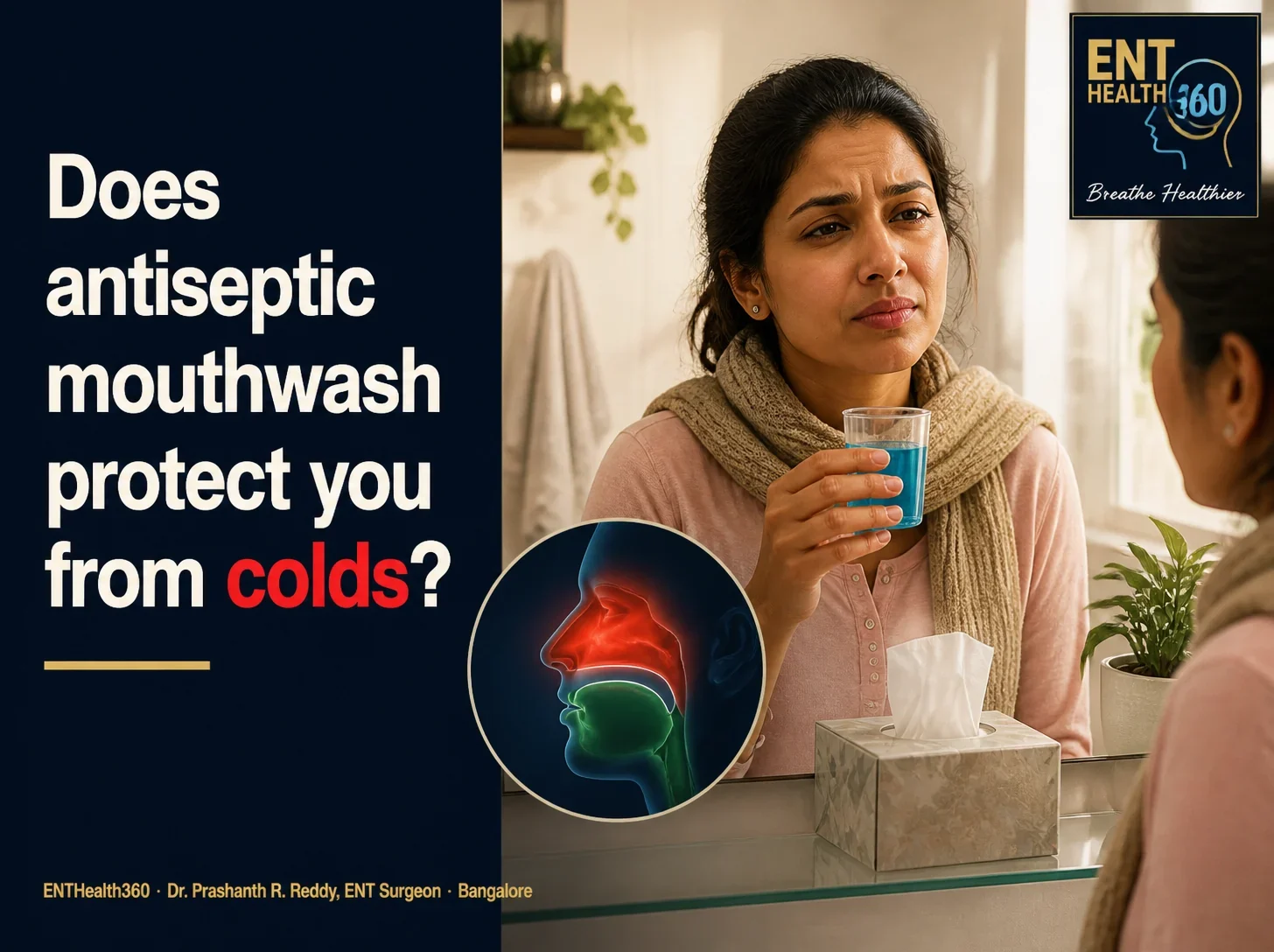
Myth: Antiseptic mouthwash kills cold and sore throat germs, so using it daily keeps you safe.
Fact: It mainly cleans the mouth. It does not reach the nose, sinuses or deeper throat, where most colds begin. Using strong antiseptic rinses every day may also disturb the helpful bacteria that live in the mouth.
Medically reviewed by Dr. Prashanth R. Reddy, ENT Surgeon. Last reviewed: 09 November 2026.
Key takeaways
- Colds and most sore throats are caused by viruses that start in the nose and throat lining.
- Mouthwash reaches the teeth, gums and tongue. It does not reach the sinuses.
- Daily strong antiseptic rinses can dry the mouth and reduce helpful oral bacteria.
- Hand washing, saline rinses and early care of a blocked nose do more for cold prevention.
Why doesn't mouthwash stop a cold?
A cold starts in the lining of the nose and throat, not in the mouth.
Common cold viruses attach to cells in the nose and upper throat. From there they spread through the lining. A 30-second swish with mouthwash cleans the teeth, gums and tongue and may briefly lower the germs in saliva, but it cannot reach the nasal passages or sinuses behind the nose.
Viruses also enter your cells within minutes, where a rinse cannot reach them. That is why a cold usually follows a touch of the nose or eyes with unwashed hands, or breathing in droplets, whatever you use to rinse your mouth.
Is daily antiseptic mouthwash harmful?
Occasional use is usually fine. Daily heavy use is where the concern lies.
- Dry mouth. Alcohol-based rinses can dry the mouth, which may worsen bad breath and sore throat.
- Oral bacteria. The mouth hosts helpful bacteria that convert dietary nitrate into nitrite, which the body uses to make nitric oxide (NO), a natural gas that helps blood vessels relax. Small studies suggest strong antibacterial rinses can blunt this process and may raise blood pressure slightly in some people.
- Taste and staining. Some rinses, such as chlorhexidine, can stain teeth or alter taste if used for long periods.
Your dentist or doctor may advise an antiseptic rinse for a specific reason, such as after a dental procedure. Follow that advice and ask how long to use it.
What actually helps prevent colds and sore throats?
Simple habits protect the nose and throat better than rinsing the mouth.
- Wash your hands often and avoid touching your face.
- Use a saline nasal rinse or spray once or twice a day to clear mucus and irritants.
- Gargle with warm water for comfort in a sore throat.
- Drink enough water and avoid very dry air, such as long hours in strong air conditioning.
- Treat a blocked nose early so you can breathe through it comfortably.
- Sleep well. Poor sleep is linked to catching colds more easily.
For many people in Bangalore with dusty commutes and long air-conditioned hours, the nose gets irritated first. Keeping it clear matters more than any mouth rinse.
How are breathing, sleep and energy connected here?
A blocked nose pushes you to breathe through your mouth, which dries the throat and can break your sleep.
Mouth breathing at night often leads to a dry, scratchy throat in the morning, snoring and lighter sleep. People then feel tired, and tired people tend to catch more colds. Keeping the nose clear supports deeper sleep, steadier energy and better recovery.
How does nose breathing support energy and BMR?
Your basal metabolic rate (BMR) is the energy your body burns at rest to keep the heart beating, the brain working and cells repairing. Your cells make that energy using oxygen, so how well you breathe matters.
Nose breathing helps in two ways:
- Warm, moist, filtered air. The nose warms, humidifies and filters each breath before it reaches the lungs. Mouth breathing skips this step and can leave the throat and airways dry.
- Nitric oxide from the sinuses. The paranasal sinuses continuously make nitric oxide (NO). When you breathe in through your nose, small amounts of this NO travel to the lungs, where studies suggest it may help widen tiny blood vessels and improve oxygen uptake. Mouth breathing largely bypasses it.
Nose breathing does not "boost" your BMR. That is set mainly by muscle mass, age, body size and hormones such as thyroid. But comfortable nasal breathing by day, and undisturbed breathing at night, support efficient oxygen supply and deeper sleep, which your body needs to use energy well and recover.
A simple check: sit quietly and breathe through your nose with your mouth closed for two minutes. If that feels difficult, or one side is always blocked, it is worth having your nose examined.
When should you see an ENT?
See an ENT if throat or nose symptoms keep returning.
- A sore throat, blocked nose or bad breath that lasts more than two weeks
- Repeated colds or sinus infections
- One-sided blockage, bleeding or foul-smelling discharge
- Snoring or dry mouth on waking most nights
- Hoarseness lasting more than three weeks
Seek urgent care for difficulty breathing or swallowing, drooling, a muffled voice with high fever, swelling of the neck or face, or a stiff neck with severe headache.
How does an ENT evaluate and treat it?
An ENT looks for the real cause rather than treating symptoms alone.
An ENT evaluation includes a history, an examination of the nose, mouth and throat and, when needed, a nasal endoscopy, where a thin camera is passed gently into the nose after a numbing spray. This shows swelling, polyps, a bent septum or reflux changes. Treatment depends on the cause and may include saline rinses, nasal sprays, allergy control, treatment of reflux or, for selected people, a procedure to improve nasal airflow.
Frequently asked questions
Does mouthwash kill the cold virus? It may lower germs in the mouth briefly, but it does not stop a cold, because the virus infects the nose and throat lining.
Is it safe to use antiseptic mouthwash every day? Many people use mild rinses without trouble. Strong antiseptic or alcohol-based rinses used daily may dry the mouth and disturb helpful bacteria, so ask your dentist how often is right for you.
Does a saline nasal rinse prevent colds? It helps clear mucus and irritants and may ease symptoms. It is not a guarantee against catching a cold.
Does nose breathing give me more energy? It does not add energy by itself, but it delivers warm, humidified air and sinus nitric oxide to the lungs, which may help oxygen uptake. Together with better sleep, that supports the energy your body uses at rest (BMR) and during activity.
References
- Eccles R. Understanding the symptoms of the common cold and influenza. Lancet Infectious Diseases. 2005;5(11):718-725.
- Kapil V, Haydar SM, Pearl V, et al. Physiological role for nitrate-reducing oral bacteria in blood pressure control. Free Radical Biology and Medicine. 2013;55:93-100.
- Bondonno CP, Liu AH, Croft KD, et al. Antibacterial mouthwash blunts oral nitrate reduction and increases blood pressure in treated hypertensive men and women. American Journal of Hypertension. 2015;28(5):572-575.
- Lundberg JO, Farkas-Szallasi T, Weitzberg E, et al. High nitric oxide production in human paranasal sinuses. Nature Medicine. 1995;1(4):370-373.
- Keck T, Leiacker R, Heinrich A, Kühnemann S, Rettinger G. Humidity and temperature profile in the nasal cavity. Rhinology. 2000;38(4):167-171.
About the author
Dr. Prashanth R Reddy is an ENT surgeon at ENTHealth360, Bangalore (MS ENT; MBA, IIM Bangalore; Seoul Rhinoplasty Fellowship), seeing patients at Sakra World Hospital, Marathahalli and in Koramangala. His practice focuses on how breathing affects sleep, energy and everyday performance.
Related reading: Can a blocked nose cause snoring? · Why is only one side of my nose blocked?
For educational purposes only. Not a substitute for medical advice. Please consult a qualified ENT specialist.
General patient education. An individual consultation is needed to assess your symptoms and treatment options.