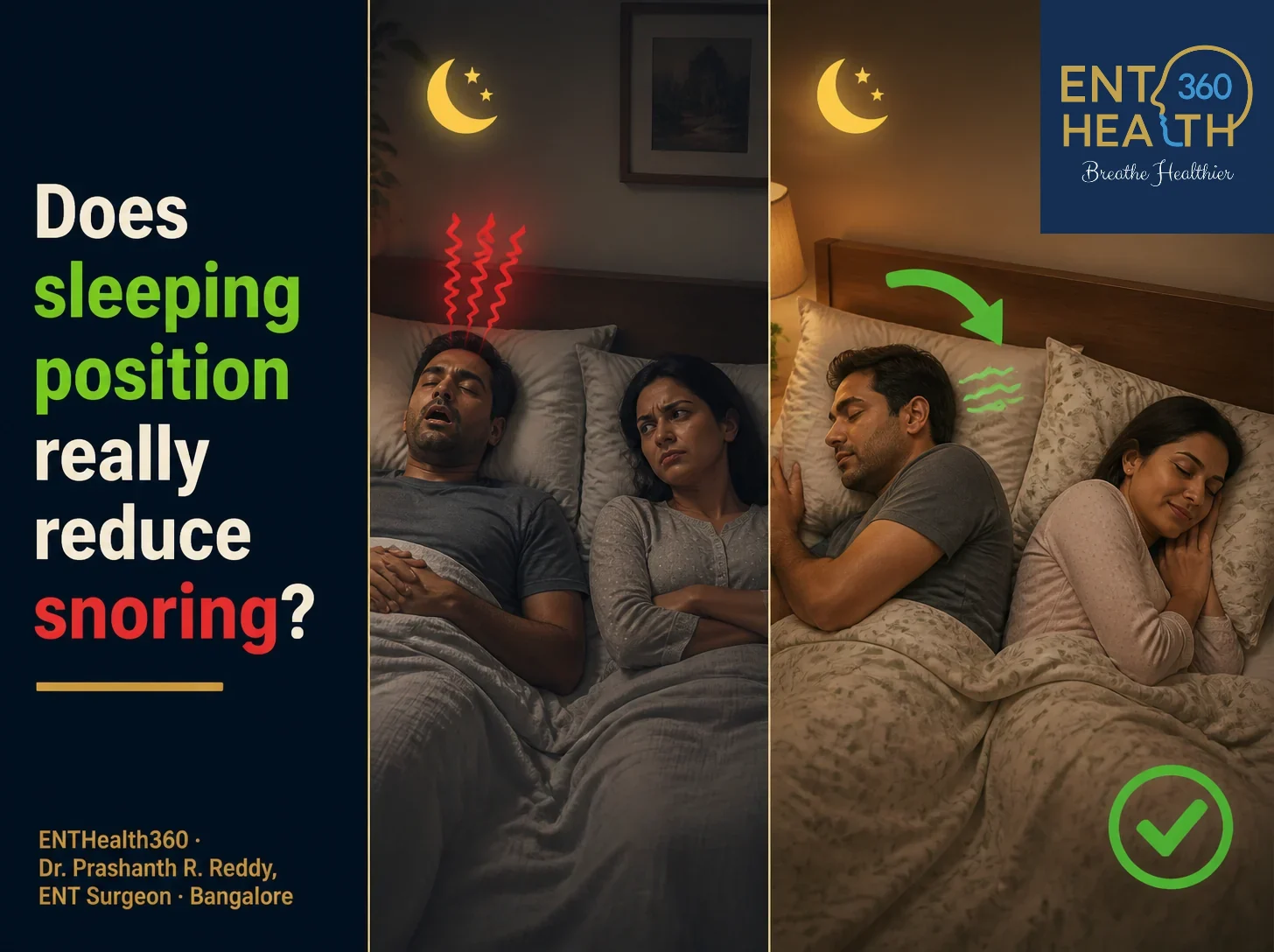
Short answer: Yes, for many people. Sleeping on your side rather than your back often reduces snoring because it stops the tongue and soft palate falling backwards into the throat. Raising the head of the bed may also help. This approach, called positional therapy, works well for many "back sleepers", but it may not be enough for moderate or severe sleep apnea.
Dr. Prashanth's perspective: Sleeping on your side does help. It keeps the tongue from falling back and narrowing the airway, and it eases pressure from the stomach pushing up against the lungs. It's not enough when there is severe sleep apnea or repeated choking in sleep. Then an ENT assessment is essential to prevent bigger problems later.
Key takeaways
- Snoring is often worst when lying flat on the back.
- Side sleeping can keep the airway more open and quieter.
- Body pillows, sleep-shirt bumps or wearable devices can help you stay on your side.
- If you snore in all positions or stop breathing at night, get evaluated.
Why does sleeping position affect snoring?
Sleeping position affects snoring because gravity changes how much the soft tissues of the throat narrow the airway.
When you lie on your back, the tongue, soft palate and uvula tend to slide backwards towards the back of the throat. The airway becomes narrower, air moves faster through the tight space, and the tissues vibrate. That vibration is the sound of snoring.
When you lie on your side, gravity pulls these tissues sideways instead of backwards. For many people, the airway stays more open and snoring becomes softer or stops. Doctors sometimes call this "positional snoring" or, when breathing pauses are present mainly on the back, "positional sleep apnea".
How can you tell if your snoring is positional?
You can often tell your snoring is positional if it is clearly louder when you are on your back.
- Your partner notices snoring mainly when you roll onto your back.
- Nudging you onto your side makes the snoring settle quickly.
- A phone recording shows quieter periods that match side-lying.
- An ENT evaluation can show where the airway narrows and whether position seems to be the main factor.
If you snore just as loudly on your side, the narrowing may be caused by something else, such as a blocked nose, large tonsils or extra tissue around the neck.
What can you do at home to sleep on your side?
You can train yourself to sleep on your side with a few simple tools.
- Body pillow: place a long pillow behind your back so rolling over feels awkward.
- Back bump: a small soft ball or rolled sock in a pocket sewn onto the back of a sleep shirt can discourage back-lying.
- Wearable positional devices: small devices worn on the chest or neck vibrate gently when you turn onto your back.
- Raise the head of the bed: placing sturdy blocks under the head-end legs creates a gentle slope. Stacking pillows tends to bend the neck and may not help.
- Support good habits: avoid alcohol close to bedtime, keep your nose clear, and maintain a healthy weight.
Give any change one to two weeks. Ask your partner, or use a phone recording, to judge the difference. If your partner notices you stop breathing during sleep, ask your doctor about an ENT evaluation.
How are breathing, sleep and energy connected here?
A small change in position can mean smoother breathing, and smoother breathing can mean deeper, less broken sleep.
When the airway stays more open, sleep is less disturbed by snoring and micro-awakenings. Many people say they wake up fresher and need less caffeine to get going. It may help your partner sleep better too. For anyone balancing demanding work, training or studies, that steadier energy can make a noticeable difference.
How does nose breathing support energy and BMR?
Your basal metabolic rate (BMR) is the energy your body burns at rest to keep the heart beating, the brain working and cells repairing. Your cells make that energy using oxygen, so how well you breathe matters.
Nose breathing helps in two ways:
- Warm, moist, filtered air. The nose warms, humidifies and filters each breath before it reaches the lungs. Conditioned air is gentler on the airway lining, which matters in Bangalore's air-conditioned offices and traffic dust. Mouth breathing skips this step and can leave the throat and airways dry.
- Nitric oxide from the sinuses. The paranasal sinuses continuously make nitric oxide (NO), a natural gas. When you breathe in through your nose, small amounts of this NO travel to the lungs, where studies suggest it may help widen tiny blood vessels and improve oxygen uptake. Mouth breathing largely bypasses it.
Nose breathing does not "boost" your BMR. That is set mainly by muscle mass, age, body size and hormones such as thyroid. But comfortable nasal breathing by day, and undisturbed breathing at night, support efficient oxygen supply and deeper sleep, which your body needs to use energy well and recover.
A simple check: sit quietly and breathe through your nose with your mouth closed for two minutes. If that feels difficult, or one side is always blocked, it is worth having your nose examined.
When should you see an ENT?
You should see an ENT if changing position does not help, or if there are signs of sleep apnea.
- Breathing pauses, choking or gasping noticed by others. Get evaluated promptly.
- Seek prompt medical care if you feel sleepy while driving.
- Snoring in all positions, every night.
- Morning headaches, dry mouth or unrefreshing sleep.
- A blocked nose most nights.
- Snoring in a child that happens most nights.
How an ENT evaluates and treats it
An ENT checks why your airway narrows and whether position is the main factor.
Evaluation includes a sleep history, examination of the nose, mouth and throat, and often a nasal endoscopy. This helps decide whether positional therapy is likely to be enough.
For simple positional snoring or mild positional sleep apnea, positional therapy may be a reasonable option on its own. For moderate or severe sleep apnea, it is usually combined with other treatments, such as CPAP, an oral appliance, nasal treatment or surgery in selected people. The right option depends on the cause.
Frequently asked questions
Does nose breathing give me more energy? It does not add energy by itself, but it delivers warm, humidified air and sinus nitric oxide to the lungs, which may help oxygen uptake. Together with better sleep, that supports the energy your body uses at rest (BMR) and during activity.
Is left or right side better for snoring? Either side usually helps the airway. Some people find the left side more comfortable, for example with acid reflux, but for snoring the main goal is avoiding the back.
Does sleeping on my stomach stop snoring? It can reduce snoring, but it often strains the neck and lower back. Side sleeping is usually more comfortable long term.
Can an extra pillow reduce snoring? A thick stack of pillows bends the neck and may narrow the airway. A gentle slope of the whole upper body often works better.
References
- Lundberg JO, Farkas-Szallasi T, Weitzberg E, et al. High nitric oxide production in human paranasal sinuses. Nature Medicine. 1995;1(4):370-373.
- Lundberg JO, Settergren G, Gelinder S, et al. Inhalation of nasally derived nitric oxide modulates pulmonary function in humans. Acta Physiologica Scandinavica. 1996;158(4):343-347.
- Keck T, Leiacker R, Heinrich A, Kühnemann S, Rettinger G. Humidity and temperature profile in the nasal cavity. Rhinology. 2000;38(4):167-171.
About the author
Dr. Prashanth R Reddy is an ENT surgeon at ENTHealth360, Bangalore (MS ENT; MBA, IIM Bangalore; Seoul Rhinoplasty Fellowship), seeing patients at Sakra World Hospital, Marathahalli and in Koramangala. His practice focuses on how breathing affects sleep, energy and everyday performance.
Related reading: Snoring vs Sleep Apnea: What Your Snore Says & How an ENT Fixes It
Medically reviewed by Dr. Prashanth R. Reddy, ENT Surgeon. Last reviewed: 14 November 2026. For educational purposes only. Not a substitute for medical advice. Please consult a qualified ENT specialist.
General patient education. An individual consultation is needed to assess your symptoms and treatment options.