Written and medically reviewed by Dr. Prashanth R. Reddy, Senior Consultant ENT Surgeon (MS ENT)
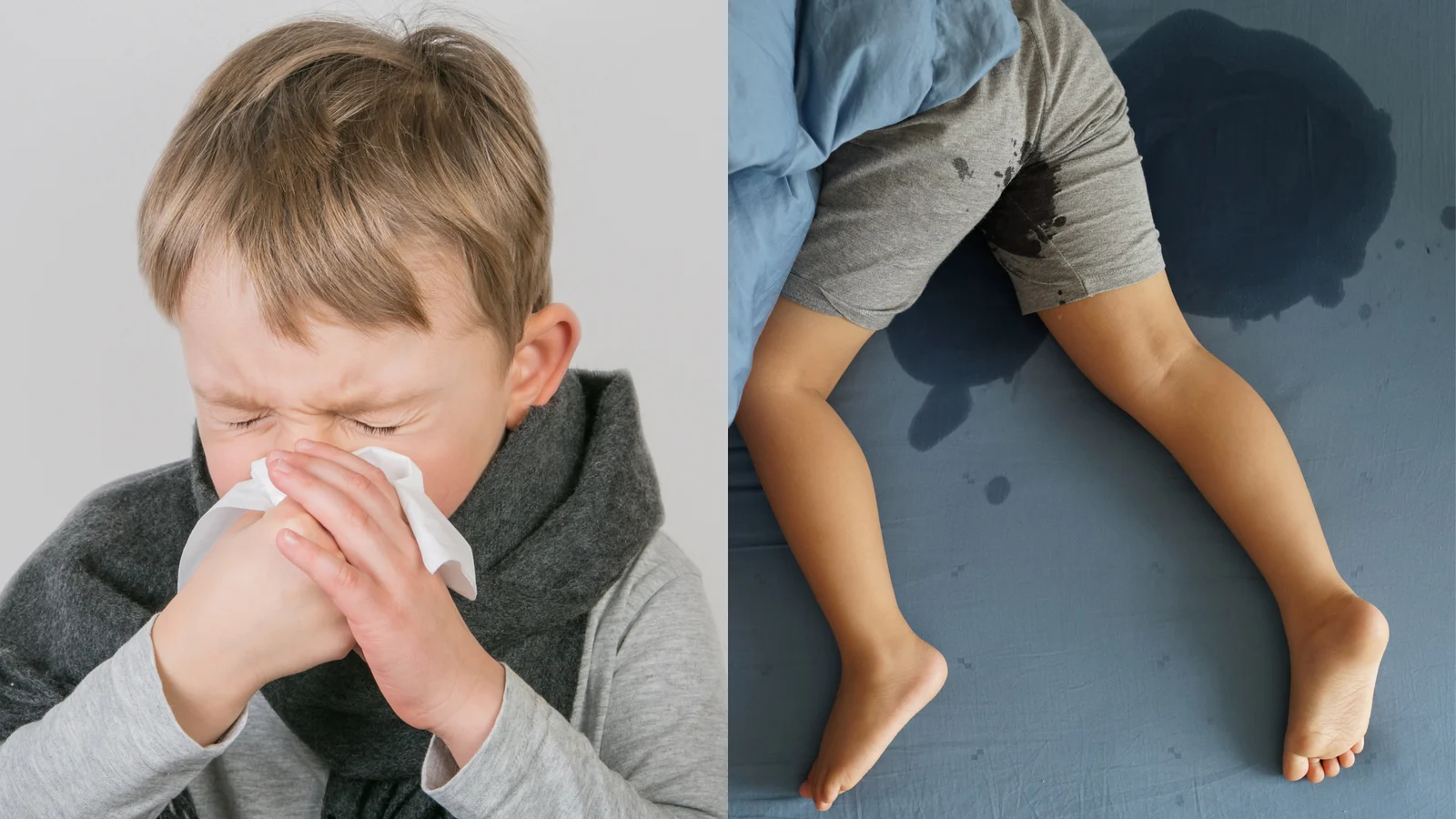
The sleepover invitation comes home in the school bag. Your son is thrilled. You're already working out how to hide a night diaper in his backpack.
He's six. He's dry all day. At night, nothing seems to change. Here's one question few people ask: does he snore?
Short answer: A child still in night diapers at 6 is common and usually not a sign of anything serious, but it's worth checking for snoring. Blocked breathing at night from enlarged adenoids or tonsils is linked to bedwetting, and in these children wet nights often reduce after the breathing is treated. A paediatrician and an ENT specialist can check the likely causes.
Top 3 signs the night wetting may be linked to breathing
- Snores or breathes through the mouth at night. Listen at the door an hour after lights out.
- Very deep sleep, hard to wake. You can lift him to the toilet and he won't remember it.
- Tired or cranky in the morning. Despite a long night's sleep.
Two or more? Tick the 2-minute symptom checklist and see an ENT specialist for an evaluation. 👃
Know a parent quietly buying the next pack of night pants? Send them this.
Is it normal for a 6-year-old to wear night diapers?
It's common for a 6-year-old to still need night diapers or pull-ups. Night-time dryness comes later than daytime dryness, and many healthy children take until 6 or 7. Bedwetting before age 5 is generally considered normal development.
So you're not alone, and your child isn't being lazy. Night dryness depends on three things maturing together: a bladder that holds enough, a body that makes less urine at night, and a brain that wakes up to a full bladder. Anything that disturbs sleep can throw that balance off.
When should I get night wetting checked?
Get night wetting checked if your child still wets most nights after age 5 or 6, if it's affecting their confidence or sleepovers, or if a child who was dry for six months or more starts wetting again. New wetting after a dry spell always deserves a doctor's visit.
See a doctor promptly if your child is very thirsty, passes a lot of urine during the day, has pain or burning when passing urine, is losing weight, has daytime accidents, or has pauses in breathing during sleep.
How can snoring cause bedwetting?
Snoring can contribute to bedwetting when it comes from a narrowed airway, usually because of enlarged adenoids or tonsils. Studies link sleep-disordered breathing with bedwetting, and in children whose adenoids or tonsils block the airway, wet nights often reduce after the breathing is treated (Jeyakumar 2012; Weissbach 2006).
Two things seem to happen. Each struggle to breathe against a blocked airway strains the heart and lungs, which shifts the hormones that normally slow urine at night, so the bladder fills faster. And the child's sleep is broken yet very deep, so the "wake up, you need the toilet" signal doesn't get through.
What else causes a child to wet the bed?
Bedwetting has several causes besides blocked breathing, and more than one can apply. A paediatrician usually checks these first:
- Family pattern. If a parent wet the bed late, a child often does too.
- Small bladder capacity or an overactive bladder. Often with daytime urgency.
- Constipation. A full bowel presses on the bladder. It's easy to miss.
- Too much fluid late in the day, especially fizzy or caffeinated drinks.
- Urine infection or, rarely, diabetes. A simple urine test rules these out.
- Stress or a big change, such as a new school or a new sibling.
The clue that points to the nose is the combination: a child who wets the bed and also snores, mouth-breathes or always seems blocked.
What can I do at home tonight?
At home, keep it calm and practical: no punishment, no shaming, and plenty of praise for dry nights. Give most drinks earlier in the day, cut fizzy and caffeinated drinks in the evening, and make a toilet trip the last thing before bed.
Then do one more thing. An hour after your child falls asleep, stand at the door and listen. Snoring, noisy breathing, an open mouth or the head tilted back are worth telling the doctor about.
How does an ENT check for blocked breathing?
An ENT checks for blocked breathing with a history, an examination of the nose, throat and ears, and usually a nasal endoscopy or an X-ray of the side of the neck to see the adenoids. Allergy is checked at the same visit.
A nasal endoscopy uses a thin camera passed gently into the nose and takes a minute or two. In very young or anxious children, an X-ray is often easier.
How are enlarged adenoids treated?
Treatment for enlarged adenoids starts with the simplest step that fits. Many children improve with nasal steroid sprays, saline and allergy care. Removing the adenoids (adenoidectomy), sometimes with the tonsils, is considered only when the adenoids are big and match the symptoms.
When surgery is advised, it's done under general anaesthesia through the mouth, with no cut on the face. Insured patients usually stay 36 to 48 hours; others go home the same day (day care), provided they are comfortable.
No one can promise dry nights after treatment. When breathing was part of the cause, wet nights often reduce, and the usual bedwetting plan from your paediatrician still helps.
Read next: Bedwetting in children: could snoring and adenoids be why? · Mouth breathing in children: the complete parent guide · Adenoid and tonsil treatment for children · All guides on children's snoring and adenoids
Frequently asked questions
Should my 6-year-old be dry at night? Many are, but plenty aren't, and that's within the normal range. Look closer if wetting is frequent after 5 or 6, or if a dry child starts wetting again.
Are pull-ups making the bedwetting worse? Pull-ups don't cause bedwetting. Some families find a few nights without them helps a child notice wetness, but only when the child is ready and not upset by it.
My daughter snores and wets the bed. Are they connected? They can be. Snoring from big adenoids or tonsils is linked with bedwetting. An ENT evaluation shows whether the airway is blocked.
Will adenoid surgery stop my son wetting the bed? It can't be promised. In children whose adenoids or tonsils block the airway, wet nights often reduce after the breathing is treated. Other causes still need checking.
See Dr. Prashanth R. Reddy in Bengaluru
Video or phone consultations are available if you live outside Bengaluru.
Call +91 821 788 4802 or +91 99026 05737 · Book online: enthealth360.com/book-appointment
References
- Jeyakumar A, Rahman SI, Armbrecht ES, Mitchell R. The association between sleep-disordered breathing and enuresis in children. Laryngoscope. 2012;122(8):1873-1877. PubMed 22549900
- Weissbach A, Leiberman A, Tarasiuk A, Goldbart A, Tal A. Adenotonsilectomy improves enuresis in children with obstructive sleep apnea syndrome. Int J Pediatr Otorhinolaryngol. 2006;70(8):1351-1356. PubMed 16504310
- Marcus CL et al. Diagnosis and management of childhood obstructive sleep apnea syndrome (AAP clinical practice guideline). Pediatrics. 2012. PubMed 22926173
About the author
Dr. Prashanth R Reddy is an ENT surgeon at ENTHealth360, Bangalore (MS ENT; MBA, IIM Bangalore; Seoul Rhinoplasty Fellowship), seeing patients at Sakra World Hospital, Marathahalli and in Koramangala. His practice focuses on how breathing affects sleep, energy and everyday performance.
Medically reviewed by Dr. Prashanth R. Reddy, ENT Surgeon. Last reviewed: 23 November 2026. For educational purposes only. Not a substitute for medical advice. Please consult a qualified ENT specialist.
General patient education. An individual consultation is needed to assess your symptoms and treatment options.