Written and medically reviewed by Dr. Prashanth R. Reddy, Senior Consultant ENT Surgeon (MS ENT)
Look at your child's last class photo. Lips apart? Now think about tonight. Snoring from the next room, a damp patch on the pillow, a child who wakes up tired after ten hours in bed.
Parents usually come in about one worry: a poor eater, a restless child, wet nights, crooked teeth, ear infections. Quite often, these share a single root.
Watch how your child breathes, not just what they do.
Short answer: Mouth breathing in children usually means the nose is blocked, most often by enlarged adenoids, big tonsils or nasal allergy. Long-term mouth breathing is linked with poor sleep, snoring, poor appetite, ADHD-like behaviour, bedwetting, ear infections and changes in how the teeth and face grow. An ENT evaluation finds the cause, and many children improve without surgery.
Top 3 signs your child is a mouth breather
- Lips apart at rest. Watching TV, reading, sitting quietly. The mouth hangs open.
- Snores or sleeps with the mouth open. Most nights, not only with a cold. Often a drool patch on the pillow.
- Wakes up tired or cranky. Dry mouth, bad breath in the morning, hard to get going.
Two or more? Tick the 2-minute symptom checklist and see an ENT specialist for an evaluation. 👃
Know a parent who keeps saying "close your mouth"? Send them this guide.
What is mouth breathing in children?
Mouth breathing in children means breathing mainly through the mouth instead of the nose, by day, at night or both. Every child mouth-breathes during a bad cold. It becomes a concern when the mouth stays open most of the time for weeks or months.
The nose is built for breathing. It warms, cleans and moistens air, and nasal breathing keeps the lips closed and the tongue resting up against the palate. That resting tongue position matters for how the upper jaw grows, which is why long-term mouth breathing shows up in the teeth and face years later.
What causes mouth breathing in a child?
The most common cause of mouth breathing in a child is a blocked nose from enlarged adenoids, large tonsils or nasal allergy. Less often it's a deviated septum, swollen turbinates, nasal polyps or a habit that stays after an old blockage has cleared.
- Enlarged adenoids. A pad of immune tissue at the back of the nose. It's usually largest in the preschool and early school years and shrinks later. When big, it blocks the back of the nose.
- Large tonsils. They narrow the throat, especially when the child lies down to sleep.
- Nasal allergy. Dust mite and pollen allergy swell the nose lining. Look for sneezing, a runny or itchy nose and dark circles under the eyes.
- Habit. Some children keep the mouth open after the blockage is gone. This is a diagnosis made after the nose has been checked, never before.
Can mouth breathing affect my child's appetite and eating?
Mouth breathing can make a child a slow, fussy eater because a child with a blocked nose has to breathe and chew through the same opening. Meals become slow and tiring, solid food may cause gagging, and broken sleep takes the edge off hunger.
Many of these children prefer milk and soft food because it goes down fast. Eating and growth often improve once breathing improves, in children whose adenoids are the cause.
Read more: Child not eating? Check their breathing first · Slow eater or gagging on food? Check the adenoids
Can mouth breathing cause ADHD-like behaviour?
Mouth breathing from a blocked nose can cause or worsen ADHD-like behaviour because it breaks up a child's sleep. Tired children often become restless, impulsive and unable to focus rather than sleepy, which can look like ADHD at school.
Be clear on one point. Treating the breathing improved behaviour, symptoms and quality of life in large trials, but it is not an ADHD treatment, and attention test scores did not change significantly (CHAT 2013; PATS 2023). Keep the paediatrician or child psychiatrist involved.
Read more: Can enlarged adenoids cause ADHD-like symptoms? · ADHD or poor sleep? Check your child's breathing
Is mouth breathing linked to bedwetting?
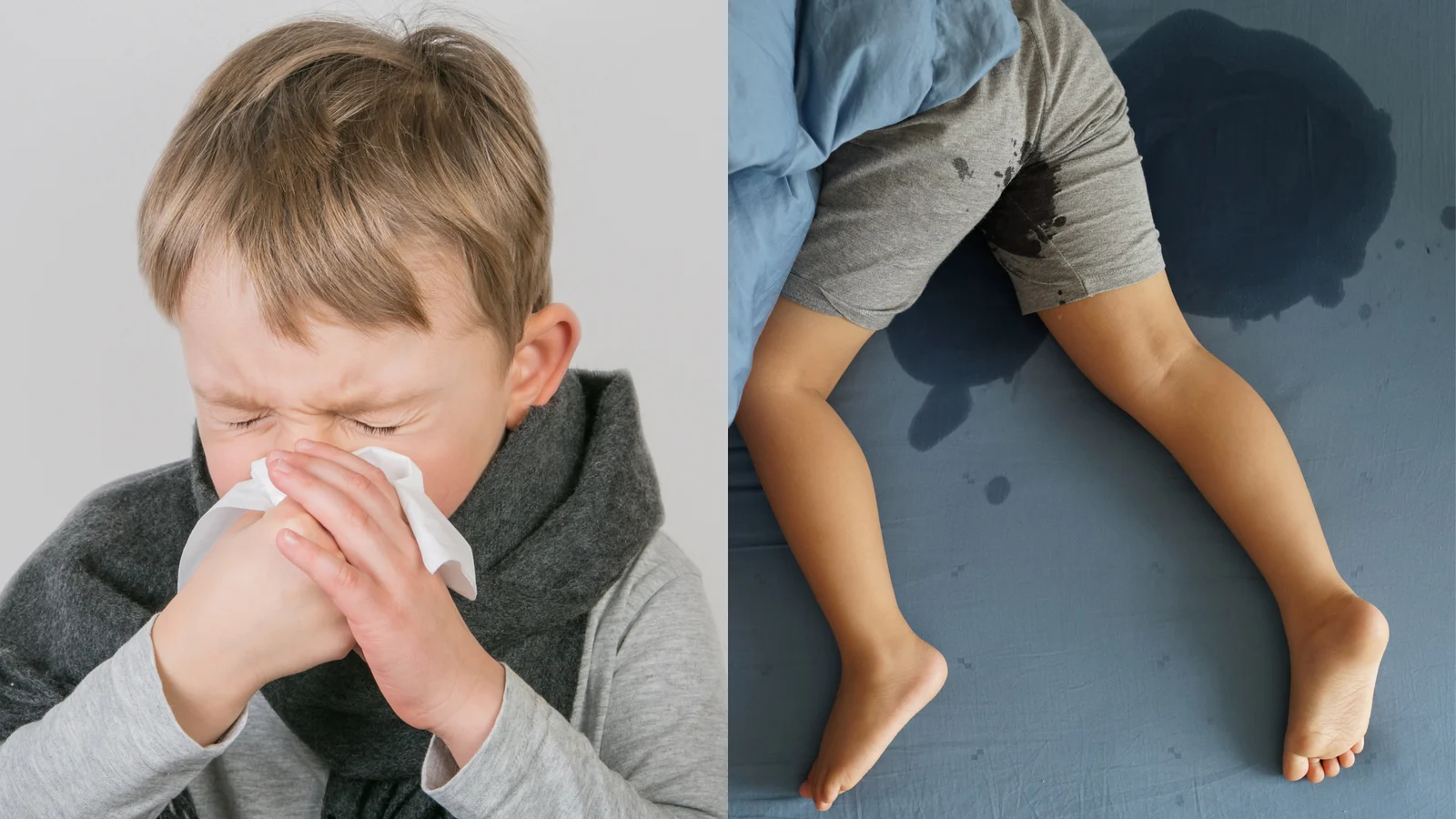
Mouth breathing and snoring are linked to bedwetting in children. Blocked breathing at night increases night-time urine and makes a child harder to wake when the bladder is full. In children whose adenoids or tonsils block the airway, wet nights often reduce after the breathing is treated.
Bedwetting is common before age 5. Look closer after 5 or 6, or if a child who was dry starts wetting again. Bladder problems, constipation, urine infection and diabetes are checked too.
Read more: Bedwetting in children: could snoring and adenoids be why? · Still in night diapers at 6? Check the snoring
Can mouth breathing change my child's teeth and face?
Long-term mouth breathing in growing children is linked with a longer face, a backward-rotated lower jaw, a narrow upper jaw, a high palate and a crossbite, according to a 2021 systematic review and meta-analysis. The face grows around the airway, so how a child breathes during the growth years matters.
When the mouth hangs open, the tongue drops to the floor of the mouth instead of pressing up and widening the upper jaw. Over years, the palate can grow high and narrow and the teeth crowd. Studies suggest growth can partly normalise when nasal breathing is restored early, which is why timing matters.
Braces straighten teeth. The nose sets the airway they grow around. Parents often hear about a narrow palate or crossbite from the dentist or orthodontist first, and that's a good moment to have the nose checked.
Read more: Mouth breathing and crooked teeth · Mouth breathing and a high-arched palate · How mouth breathing changes a child's face · Is your child's smile crooked because of a blocked nose? · Nasal blockage and a small lower jaw · Why is my baby always sucking their thumb?
Why does my child keep getting ear infections?
Children with big adenoids often get repeated ear infections or glue ear because the adenoids sit right next to the openings of the ear tubes (Eustachian tubes). Swollen adenoids block those tubes and hold germs close to them, so fluid collects behind the eardrum.
Watch for a child who turns the TV up, says "what?" a lot, or has a blocked nose with every ear infection.
Read more: Why your child's ear infections may be a nose problem
Can mouth breathing affect school performance?
Mouth breathing can affect school performance when it comes with snoring and broken sleep. A child who sleeps poorly may struggle with concentration, memory and mood in class, and a child with glue ear may simply not hear the teacher clearly.
Read more: Can mouth breathing affect a child's school performance?
Is my child's snoring normal?
Occasional snoring with a cold is common in children. Snoring most nights, snoring with gasps or pauses, restless sleep, sweating and sleeping with the neck stretched back are not normal, and they point to a narrowed airway that an ENT specialist should evaluate.
A quick check at home: an hour after your child falls asleep, stand by the bed for a minute. Is the mouth open? Is there snoring or noisy breathing? Is the head tilted back?
Read more: Snoring in children: causes, risks and when to seek help
What other problems can mouth breathing cause?
Other problems linked to mouth breathing in children include dry lips, bad breath, tooth decay, red swollen front gums, repeated sore throats and a swallowed-air tummy ache. A dry mouth loses the protection saliva gives the teeth and gums.
Read more: Bad breath · Tooth decay · Gum disease · Throat infections and dry lips · Bloating
When should I take my child to an ENT specialist?
Take your child to an ENT specialist if mouth breathing or snoring happens most nights for more than a few weeks, or if it comes with any of the problems above. Two or more signs from the Top 3 list is a good reason to book an evaluation.
See a doctor promptly if your child has pauses in breathing or gasping during sleep, struggles to breathe by day, or is losing weight.
How does an ENT find the cause of mouth breathing?
An ENT finds the cause of mouth breathing with a history, an examination of the nose, mouth, throat and ears, and usually a nasal endoscopy or an X-ray of the side of the neck to see the adenoids. Allergy is checked at the same visit.
A nasal endoscopy uses a thin camera passed gently into the nose and takes a minute or two. In very young or anxious children, an X-ray is often easier. The ENT also looks at the tonsils, the septum and the lining of the nose.
How is mouth breathing treated in children?
Treatment of mouth breathing in children depends on the cause. Many children improve with nasal steroid sprays, saline and allergy care. Removing the adenoids (adenoidectomy), sometimes with the tonsils, is considered only when they are big and match the symptoms.
When surgery is advised, it's done under general anaesthesia through the mouth, with no cut on the face. Insured patients usually stay 36 to 48 hours; others go home the same day (day care), provided they are comfortable.
Once the nose is clear, some children still keep the mouth open out of habit. Lip and tongue exercises, and teamwork with the child's dentist or orthodontist, help retrain resting posture.
Read next: Adenoid and tonsil treatment for children · All guides on children's snoring, adenoids and mouth breathing · Symptom checklists
Frequently asked questions
Is mouth breathing in children always a problem? No. Mouth breathing during a cold is normal. Mouth breathing most of the day or night for weeks is worth an ENT evaluation.
At what age should I worry about my toddler breathing through the mouth? At any age, regular snoring with pauses or gasps needs a doctor. For everyday open-mouth breathing, a check is reasonable once it has gone on for more than a few weeks, even in a toddler.
Can mouth breathing in a child be fixed without surgery? Often, yes. Many children improve with nasal sprays, saline and allergy care. Surgery is considered only when the adenoids or tonsils are big and match the symptoms.
Will my child's face change back if the mouth breathing is treated? Studies suggest growth can partly normalise when nasal breathing is restored early, while the child is still growing. How much depends on age and on how long the mouth breathing went on.
Does mouth taping help children? Don't tape a child's mouth. If a child can't breathe well through the nose, taping is unsafe. Find and treat the cause instead.
Do adenoids shrink on their own? Adenoids usually shrink through later childhood. If they are affecting sleep, eating, behaviour, ears or growth now, waiting is not always the right choice.
See Dr. Prashanth R. Reddy in Bengaluru
Video or phone consultations are available if you live outside Bengaluru.
Call +91 821 788 4802 or +91 99026 05737 · Book online: enthealth360.com/book-appointment
References
- Zhao Z, Zheng L, Huang X, et al. Effects of mouth breathing on facial skeletal development in children: a systematic review and meta-analysis. BMC Oral Health. 2021;21(1):108. PubMed 33691678
- Marcus CL, Moore RH, Rosen CL, et al. A randomized trial of adenotonsillectomy for childhood sleep apnea (CHAT). N Engl J Med. 2013;368(25):2366-2376. PubMed 23692173
- Redline S, Cook K, Chervin RD, et al. Adenotonsillectomy for snoring and mild sleep apnea in children: a randomized clinical trial (PATS). JAMA. 2023;330(21):2084-2095. PubMed 38051326
- Jeyakumar A, Rahman SI, Armbrecht ES, Mitchell R. The association between sleep-disordered breathing and enuresis in children. Laryngoscope. 2012;122(8):1873-1877. PubMed 22549900
- Weissbach A, Leiberman A, Tarasiuk A, Goldbart A, Tal A. Adenotonsilectomy improves enuresis in children with obstructive sleep apnea syndrome. Int J Pediatr Otorhinolaryngol. 2006;70(8):1351-1356. PubMed 16504310
- Marcus CL et al. Diagnosis and management of childhood obstructive sleep apnea syndrome (AAP clinical practice guideline). Pediatrics. 2012. PubMed 22926173
About the author
Dr. Prashanth R Reddy is an ENT surgeon at ENTHealth360, Bangalore (MS ENT; MBA, IIM Bangalore; Seoul Rhinoplasty Fellowship), seeing patients at Sakra World Hospital, Marathahalli and in Koramangala. His practice focuses on how breathing affects sleep, energy and everyday performance.
Medically reviewed by Dr. Prashanth R. Reddy, ENT Surgeon. Last reviewed: 23 November 2026. For educational purposes only. Not a substitute for medical advice. Please consult a qualified ENT specialist.
General patient education. An individual consultation is needed to assess your symptoms and treatment options.