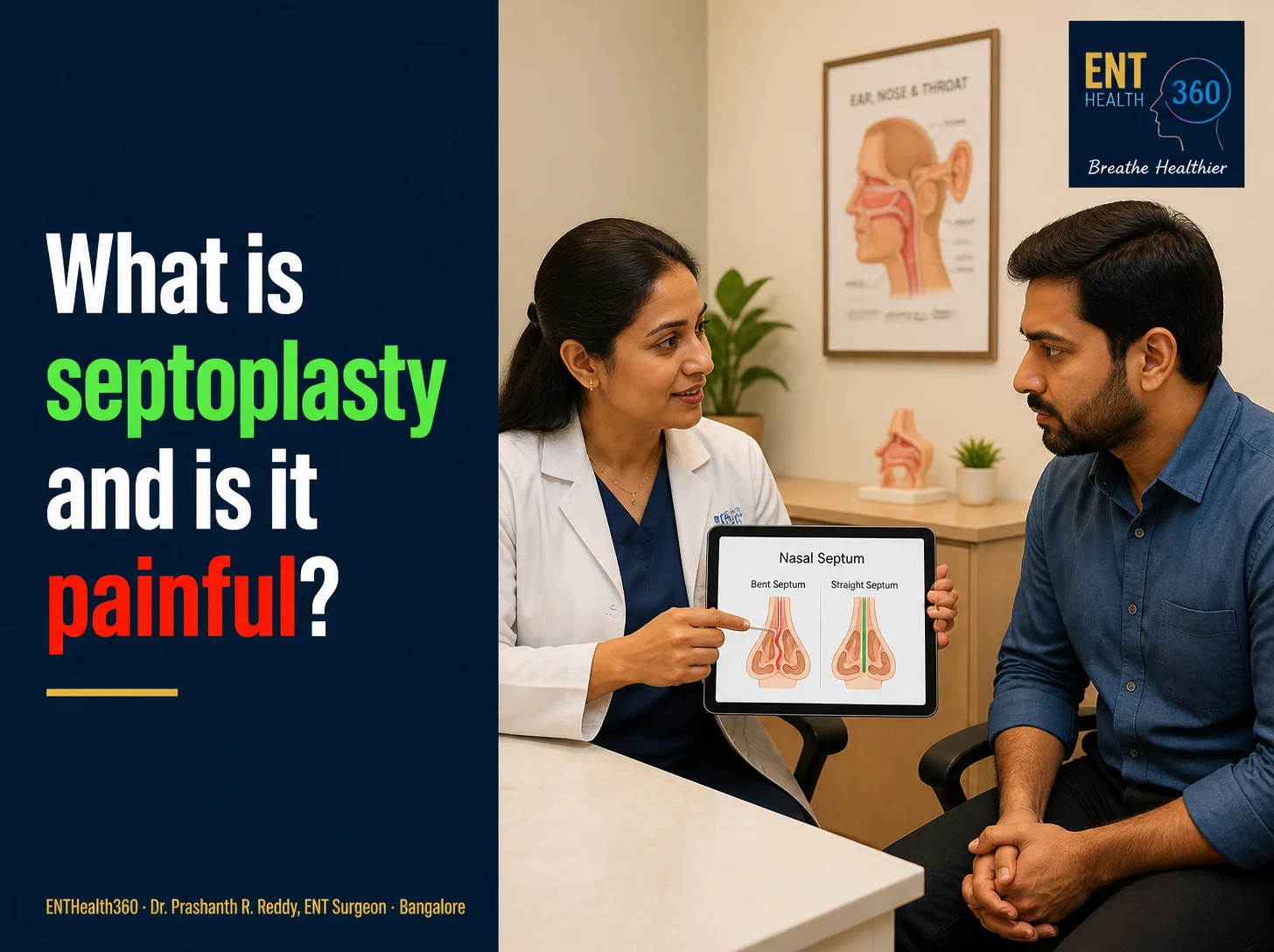
Short answer: Septoplasty is an operation done through the nostrils to straighten a deviated septum and improve nasal breathing. It is usually performed under anaesthesia with no external cuts. Most people describe recovery as stuffiness and discomfort for some days rather than severe pain, and this is usually manageable with regular painkillers.
Dr. Prashanth's perspective: Septoplasty straightens a crooked septum, the wall of cartilage and bone in the middle of the nose. It is done entirely inside the nose, with no cuts outside. Because there are no moving parts inside the nose, most people have very little pain afterwards. The main complaint is a stuffy nose for a few days.
Key takeaways
- Septoplasty straightens the bent parts of the septum through the nostrils.
- It does not usually change the outside shape of the nose.
- Recovery is mostly stuffiness and discomfort, often managed with regular painkillers.
- Many surgeons now avoid heavy nasal packing; splints, if used, are removed at follow-up.
What happens during septoplasty?
During septoplasty, the surgeon reshapes or removes the bent parts of the septum's cartilage and bone, working through the nostrils.
The septum is the wall that divides the nose into two passages. When it is significantly bent, it can block airflow on one or both sides. In septoplasty, the lining is gently lifted, the deviated portions are straightened or removed, and enough strong cartilage is preserved to keep the nose supported. The lining is then laid back in place.
The procedure is usually done under general anaesthesia and is often a day-care or short-stay operation. There are no cuts on the outside of the nose. It may be combined with turbinate reduction or endoscopic sinus surgery if those are also contributing.
Is septoplasty painful, and what does recovery feel like?
Most people describe septoplasty recovery as uncomfortable and stuffy rather than severely painful.
Common in the first days:
- A blocked nose due to swelling and dried mucus
- Mild to moderate discomfort, usually controlled with regular painkillers
- Slight bloodstained discharge
- Mild headache or pressure across the nose
About packing and splints: many surgeons now avoid heavy nasal packing. Soft splints may be placed to support the septum while it heals and are removed at a follow-up visit. Removal is usually brief.
The nose usually feels progressively clearer over the following weeks as swelling settles. Your ENT will explain the expected recovery for your situation.
What can you do at home to recover comfortably?
Following simple aftercare steps may help healing and comfort.
- Take painkillers regularly as advised, rather than waiting for pain to build.
- Use saline sprays or rinses as instructed to keep the nose clean.
- Sleep with your head raised on an extra pillow.
- Avoid blowing your nose forcefully, heavy lifting and strenuous exercise until cleared.
- Sneeze with your mouth open.
- Avoid smoking and alcohol during early recovery.
- Avoid medicines such as aspirin unless your doctor approves.
Many people working desk jobs return to work within about a week, but this varies.
How are breathing, sleep and energy connected here?
For people whose bent septum is the main cause of blockage, septoplasty may help nasal breathing, which can support better sleep and daytime energy.
A blocked nose often leads to mouth breathing at night, snoring and lighter sleep. People often describe waking tired, feeling foggy in meetings and finding workouts harder. Restoring nasal airflow may help some people sleep more deeply, though results vary and surgery alone may not resolve snoring or sleep apnoea.
In Bangalore, many people also have allergy-related swelling, so ongoing allergy care after surgery may still be needed.
How does nose breathing support energy and BMR?
Your basal metabolic rate (BMR) is the energy your body burns at rest to keep the heart beating, the brain working and cells repairing. Your cells make that energy using oxygen, so how well you breathe matters.
Nose breathing helps in two ways:
- Warm, moist, filtered air. The nose warms, humidifies and filters each breath before it reaches the lungs. Conditioned air is gentler on the airway lining, which matters in Bangalore's air-conditioned offices and traffic dust. Mouth breathing skips this step and can leave the throat and airways dry.
- Nitric oxide from the sinuses. The paranasal sinuses continuously make nitric oxide (NO), a natural gas. When you breathe in through your nose, small amounts of this NO travel to the lungs, where studies suggest it may help widen tiny blood vessels and improve oxygen uptake. Mouth breathing largely bypasses it.
Nose breathing does not "boost" your BMR. That is set mainly by muscle mass, age, body size and hormones such as thyroid. But comfortable nasal breathing by day, and undisturbed breathing at night, support efficient oxygen supply and deeper sleep, which your body needs to use energy well and recover.
A simple check: sit quietly and breathe through your nose with your mouth closed for two minutes. If that feels difficult, or one side is always blocked, it is worth having your nose examined.
When should you see an ENT?
See an ENT to discuss septoplasty if nasal blockage persists despite consistent medical treatment.
Consider an ENT review if:
- Blockage affects your sleep, work or exercise
- Steroid sprays and rinses have not helped after a few months
- You have recurrent sinus infections or nosebleeds
After surgery, seek urgent care for:
- Heavy bleeding that does not stop with gentle pressure and rest
- High fever, increasing pain or new swelling of the nose
- Clear watery discharge with a salty taste, or a severe headache
- Changes in vision
How an ENT evaluates and treats it
An ENT decides on septoplasty after confirming that the septum is a key cause of your symptoms.
Evaluation usually includes a history, examination and nasal endoscopy. A CT scan may be advised if sinus disease is suspected. Your ENT will also check the turbinates, nasal valve and allergy status, since these often contribute.
Many people first try medicines such as steroid sprays and saline rinses. If blockage still affects daily life, septoplasty may be offered, sometimes with turbinate reduction. Risks such as bleeding, infection or persistent blockage are discussed beforehand. The right option depends on the cause.
Frequently asked questions
Does nose breathing give me more energy? It does not add energy by itself, but it delivers warm, humidified air and sinus nitric oxide to the lungs, which may help oxygen uptake. Together with better sleep, that supports the energy your body uses at rest (BMR) and during activity.
How long does septoplasty take? The operation itself commonly takes around one hour, though this varies. Combined procedures may take longer.
Will septoplasty change the shape of my nose? Septoplasty alone does not usually change the outside appearance. If shape changes are wanted, a combined procedure called septorhinoplasty may be discussed.
When can I exercise after septoplasty? Light walking is usually encouraged early. Strenuous exercise is commonly avoided for a few weeks; your ENT will advise the right timeline for you.
References
- Lundberg JO, Farkas-Szallasi T, Weitzberg E, et al. High nitric oxide production in human paranasal sinuses. Nature Medicine. 1995;1(4):370-373.
- Lundberg JO, Settergren G, Gelinder S, et al. Inhalation of nasally derived nitric oxide modulates pulmonary function in humans. Acta Physiologica Scandinavica. 1996;158(4):343-347.
- Keck T, Leiacker R, Heinrich A, Kühnemann S, Rettinger G. Humidity and temperature profile in the nasal cavity. Rhinology. 2000;38(4):167-171.
About the author
Dr. Prashanth R Reddy is an ENT surgeon at ENTHealth360, Bangalore (MS ENT; MBA, IIM Bangalore; Seoul Rhinoplasty Fellowship), seeing patients at Sakra World Hospital, Marathahalli and in Koramangala. His practice focuses on how breathing affects sleep, energy and everyday performance.
Related reading: Why Is My Nose Always Blocked? Deviated Septum, Turbinates & Nosebleeds Explained
Medically reviewed by Dr. Prashanth R. Reddy, ENT Surgeon. Last reviewed: 12 November 2026. For educational purposes only. Not a substitute for medical advice. Please consult a qualified ENT specialist.
General patient education. An individual consultation is needed to assess your symptoms and treatment options.