Short answer: For a first, mild sinus episode, a general physician is a reasonable starting point. See an ENT (ear, nose and throat) specialist if symptoms last more than 12 weeks, keep returning, cause loss of smell, affect one side only, or need repeated antibiotics. An ENT can examine inside the nose with an endoscope.
Key takeaways
- A general physician can manage a simple, short-term sinus infection.
- Chronic, recurrent or one-sided symptoms are better assessed by an ENT.
- An ENT can perform nasal endoscopy in the clinic and interpret sinus CT scans.
- Eye swelling, vision changes or severe headache need urgent care, not a routine appointment.
Dr. Prashanth's perspective
A patient should consult an ENT doctor whenever sinus problems come back more than twice a year, or if they have needed antibiotics more than twice for a sinus-related problem. At that point the nose and sinuses need a proper evaluation to understand the underlying cause.
— Dr. Prashanth R. Reddy, ENT Surgeon, ENTHealth360
What is the difference between a GP and an ENT for sinus problems?
A general physician (GP) treats a wide range of everyday illnesses, while an ENT specialist focuses specifically on the ear, nose, throat, sinuses and related structures.
Most short sinus infections follow a cold and settle within one to two weeks. A GP can diagnose this from your symptoms, advise home care and decide whether medicines are needed.
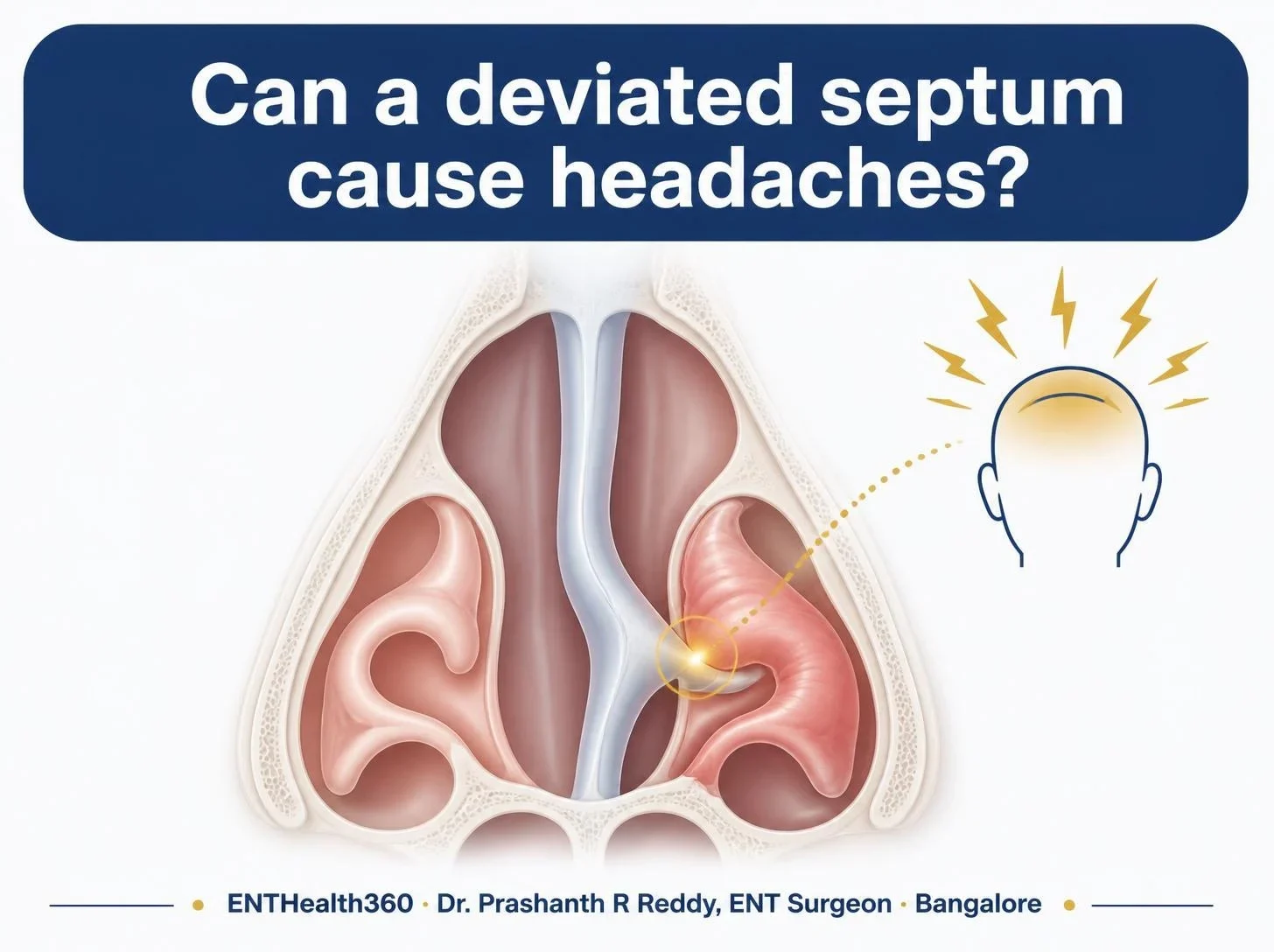
An ENT has the training and equipment to look inside the nose and sinus openings directly. This matters when symptoms are long-standing or keep returning, because the cause is often something that cannot be seen from outside, such as polyps, a deviated septum or swollen turbinates (the bony ridges inside the nose that warm and humidify air).
How do you know your sinus problem needs an ENT?
Your sinus problem likely needs an ENT if it has become long-lasting, frequent or unusual.
Consider seeing an ENT if you have:
- Symptoms lasting more than 12 weeks (chronic sinusitis)
- Three or more sinus episodes a year
- Loss of smell or taste
- Blockage or discharge mainly on one side
- Bloodstained or foul-smelling discharge
- A need for repeated antibiotic courses
- Snoring, mouth breathing or poor sleep along with nasal blockage
A family doctor is still a good first contact for a fresh, mild episode, and can refer you if needed.
What can you do at home while deciding?
For a mild episode without warning signs, simple home care often helps.
- Use a saline rinse once or twice a day to clear mucus.
- Try steam inhalation for a few minutes.
- Drink plenty of fluids and rest.
- Use decongestant nasal sprays for no more than a few days.
- Avoid smoke, dust and strong fragrances.
Keep a short note of how long symptoms last and what you have tried. This helps whichever doctor you see. Avoid starting leftover antibiotics on your own, as many sinus infections are viral.
How are breathing, sleep and energy connected here?
Getting the right diagnosis matters because chronic sinus blockage can quietly affect sleep and daytime energy.
When the nose is blocked, many people breathe through the mouth at night. This can increase snoring, dry the throat and fragment sleep. The result is often waking unrefreshed, morning headaches and lower focus at work or in class.
In Bangalore, many people spend long hours in air-conditioned offices and in traffic pollution, both of which can irritate the nasal lining. Treating the underlying cause may help many people breathe more easily at night and feel steadier during the day.
How does nose breathing support energy and BMR?
Your basal metabolic rate (BMR) is the energy your body burns at rest to keep the heart beating, the brain working and cells repairing. Your cells make that energy using oxygen, so how well you breathe matters.
Nose breathing helps in two ways:
- Warm, moist, filtered air. The nose warms, humidifies and filters each breath before it reaches the lungs. Conditioned air is gentler on the airway lining, which matters in Bangalore's air-conditioned offices and traffic dust. Mouth breathing skips this step and can leave the throat and airways dry.
- Nitric oxide from the sinuses. The paranasal sinuses continuously make nitric oxide (NO), a natural gas. When you breathe in through your nose, small amounts of this NO travel to the lungs, where studies suggest it may help widen tiny blood vessels and improve oxygen uptake. Mouth breathing largely bypasses it.
Nose breathing does not "boost" your BMR. That is set mainly by muscle mass, age, body size and hormones such as thyroid. But comfortable nasal breathing by day, and undisturbed breathing at night, support efficient oxygen supply and deeper sleep, which your body needs to use energy well and recover.
A simple check: sit quietly and breathe through your nose with your mouth closed for two minutes. If that feels difficult, or one side is always blocked, it is worth having your nose examined.
When should you see an ENT?
See an ENT for chronic or recurrent sinus symptoms, and seek urgent care for red-flag signs.
Urgent (emergency department or same-day ENT):
- Swelling or redness around the eye, double vision or reduced vision
- Severe headache, high fever, confusion or a stiff neck
- Swelling of the forehead or cheek
Routine ENT review:
- Symptoms beyond 12 weeks or frequent episodes
- One-sided blockage, bleeding or smell loss
- No improvement despite treatment from your GP
How an ENT evaluates and treats it
An ENT visit usually includes a detailed history, an examination and a nasal endoscopy.
Nasal endoscopy is a quick clinic procedure. After a numbing spray, a thin camera is passed into the nose to look at the lining, the sinus drainage areas and the septum. A CT scan of the sinuses may be advised if chronic sinusitis, polyps or surgery are being considered.
Treatment may range from a targeted medication plan, such as saline irrigation, steroid nasal sprays and allergy control, to minimally invasive endoscopic sinus surgery for those who do not improve. The right option depends on the cause and on how much symptoms affect your daily life.
Frequently asked questions
Does nose breathing give me more energy? It does not add energy by itself, but it delivers warm, humidified air and sinus nitric oxide to the lungs, which may help oxygen uptake. Together with better sleep, that supports the energy your body uses at rest (BMR) and during activity.
Can a GP treat chronic sinusitis? A GP can start treatment and often helps many people. If symptoms persist beyond 12 weeks or keep returning, an ENT assessment with nasal endoscopy is usually advised.
Do I need a referral to see an ENT in India? In most private settings in India you can see an ENT directly without a referral. Bringing notes from your GP and any previous reports is still helpful.
Is a CT scan always needed for sinus problems? No. Most short sinus infections do not need a scan. A CT scan is usually reserved for chronic sinusitis, suspected complications or planning surgery.
References
- Lundberg JO, Farkas-Szallasi T, Weitzberg E, et al. High nitric oxide production in human paranasal sinuses. Nature Medicine. 1995;1(4):370-373.
- Lundberg JO, Settergren G, Gelinder S, et al. Inhalation of nasally derived nitric oxide modulates pulmonary function in humans. Acta Physiologica Scandinavica. 1996;158(4):343-347.
- Keck T, Leiacker R, Heinrich A, Kühnemann S, Rettinger G. Humidity and temperature profile in the nasal cavity. Rhinology. 2000;38(4):167-171.
About the author
Dr. Prashanth R Reddy is an ENT surgeon at ENTHealth360, Bangalore (MS ENT; MBA, IIM Bangalore; Seoul Rhinoplasty Fellowship), seeing patients at Sakra World Hospital, Marathahalli and in Koramangala. His practice focuses on how breathing affects sleep, energy and everyday performance.
Related reading: Why does my sinus keep coming back every few months? · How do I know if I have sinus problems?
For educational purposes only. Not a substitute for medical advice. Please consult a qualified ENT specialist.
General patient education. An individual consultation is needed to assess your symptoms and treatment options.