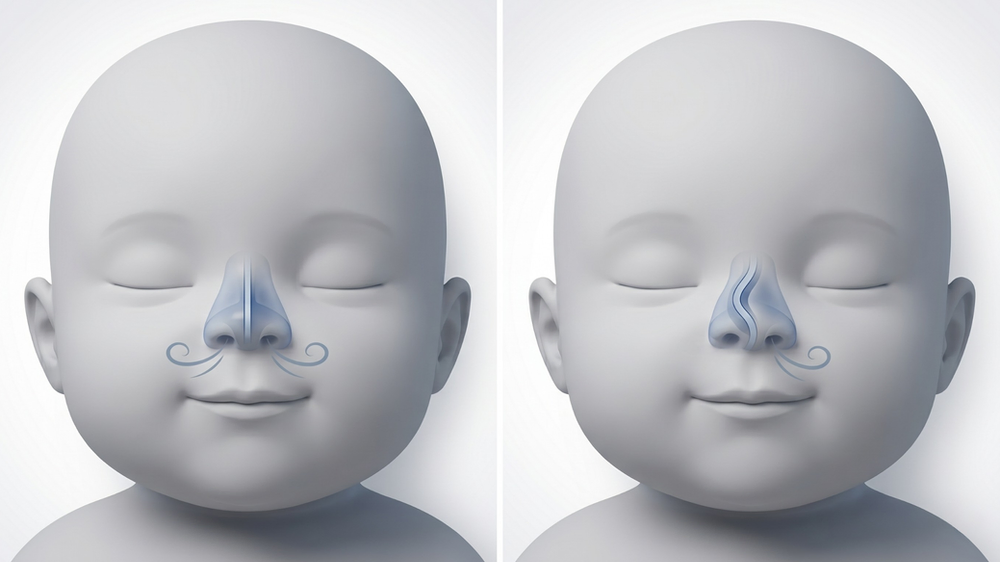
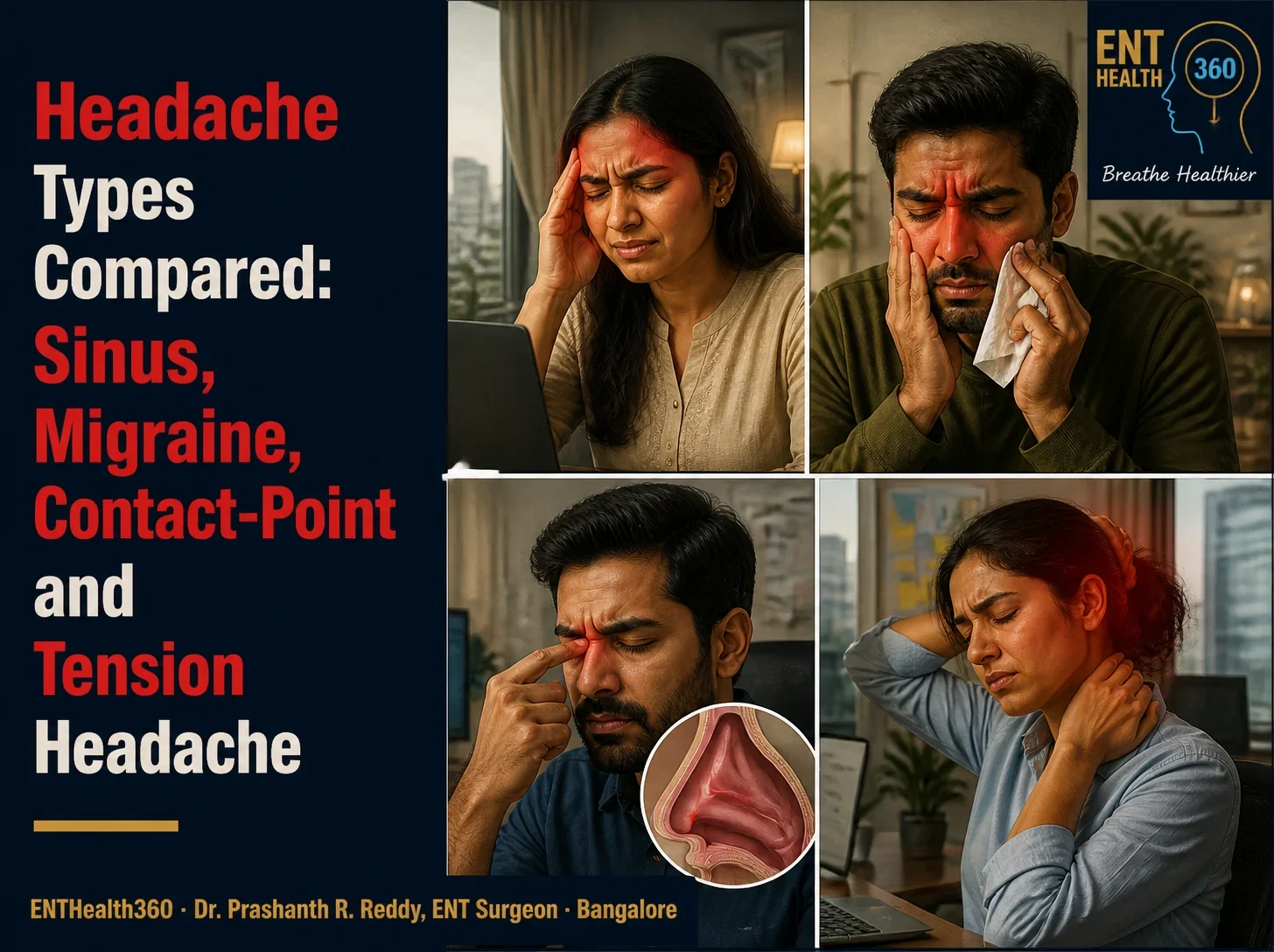
Short answer: Some headaches that look like migraine start inside the nose. They come from a contact point, a spot where two surfaces press together, such as a septal spur touching a turbinate. The pressure can irritate branches of the trigeminal nerve, causing one-sided pain around the eye, forehead or temple. The site of contact decides where the pain is felt. An ENT confirms it with nasal endoscopy, a CT scan and sometimes a numbing test.
Medically reviewed by Dr. Prashanth R. Reddy, ENT Surgeon (MS ENT) · Last reviewed: 28 October 2026
Key takeaways
- A contact point is a place inside the nose where a spur, a bend or a swollen turbinate presses on the opposite surface.
- Because the nose and the forehead, eyes and temples share the same nerve network, pain from a contact point is often felt away from the nose and mistaken for migraine.
- Different contact sites tend to cause pain in different places, which the table below compares.
- Diagnosis needs the headache pattern, endoscopy and CT to agree, with other headache causes considered. Many people have contact points and no headache at all.
- Treatment starts with medicines. Endoscopic correction through the nostrils is considered only for selected people.
Why can a nasal contact point feel like migraine?
The lining of the nose is supplied by branches of the trigeminal nerve, the same nerve that carries pain from the forehead, around the eyes and the temples. When two surfaces inside the nose press together, the irritated nerve endings can send pain to these areas. This is called referred pain. The pain is often on one side, can come in spells, and may worsen with anything that swells the nasal lining: a cold, an allergy flare, air conditioning or lying down.
That pattern can look very like migraine, and migraine itself can cause a stuffy nose and a watery eye during an attack. The international headache classification recognises headache caused by disorders of the nasal lining, turbinates or septum, but it asks for clear evidence linking the two before the diagnosis is made.
Nasal trigger sites compared
Use this table as a guide to patterns, not as a diagnosis. Pain maps overlap, and one person can have more than one contact point or more than one type of headache.
| Contact site | Where pain is usually felt | Why it can be mistaken for migraine | What endoscopy and CT show | When endoscopic correction may be considered |
|---|---|---|---|---|
| Septal spur touching the inferior or middle turbinate | Around or behind the eye, forehead or temple, on the side of the spur | Recurrent one-sided pain that comes and goes with nasal congestion | A bony spur from the septum pressing into the turbinate; the CT shows exactly where they meet | Pain matches the side of the spur, a numbing test helps, and medicines have not helped enough |
| Concha bullosa (air-filled middle turbinate) pressing on the septum | Deep pressure between or behind the eyes, sometimes the forehead | A deep, dull ache that can last hours and return often | An air cell inside the middle turbinate, enlarging it until it touches the septum | The enlarged turbinate is clearly in contact on the painful side and other causes are excluded |
| Middle turbinate against the side wall of the nose | Inner corner of the eye, upper cheek or forehead | Pain near the eye with a blocked feeling, often labelled "sinus migraine" | The turbinate bent or pressing outwards against the side wall, sometimes narrowing a sinus drainage path | The contact is confirmed on CT and the drainage path or pain pattern fits |
| Anterior ethmoidal nerve area (top front of the nose) | Inner corner of the eye, bridge of the nose, lower forehead | Pain between the eyes that does not settle with usual headache tablets | Contact high up at the front of the septum or middle turbinate; CT shows the narrow upper nasal space | Pain is reproduced or relieved from this area and the findings agree |
| Sphenopalatine area at the back of the nose (Sluder's neuralgia, often missed and underdiagnosed) | Behind the eye, upper jaw or teeth, sometimes the temple, often with tearing or a runny nose on that side | One-sided attacks with eye and nose symptoms, which can resemble cluster headache or migraine | Contact or narrowing near the back of the nose; findings here are less specific | Only after careful evaluation; a nerve block in this area is sometimes used to help diagnose or treat |
For every site, the first step is the same: saline rinses, a steroid nasal spray, allergy control and a headache diary, alongside any treatment from a physician or neurologist.
Migraine or contact point: quick clues
| Clue | Points more towards migraine | Points more towards a nasal contact point |
|---|---|---|
| Type of pain | Throbbing or pulsing attacks | Dull, deep ache or pressure |
| Side | Can switch sides between attacks | Keeps returning on the same side |
| Nose | Stuffy only during an attack | Blocked on the painful side, often between headaches too |
| With the pain | Nausea, sensitivity to light and sound | Usually no nausea |
| Triggers | Missed meals, poor sleep, stress, periods, bright screens | Colds, allergy flares, AC, lying down |
| Response to treatment | Often responds to migraine treatment | Often responds poorly to usual headache tablets |
These clues raise or lower suspicion; they do not settle the question. Some people have both migraine and a nasal contact point.
How an ENT confirms a contact-point headache
- History and a two-week headache diary: side, timing, triggers, nasal symptoms and how many days a week painkillers are taken.
- Nasal endoscopy: a thin camera, after a numbing spray, shows the septum, turbinates and any surfaces touching.
- CT scan of the nose and sinuses: shows contact points deeper in the nose, the shape of the turbinates and the health of the sinuses.
- Local anaesthetic test: a numbing medicine placed on the suspected contact. Relief soon after supports the nose as a source; a negative test does not always rule it out.
- Considering other causes: migraine, tension-type and cluster headache, medication-overuse headache, eye problems and, where warning signs exist, conditions that need urgent scans. Care is planned with your physician or neurologist where needed.
What does treatment involve?
Treatment usually starts with calming the nasal lining, because swelling makes a contact press harder. In selected people whose pain continues despite medicines, and in whom the examination, CT scan and numbing test all point to the same site, endoscopic surgery done through the nostrils may be considered to remove the contact. This can include straightening the septum or removing a spur, reducing a turbinate or opening a concha bullosa. Because the work is done inside the nose, there is no cut on the face. At ENTHealth360 this approach is described as "Zero Cut. Zero Scar. Zero Bandage.", a description of the technique, not a promise of a particular result.
Correcting a contact point is not a treatment for migraine in general. If migraine is also present, it may still need its own treatment.
When should you seek urgent care?
Go to an emergency department the same day for a sudden, severe "worst-ever" headache; headache with fever, a stiff neck or confusion; swelling or redness around the eye, double vision or reduced vision; weakness, numbness or difficulty speaking; or a headache after a head injury.
Frequently asked questions
If my CT shows a septal spur, is that the cause of my headache?
Not necessarily. Many people have spurs or contact points and no headache. The scan is read together with your pain pattern, the endoscopy and, often, a numbing test.
Can a contact-point headache be on both sides?
It is usually one-sided, but contact points can be present on both sides of the nose.
Why don't my migraine tablets work?
There can be many reasons, including frequent painkiller use. A headache that keeps returning on one side with a blocked nose on that side is one pattern worth an ENT examination.
Is Sluder's neuralgia the same as a contact-point headache?
They overlap. Sluder's neuralgia is pain linked to the sphenopalatine area at the back of the nose, and a contact point there is one of its causes. It is a real cause of one-sided headache and facial pain. It is often missed and underdiagnosed, because the nose is not always examined when headaches are assessed.
Which doctor should I see first?
If the headache sits on one side with nasal symptoms on that side, start with an ENT. If it clearly fits migraine with no nasal signs, start with a physician or neurologist. Many people benefit from both.
References
- Headache Classification Committee of the International Headache Society. The International Classification of Headache Disorders, 3rd edition. Cephalalgia. 2018;38(1):1-211.
- Harrison L, Jones NS. Intranasal contact points as a cause of facial pain or headache: a systematic review. Clinical Otolaryngology. 2013;38(1):8-22.
- Behin F, Behin B, Bigal ME, Lipton RB. Surgical treatment of patients with refractory migraine headaches and intranasal contact points. Cephalalgia. 2005;25(6):439-443.
- Schreiber CP, Hutchinson S, Webster CJ, et al. Prevalence of migraine in patients with a history of self-reported or physician-diagnosed "sinus" headache. Archives of Internal Medicine. 2004;164(16):1769-1772.
Related reading: What is a contact point headache? · Sinus headache or migraine: how can I tell? · Sluder's neuralgia · Can a deviated septum cause headaches?
Complete guide: Nasal headache and endoscopic nerve decompression: causes, diagnosis and treatment
About the author
Dr. Prashanth R. Reddy is a Senior Consultant ENT Surgeon in Bengaluru (MS ENT; Fellowship in Rhinoplasty, Seoul; MBA, IIM Bangalore) with over 20 years of practice. He sees patients at Sakra World Hospital, Marathahalli and at the ENTHealth360 clinic in Koramangala. His practice focuses on nasal causes of headache, snoring and sleep-disordered breathing.
For educational purposes only. Not a substitute for medical advice. Please consult a qualified ENT specialist.
General patient education. An individual consultation is needed to assess your symptoms and treatment options.