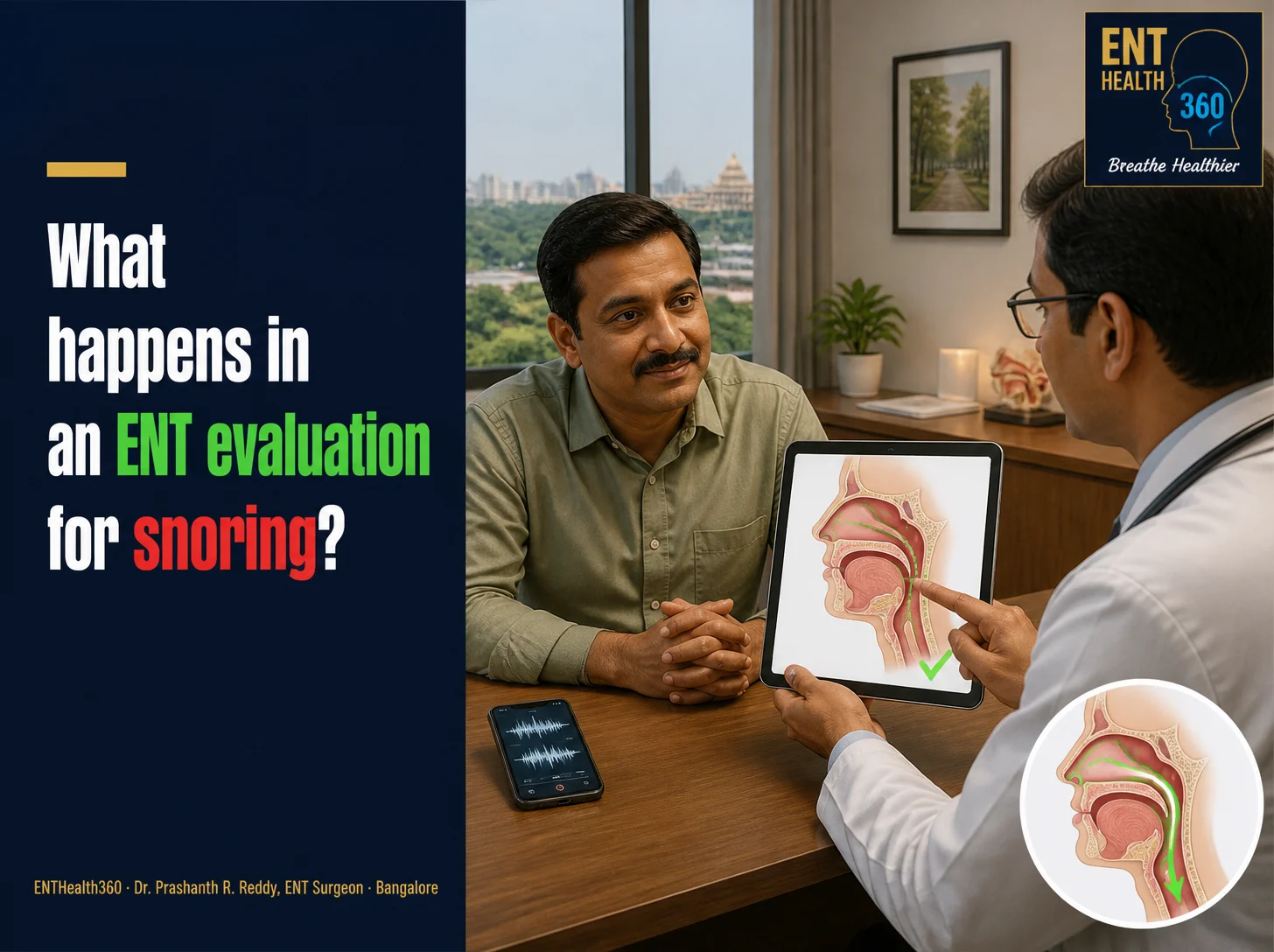
Short answer: An ENT evaluation for snoring finds where and why your airway narrows during sleep. It combines your sleep history with an examination of the nose, palate, tonsils, tongue and jaw, a nasal endoscopy (a thin camera passed gently into the nose) and, when a fixed blockage is suspected, a CT scan. These findings decide which treatment is likely to help.
Key takeaways
- Snoring is a sound. The useful question is which part of the airway is narrow: the nose, the palate and tonsils, or the tongue base.
- Nasal endoscopy shows the inside of the nose and the back of the nose in a few minutes, after a numbing spray.
- A CT scan maps the septum, turbinates, sinuses and airway framework when a structural cause is suspected.
- Treatment is matched to what the evaluation finds, from simple nasal care to surgery for selected people.
Dr. Prashanth's perspective
For most patients, a Level 3 sleep study is enough to assess obstructive sleep apnea. Level 1 and Level 2 studies are needed only for advanced assessment, when Level 3 is not sufficient. What patients worry about most is the cables they have to wear while sleeping, but with a Level 3 study the cables are very minimal and not complicated.
— Dr. Prashanth R. Reddy, ENT Surgeon, ENTHealth360
Why does the cause of snoring matter?
Snoring happens when air passes through a narrowed airway and makes soft tissue vibrate. The narrowing can be at more than one level:
- The nose: a bent septum, swollen turbinates, nasal polyps or allergy.
- The palate and tonsils: a long soft palate, a large uvula or enlarged tonsils.
- The tongue base and jaw: a tongue that falls back during sleep, or a small or set-back jaw.
Two people with equally loud snoring can need completely different treatment. Treating the wrong level is one of the commonest reasons snoring remedies disappoint.
What happens step by step?
An ENT evaluation usually takes place in one clinic visit, with a scan arranged if needed.
- Sleep history. How loud and how often you snore, whether a partner has noticed breathing pauses or gasping, how rested you feel, and whether alcohol, sleeping on your back or a blocked nose makes it worse.
- General check. Weight, neck size and blood pressure, because these affect the airway.
- Nose examination. The ENT looks at the front of the nose and checks airflow through each side.
- Nasal endoscopy. After a numbing spray, a thin camera is passed gently into each nostril. It shows the septum, the turbinates, the sinus openings, any polyps and the back of the nose, where adenoid tissue can sit. It takes a few minutes and is usually well tolerated.
- Mouth and throat. The ENT examines the soft palate, uvula, tonsils, tongue position and bite.
- CT scan, when needed. A CT of the nose and sinuses shows the septum, turbinates, sinuses and the bony framework of the airway in detail. It is advised when a fixed structural blockage is suspected or when surgery is being considered.
- Further tests for selected people. If sleep apnea is suspected, a sleep test can measure how severe it is. In people being considered for surgery, a drug-induced sleep endoscopy may show how the airway behaves during sleep.
How can you prepare for the visit?
- Record your snoring on your phone for a few nights. Note any pauses or gasps.
- Bring earlier reports, including any CT scans, X-rays or sleep test results.
- List your medicines, especially nasal sprays and sleeping tablets.
- Note your patterns: worse on your back, after alcohol, or with a blocked nose.
- Bring your partner's observations if you can; they often notice what you cannot.
How are breathing, sleep and energy connected here?
When the airway narrows at night, the effort to breathe goes up and sleep becomes lighter and more broken, even if you do not remember waking. Many people who snore wake unrefreshed, with a dry mouth or a morning headache, and feel sluggish through the afternoon.
A blocked nose adds to this by pushing you to breathe through your mouth, which lets the jaw drop back and narrows the throat further. That is why the nose is checked carefully in every snoring evaluation.
How does nose breathing support energy and BMR?
Your basal metabolic rate (BMR) is the energy your body burns at rest to keep the heart beating, the brain working and cells repairing. Your cells make that energy using oxygen, so how well you breathe matters.
Nose breathing helps in two ways:
- Warm, moist, filtered air. The nose warms, humidifies and filters each breath before it reaches the lungs. Conditioned air is gentler on the airway lining, which matters in Bangalore's air-conditioned offices and traffic dust. Mouth breathing skips this step and can leave the throat and airways dry.
- Nitric oxide from the sinuses. The paranasal sinuses continuously make nitric oxide (NO), a natural gas. When you breathe in through your nose, small amounts of this NO travel to the lungs, where studies suggest it may help widen tiny blood vessels and improve oxygen uptake. Mouth breathing largely bypasses it.
Nose breathing does not "boost" your BMR. That is set mainly by muscle mass, age, body size and hormones such as thyroid. But comfortable nasal breathing by day, and undisturbed breathing at night, support efficient oxygen supply and deeper sleep, which your body needs to use energy well and recover.
A simple check: sit quietly and breathe through your nose with your mouth closed for two minutes. If that feels difficult, or one side is always blocked, it is worth having your nose examined.
When should you see an ENT?
- You snore most nights, or your snoring is getting louder.
- Your partner notices pauses in breathing, gasping or choking.
- You wake unrefreshed, with a dry mouth or a headache.
- Your nose is often blocked, or always blocked on one side.
- You feel sleepy during the day, especially while driving.
Seek urgent medical care if you have fallen asleep while driving, or have chest pain or severe breathlessness at night.
What happens after the evaluation?
The ENT explains where the narrowing is and what the options are. Depending on the findings, these may include treating allergy or a blocked nose, weight management, sleeping on your side, a dental mouth guard, CPAP for moderate to severe sleep apnea, or surgery for selected people, such as straightening the septum, reducing the turbinates, removing large tonsils or a palate procedure. The right option depends on the cause.
Frequently asked questions
Does nasal endoscopy hurt? Most people feel pressure or a tickle rather than pain. A numbing spray is used first, and it takes only a few minutes.
Do I always need a CT scan for snoring? No. A CT scan is advised when a fixed blockage such as a bent septum, polyps or sinus disease is suspected, or when surgery is being planned.
Can the ENT tell where my snoring comes from in one visit? Often, yes. The examination and endoscopy usually show the main narrow points, and a CT scan adds detail when needed.
Does nose breathing give me more energy? It does not add energy by itself, but it delivers warm, humidified air and sinus nitric oxide to the lungs, which may help oxygen uptake. Together with better sleep, that supports the energy your body uses at rest (BMR) and during activity.
References
- Friedman M, Tanyeri H, La Rosa M, et al. Clinical predictors of obstructive sleep apnea. Laryngoscope. 1999;109(12):1901-1907.
- Kent D, Stanley J, Aurora RN, et al. Referral of adults with obstructive sleep apnea for surgical consultation: an American Academy of Sleep Medicine clinical practice guideline. Journal of Clinical Sleep Medicine. 2021;17(12):2499-2505.
- Ishii L, Roxbury C, Godoy A, Ishman S, Ishii M. Does nasal surgery improve OSA in patients with nasal obstruction and OSA? A meta-analysis. Otolaryngology–Head and Neck Surgery. 2015;153(3):326-333.
- Lundberg JO, Farkas-Szallasi T, Weitzberg E, et al. High nitric oxide production in human paranasal sinuses. Nature Medicine. 1995;1(4):370-373.
About the author
Dr. Prashanth R Reddy is an ENT surgeon at ENTHealth360, Bangalore (MS ENT; MBA, IIM Bangalore; Seoul Rhinoplasty Fellowship), seeing patients at Sakra World Hospital, Marathahalli and in Koramangala. His practice focuses on nasal causes of headache, snoring and sleep-disordered breathing.
Related reading: Why am I always tired even after 8 hours of sleep? · Why do I wake up tired every morning?
For educational purposes only. Not a substitute for medical advice. Please consult a qualified ENT specialist.
General patient education. An individual consultation is needed to assess your symptoms and treatment options.