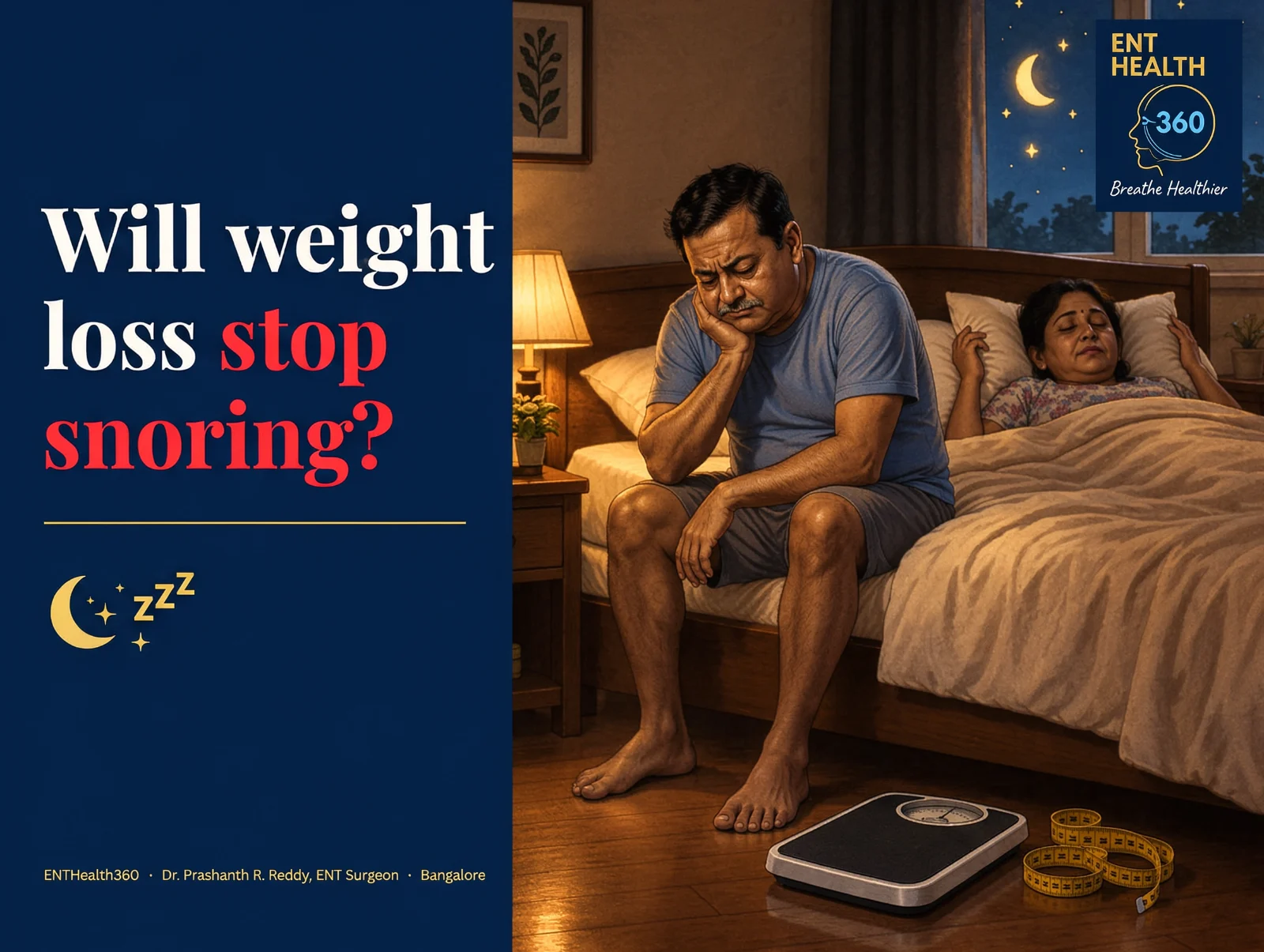
Short answer: Weight loss can reduce snoring and sleep apnea in many people who carry extra weight, because less fat around the neck and throat means a wider airway. Even around 10% weight loss may make a noticeable difference. It is not a cure for everyone, since nose, palate, tonsil and jaw problems can cause snoring at any weight.
Key takeaways
- Extra fat around the neck, tongue and throat walls narrows the airway.
- For people who are overweight, weight loss is one of the most useful long-term measures.
- Slim people can snore too, from nasal or anatomical causes.
- Loud snoring or daytime tiredness should be evaluated, not just managed with diet.
Top 3 things to know about weight and snoring
- Weight loss helps most when extra weight is the cause. If your snoring started or got louder as you gained weight, losing it is a good place to start.
- Slim people snore too. A blocked nose, large tonsils, a long soft palate or a smaller jaw can cause snoring at any weight.
- Loud snoring with pauses or daytime sleepiness needs an ENT evaluation. Diet alone is not enough if sleep apnea is possible.
Why does extra weight make snoring worse?
Extra weight can narrow the airway from the outside and the inside, which makes the throat more likely to vibrate or collapse during sleep.
Fat builds up around the neck, which presses on the airway when you lie down. It is also deposited in the tongue and the soft walls of the throat, which makes these tissues bulkier. Weight around the tummy can reduce lung volume when lying flat, which makes the airway floppier.
When you sleep and the throat muscles relax, this already-narrow space becomes even tighter. Air speeds up, tissues flutter and snoring follows. In some people, the airway closes enough to cause obstructive sleep apnea.
How do you know if weight is the main cause?
Weight is more likely to be a major factor if your snoring started or worsened as you gained weight.
Clues that weight is playing a big role:
- Snoring began or got louder after recent weight gain
- A larger collar size than before
- Snoring improves when you lose a few kilos
Clues that something else is involved:
- You are slim but still snore loudly
- Your nose feels blocked most of the time
- You have large tonsils or a smaller, set-back jaw
- Snoring started in childhood
Most people have more than one contributor, which is why a full airway check is helpful.
What can you do at home?
Steady, sustainable weight loss combined with good sleep habits works better than crash diets.
- Aim for gradual loss through balanced meals and regular activity.
- Include both aerobic exercise and strength training; exercise may improve sleep quality on its own.
- Eat dinner a few hours before bed, and limit late-night snacking.
- Avoid alcohol in the evening, which adds calories and relaxes the throat.
- Sleep on your side and keep the nose clear.
- Track progress by asking your partner, or recording your snoring once a week.
If you have diabetes, heart disease or other conditions, ask your doctor before starting a new diet or exercise plan.
How are breathing, sleep and energy connected here?
Weight, breathing and sleep influence each other in a loop.
A narrowed airway can break up sleep. Poor sleep affects hunger hormones, which may increase cravings for high-sugar foods. Tiredness makes it harder to exercise, which can lead to more weight gain and more snoring.
The loop can also run the other way. Many people report that once their night-time breathing improves, sleep feels deeper, energy is steadier and workouts feel more manageable. Good sleep also supports a healthy BMR, the energy your body burns at rest. For busy professionals in Bangalore juggling long commutes and late calls, this can make healthy routines easier to maintain.
How does nose breathing support energy and BMR?
Your basal metabolic rate (BMR) is the energy your body burns at rest to keep the heart beating, the brain working and cells repairing. Your cells make that energy using oxygen, so how well you breathe matters.
Nose breathing helps in two ways:
- Warm, moist, filtered air. The nose warms, humidifies and filters each breath before it reaches the lungs. Conditioned air is gentler on the airway lining, which matters in Bangalore's air-conditioned offices and traffic dust. Mouth breathing skips this step and can leave the throat and airways dry.
- Nitric oxide from the sinuses. The paranasal sinuses continuously make nitric oxide (NO), a natural gas. When you breathe in through your nose, small amounts of this NO travel to the lungs, where studies suggest it may help widen tiny blood vessels and improve oxygen uptake. Mouth breathing largely bypasses it.
Nose breathing does not "boost" your BMR. That is set mainly by muscle mass, age, body size and hormones such as thyroid. But comfortable nasal breathing by day, and undisturbed breathing at night, support efficient oxygen supply and deeper sleep, which your body needs to use energy well and recover.
A simple check: sit quietly and breathe through your nose with your mouth closed for two minutes. If that feels difficult, or one side is always blocked, it is worth having your nose examined.
When should you see an ENT?
See an ENT if snoring is loud, persistent or comes with other symptoms, even if you are working on your weight.
- Breathing pauses noticed by your partner
- Waking up gasping or choking
- Daytime sleepiness or poor concentration
- High blood pressure or type 2 diabetes along with snoring
- Snoring despite being slim, or a constantly blocked nose
Seek urgent medical care if you fall asleep while driving, or have chest pain or severe breathlessness at night.
How does an ENT evaluate and treat it?
An ENT looks for all the causes of airway narrowing, so treatment is not based on weight alone.
Evaluation includes a history, examination of the nose, throat and jaw, and often a nasal endoscopy. An ENT evaluation helps check for sleep apnea and its severity.
Treatment may include a weight management plan, often with a physician or dietitian, plus nasal treatment, positional therapy, a custom oral appliance or CPAP. Surgery may be considered for specific anatomical causes. If sleep apnea is moderate or severe, treating it alongside weight loss is usually advised. The right option depends on the cause.
Frequently asked questions
Does nose breathing give me more energy? It does not add energy by itself, but it delivers warm, humidified air and sinus nitric oxide to the lungs, which may help oxygen uptake. Together with better sleep, that supports the energy your body uses at rest (BMR) and during activity.
How much weight do I need to lose to stop snoring? It varies. Some people notice improvement with modest loss, while others need more, and some still snore at a healthy weight.
Can sleep apnea make it harder to lose weight? It may. Poor sleep affects appetite hormones and energy levels, which can make weight loss harder.
Should I start CPAP or lose weight first? If you have moderate or severe sleep apnea, doctors often suggest treating it now rather than waiting, while working on weight at the same time.
See Dr. Prashanth R. Reddy in Bengaluru
Video or phone consultations are available if you live outside Bengaluru.
Call +91 821 788 4802 or +91 99026 05737 · Book online: enthealth360.com/book-appointment
References
- Lundberg JO, Farkas-Szallasi T, Weitzberg E, et al. High nitric oxide production in human paranasal sinuses. Nature Medicine. 1995;1(4):370-373.
- Lundberg JO, Settergren G, Gelinder S, et al. Inhalation of nasally derived nitric oxide modulates pulmonary function in humans. Acta Physiologica Scandinavica. 1996;158(4):343-347.
- Keck T, Leiacker R, Heinrich A, Kühnemann S, Rettinger G. Humidity and temperature profile in the nasal cavity. Rhinology. 2000;38(4):167-171.
About the author
Dr. Prashanth R Reddy is an ENT surgeon at ENTHealth360, Bangalore (MS ENT; MBA, IIM Bangalore; Seoul Rhinoplasty Fellowship), seeing patients at Sakra World Hospital, Marathahalli and in Koramangala. His practice focuses on how breathing affects sleep, energy and everyday performance.
Related reading: Does sleeping position really reduce snoring? · Can sleep apnea cause morning headaches? · FAQs about snoring surgery
Medically reviewed by Dr. Prashanth R. Reddy, ENT Surgeon. Last reviewed: 21 November 2026. For educational purposes only. Not a substitute for medical advice. Please consult a qualified ENT specialist.
General patient education. An individual consultation is needed to assess your symptoms and treatment options.