👃 Nose always blocked? Take the 30-second check
Your nose is the front door for air. If the door is stuck, your whole body feels it, especially your sleep.
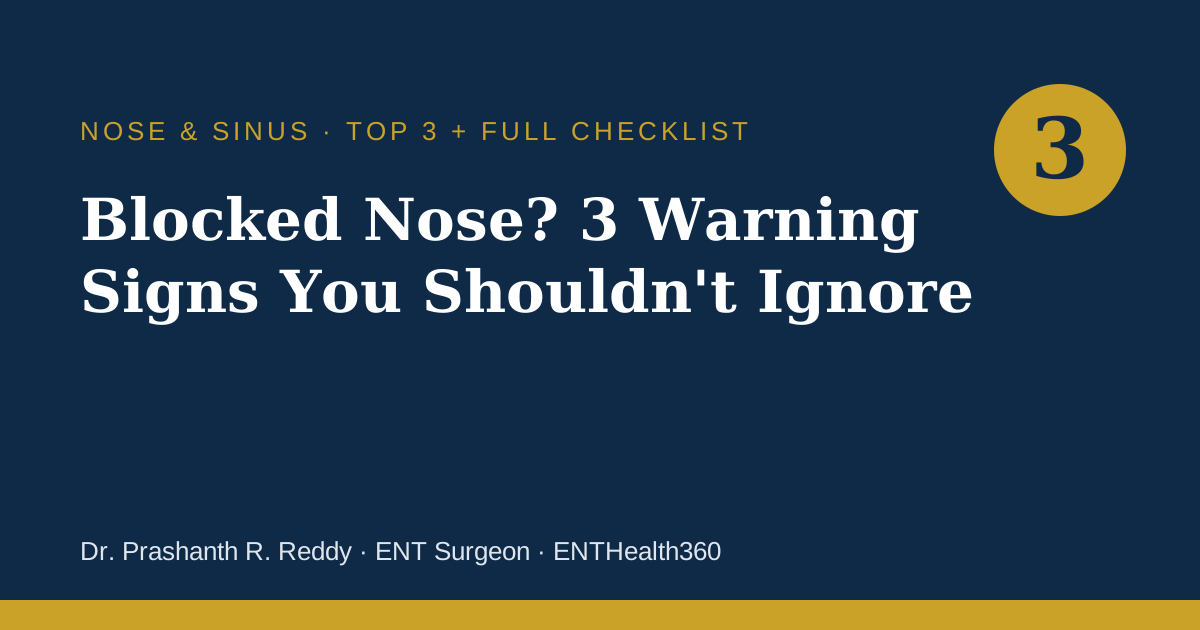
🚨 3 warning signs you shouldn't ignore
- 🩸 One side blocked with bleeding. Get it checked early to rule out a growth.
- 👃 Losing smell or taste. Can mean polyps or heavy swelling.
- 💨 Nose spray for more than 5 days. Overuse makes the blockage worse (rebound blockage).
Now the full 10-point check. Tick what sounds like you:
- ➡️ One side always blocked
- 🔄 Block keeps switching sides
- 🌙 Worse at night or lying down
- 👄 Mouth open while sleeping, dry mouth
- 😴 Snoring
- 🤕 Old nose injury or bent nose
- 🟢 Thick yellow or green mucus
- 👃 Can't smell or taste well
- 💨 Using nose spray for 5+ days
- 🩸 One side blocked with bleeding
Ticked 3 or more, or bleeding on one side? Time to see an ENT.
✅ Want a quick personal check? Take the blocked nose self-check. Tick your answers and keep them for your ENT visit.
📲 Know someone who can't sleep without nasal spray? Send them this.
The full guide
Short answer: If your nose is often blocked, check whether one or both sides are affected, whether it switches sides, if it is worse at night or lying down, mouth breathing, snoring, a deviated septum or old injury, coloured discharge, reduced smell, nasal spray use beyond 5 days, and one-sided blockage with bleeding, which should be checked early.
Medically reviewed by Dr. Prashanth R. Reddy, ENT Surgeon (MS ENT) · Last reviewed: 1 November 2026
The 10-point checklist
- One side or both sides blocked. A fixed one-sided block suggests a structural cause like a deviated septum; both sides suggest swelling or allergy.
- Blockage that keeps switching sides. The nose naturally alternates, but strong switching usually means swollen turbinates.
- Worse at night or when lying down. Lying flat increases blood flow to the nasal lining, so swelling and blockage worsen at night.
- Mouth breathing or a dry mouth on waking. A sign that you are not breathing well through your nose during sleep.
- Snoring. Nasal blockage drives mouth breathing and makes snoring and sleep apnea worse.
- Deviated septum or an old nose injury. A bent septum can narrow one side permanently and does not settle with sprays alone.
- Thick yellow or green discharge. Suggests sinus infection, especially if it lasts beyond 10 days or comes with facial pain.
- Reduced smell or taste. Can mean significant swelling or nasal polyps.
- Using nasal spray for more than 5 days. Decongestant sprays cause rebound blockage when overused (rhinitis medicamentosa).
- One-sided blockage with bleeding. Persistent one-sided symptoms with bleeding should be examined early to rule out a growth.
Next step: For any of these, see an ENT specialist for an evaluation.
Checklist at a glance
| # | What to check | Why it matters |
|---|---|---|
| 1 | One side or both sides blocked | A fixed one-sided block suggests a structural cause like a deviated septum; both sides suggest swelling or allergy. |
| 2 | Blockage that keeps switching sides | The nose naturally alternates, but strong switching usually means swollen turbinates. |
| 3 | Worse at night or when lying down | Lying flat increases blood flow to the nasal lining, so swelling and blockage worsen at night. |
| 4 | Mouth breathing or a dry mouth on waking | A sign that you are not breathing well through your nose during sleep. |
| 5 | Snoring | Nasal blockage drives mouth breathing and makes snoring and sleep apnea worse. |
| 6 | Deviated septum or an old nose injury | A bent septum can narrow one side permanently and does not settle with sprays alone. |
| 7 | Thick yellow or green discharge | Suggests sinus infection, especially if it lasts beyond 10 days or comes with facial pain. |
| 8 | Reduced smell or taste | Can mean significant swelling or nasal polyps. |
| 9 | Using nasal spray for more than 5 days | Decongestant sprays cause rebound blockage when overused (rhinitis medicamentosa). |
| 10 | One-sided blockage with bleeding | Persistent one-sided symptoms with bleeding should be examined early to rule out a growth. |
When should you see an ENT?
See an ENT if blockage lasts more than a few weeks, affects sleep, needs sprays every day, or comes with reduced smell, one-sided bleeding or facial pain. A nasal endoscopy and, if needed, a CT scan show the cause, such as a deviated septum, enlarged turbinates, polyps or sinusitis.
Frequently asked questions
Why is only one side of my nose blocked?
A deviated septum, a swollen turbinate or a polyp on one side are common causes. The nasal cycle also makes sides alternate. Persistent one-sided blockage should be examined.
Why does my nose block when I lie down?
Lying flat increases blood flow to the nasal lining, which swells the turbinates. Raising the head end of the bed and treating allergy can help.
Is it safe to use nasal decongestant spray every day?
No. Use them for no more than 3 to 5 days. Long-term use causes rebound blockage. Ask your doctor about saline or steroid sprays instead.
Can a deviated septum be fixed without surgery?
Medicines can ease the swelling around it but cannot straighten the septum. If blockage is significant, septoplasty is an option an ENT may discuss.
Can a blocked nose affect sleep?
Yes. It causes mouth breathing, snoring and broken sleep, and can worsen sleep apnea.
References
- Rosenfeld RM, Piccirillo JF, Chandrasekhar SS, et al. Clinical practice guideline (update): adult sinusitis. Otolaryngology–Head and Neck Surgery. 2015;152(2 Suppl):S1-S39.
- Ramey JT, Bailen E, Lockey RF. Rhinitis medicamentosa. Journal of Investigational Allergology and Clinical Immunology. 2006;16(3):148-155.
- Ishii L, Roxbury C, Godoy A, Ishman S, Ishii M. Does nasal surgery improve OSA in patients with nasal obstruction and OSA? A meta-analysis. Otolaryngology–Head and Neck Surgery. 2015;153(3):326-333.
Related reading: All symptom checklists · Why does my nose block when I lie down? · 10 things to check if you sneeze often · 10 things every snorer should check
About the author
Dr. Prashanth R. Reddy is a Senior Consultant ENT Surgeon in Bengaluru (MS ENT; Fellowship in Rhinoplasty, Seoul; MBA, IIM Bangalore) with decades of practice. He sees patients at Sakra World Hospital, Marathahalli and at the ENTHealth360 clinic in Koramangala. His practice focuses on nasal causes of headache, snoring and sleep-disordered breathing.
For educational purposes only. Not a substitute for medical advice. Please consult a qualified ENT specialist.
General patient education. An individual consultation is needed to assess your symptoms and treatment options.