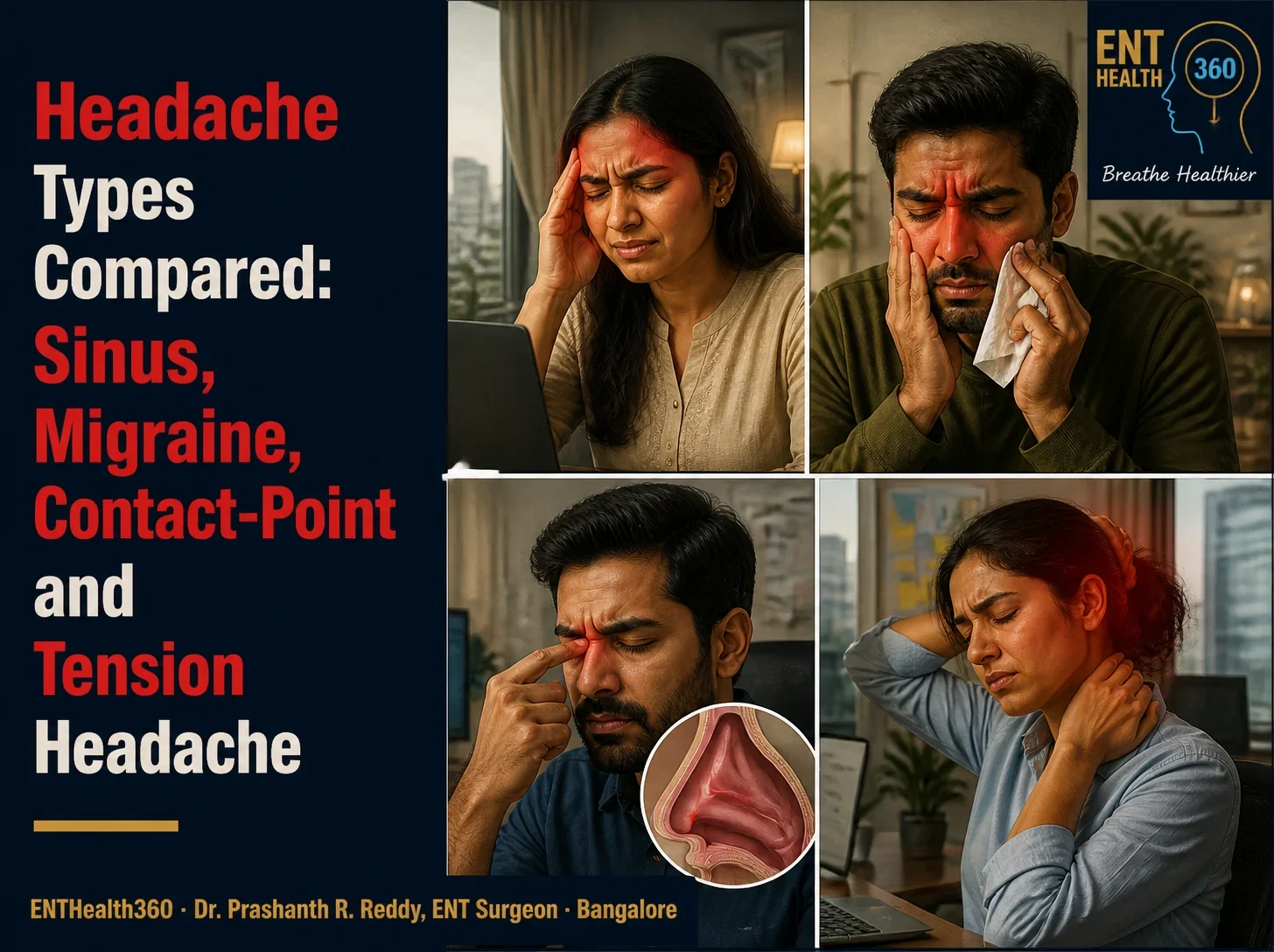
Short answer: Sinus headache, migraine, nasal contact-point headache and tension-type headache can all cause pain around the forehead and eyes, but they differ in pattern. Migraine is throbbing and comes in attacks with nausea or light sensitivity. Sinus headache comes with thick discharge and a blocked nose after a cold. Contact-point headache sits on one side with a nose that stays blocked on that side. Tension headache feels like a tight band on both sides.
Medically reviewed by Dr. Prashanth R. Reddy, ENT Surgeon (MS ENT) · Last reviewed: 28 October 2026
Key takeaways
- The single most useful clue is what comes with the pain: nausea and light sensitivity, thick nasal discharge, one-sided nasal blockage, or neck and shoulder tightness.
- Most headaches people call "sinus" turn out to be migraine, and migraine itself can cause a stuffy nose and watery eyes.
- A contact point inside the nose is a less common but real cause of one-sided headache, recognised in the international headache classification.
- Each type is treated differently, so the label matters. An ENT examination of the nose helps separate the nasal causes from the rest.
Sinus, migraine, contact-point and tension headache: side by side
Use this table as a guide to patterns, not as a diagnosis. Many people have more than one type of headache.
| Feature | Migraine | Sinus headache | Nasal contact-point headache | Tension-type headache |
|---|---|---|---|---|
| Where it hurts | Often one side of the head, temple or behind the eye; can be both sides | Cheeks, forehead, between or behind the eyes; often both sides | One side: around or behind the eye, inner corner of the eye, forehead or temple | Both sides, like a band around the forehead, head or back of the head |
| What it feels like | Throbbing or pulsing, moderate to severe | Pressure or fullness, heavier when bending forward | Dull, deep ache or pressure; sometimes sharp | Pressing or tightening, mild to moderate |
| How long it lasts | Attacks of 4 hours to 3 days, then pain-free spells | Days, rising and falling with the cold or infection | Often recurrent or long-standing, worse when the nose is congested | 30 minutes to several days |
| Nose symptoms | Possible stuffy or runny nose and watery eye, only during the attack | Thick yellow or green discharge, blocked nose, reduced smell | Nose blocked on the same side as the pain; often no discharge | None |
| Other symptoms | Nausea, light and sound sensitivity, worse with activity; sometimes visual aura | Follows a cold; sometimes fever or upper toothache | Usually no nausea; may worsen lying down, in AC or with a cold | Tender neck and shoulder muscles; no nausea; activity does not worsen it |
| Common triggers | Missed meals, poor sleep, stress, bright screens, periods, weather change | Viral cold, allergy flare, blocked sinus drainage | Anything that swells the nasal lining: colds, allergy, AC, lying down | Stress, long screen hours, poor posture, poor sleep |
| Usual medicines | Respond to migraine-specific treatment | Saline, steroid sprays; antibiotics only if bacterial | Often respond poorly to usual headache medicines | Often ease with rest and occasional simple painkillers |
| Key test | Clinical history and headache diary | Nasal endoscopy; CT scan if chronic | Nasal endoscopy, CT scan, sometimes a local anaesthetic test | Clinical history and examination |
| Doctor to start with | Physician or neurologist | ENT or family doctor | ENT surgeon | Family doctor or physician |
Why do these headaches get mixed up?
All four can cause pain in the same areas: the forehead, around the eyes and the temples. The nerve network that carries head pain (the trigeminal nerve) also supplies the nose and sinuses. During a migraine, this network can make the nose stuffy and the eye watery, so many people reasonably assume the problem is "sinus".
In one large study of nearly 3,000 people with "sinus headache", close to nine in ten met the criteria for migraine. The reverse also happens: some people with a genuine nasal cause, such as a contact point, are treated for migraine for years without anyone examining the nose.
What is a nasal contact-point headache?
Inside the nose, the septum (the central wall) can bend or carry a bony spur. When that spur presses against the side wall of the nose, usually a turbinate, the contact can irritate nerve endings and send pain to the forehead, eye or temple. This is called a rhinogenic or contact-point headache. The international headache classification recognises headache caused by disorders of the nasal lining, turbinates or septum.
It is diagnosed only when nasal endoscopy and a CT scan show the contact, other headache causes have been considered, and the pain matches the side of the contact. In selected people whose pain continues despite medicines, endoscopic surgery done through the nostrils to remove the contact may be considered. Read more in What is a contact point headache?.
Quick clues: which type is more likely?
- More likely migraine: throbbing pain in attacks, nausea, wanting a dark quiet room, and clear triggers such as missed meals or poor sleep.
- More likely sinus: pain began with a cold, with thick discoloured discharge and reduced smell.
- Consider a nasal contact point: pain repeatedly on the same side, a nose that is always blocked on that side, and little relief from usual headache medicines.
- More likely tension-type: a tight band on both sides of the head, linked to stress, screens or posture, with sore neck muscles.
- Watch for medication-overuse headache: taking painkillers on many days of the month can make any of these more frequent. If you need them more than two or three days a week, see a doctor.
What can you do before your appointment?
- Keep a two-week headache diary. Note the time, which side hurts, how long it lasts, possible triggers, and any nasal symptoms.
- Note your painkiller use, including how many days a week you take something.
- Try a saline rinse once or twice a day if your nose feels blocked, using boiled-and-cooled, distilled or sterile water.
- Protect your sleep and meals. Regular sleep and regular meals reduce headaches for many people.
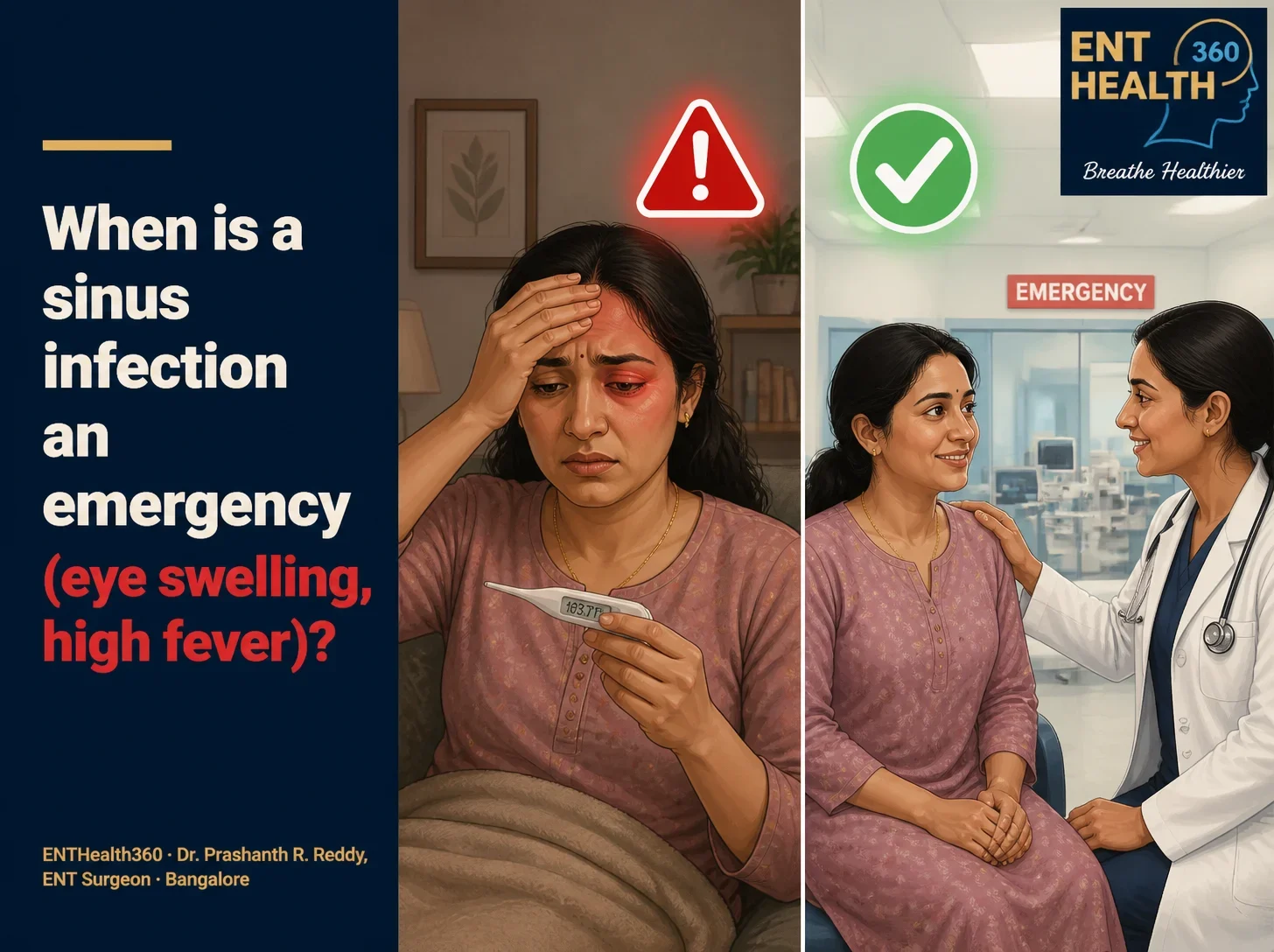
When should you seek urgent care?
Go to an emergency department the same day for a sudden, severe "worst-ever" headache; headache with fever, a stiff neck or confusion; swelling or redness around the eye, double vision or reduced vision; weakness, numbness or difficulty speaking; or a headache after a head injury.
How an ENT helps sort it out
An ENT's role is to find out whether the nose is part of the picture. After a detailed history and a look at your diary, a nasal endoscopy (a thin camera passed gently into the nose after a numbing spray) shows the septum, turbinates, sinus openings and any contact points. A CT scan is advised when chronic sinusitis or a contact point is suspected. If the nose is normal, the next step is usually a physician or neurologist. The right treatment depends on the cause.
Frequently asked questions
Can I have more than one type of headache?
Yes. Migraine and tension-type headache often occur in the same person, and some people also have a nasal cause. This is why a diary and an examination help.
Does pain when I bend forward mean it is sinus?
It can suggest sinus pressure, but migraine pain also worsens with movement. Look at the whole pattern, including nasal symptoms.
Can a deviated septum cause headaches?
Sometimes, when a spur presses on the side wall of the nose. Most people with a bent septum have no headache, so the link is confirmed with endoscopy and a CT scan. See Can a deviated septum cause headaches?.
Will antibiotics help my headache?
Only if there is a bacterial sinus infection. They do not help migraine, tension-type or contact-point headache.
Which doctor should I see first?
If your headaches come with nasal symptoms, or sit on one side with a blocked nose on that side, start with an ENT. If they clearly fit migraine with no nasal signs, start with a physician or neurologist.
References
- Headache Classification Committee of the International Headache Society. The International Classification of Headache Disorders, 3rd edition. Cephalalgia. 2018;38(1):1-211.
- Schreiber CP, Hutchinson S, Webster CJ, et al. Prevalence of migraine in patients with a history of self-reported or physician-diagnosed "sinus" headache. Archives of Internal Medicine. 2004;164(16):1769-1772.
- Harrison L, Jones NS. Intranasal contact points as a cause of facial pain or headache: a systematic review. Clinical Otolaryngology. 2013;38(1):8-22.
- Fokkens WJ, Lund VJ, Hopkins C, et al. European Position Paper on Rhinosinusitis and Nasal Polyps 2020. Rhinology. 2020;58(Suppl S29):1-464.
Related reading: Sinus headache or migraine: how can I tell? · Nasal headache and endoscopic nerve decompression · Can sinusitis cause headache every day?
About the author
Dr. Prashanth R. Reddy is a Senior Consultant ENT Surgeon in Bengaluru (MS ENT; Fellowship in Rhinoplasty, Seoul; MBA, IIM Bangalore) with over 20 years of practice. He sees patients at Sakra World Hospital, Marathahalli and at the ENTHealth360 clinic in Koramangala. His practice focuses on nasal causes of headache, snoring and sleep-disordered breathing.
For educational purposes only. Not a substitute for medical advice. Please consult a qualified ENT specialist.
General patient education. An individual consultation is needed to assess your symptoms and treatment options.