😴 Snoring? Take the 30-second check
Snoring is not just noise. Sometimes it is your body saying "I can't breathe properly".
🚨 3 signs it could be sleep apnea
- 🛑 You stop breathing at night. Pauses and gasps are the clearest sign of sleep apnea.
- 🚗 Sleepy while driving. Drowsy driving is dangerous for you and everyone on the road.
- 🩸 High BP with snoring. Snoring with hard-to-control BP is a common hidden sign of sleep apnea.
Now the full 10-point check. Tick what sounds like you:
- 🛑 You stop breathing at night (ask your partner!)
- 🥱 Sleepy at your desk or behind the wheel
- 🤕 Wake up with a headache
- 🩸 High BP
- 👃 Nose always blocked
- 👅 Big tonsils or a long palate
- 👔 Collar size over 17 inches
- ⚖️ Extra weight around the tummy
- 🍬 High sugar
- 🚽 Wake up to pee at night
Ticked 3 or more? Time to see an ENT.
✅ Want a quick personal check? Find out where your snoring comes from: nose, palate or throat. Tick your answers and keep them for your ENT visit.
📲 Sleep next to a snorer? Send them this. (They usually listen to you!)
The full guide
Short answer: If you snore, check for breathing pauses or gasping, daytime sleepiness, morning headaches, high blood pressure, a blocked nose or deviated septum, large tonsils or a long soft palate, neck size, weight, blood sugar and waking to pass urine. Several of these together suggest sleep apnea, and an ENT evaluation shows where the airway narrows.
Medically reviewed by Dr. Prashanth R. Reddy, ENT Surgeon (MS ENT) · Last reviewed: 1 November 2026
The 10-point checklist
- Breathing pauses or gasping at night. Ask your partner: pauses followed by a gasp or snort are the clearest sign of obstructive sleep apnea.
- Daytime sleepiness. Dozing off while reading, in meetings or while driving means your sleep is broken, even if you spend enough hours in bed.
- Morning headaches. Low oxygen and broken sleep at night can leave a dull headache on waking.
- Blood pressure. Sleep apnea is a common hidden cause of high or hard-to-control blood pressure.
- Blocked nose or deviated septum. A blocked nose forces mouth breathing, which makes the throat collapse more easily.
- Enlarged tonsils, adenoids or a long soft palate. These narrow the airway at the back of the mouth and are a frequent source of snoring.
- Neck size. A collar size over 17 inches (43 cm) is a recognised risk factor for sleep apnea.
- Weight and waist size. Extra weight around the neck and belly narrows the airway; even modest weight loss can reduce snoring.
- Blood sugar (HbA1c). Sleep apnea is linked with insulin resistance and type 2 diabetes.
- Waking at night to pass urine. Repeated night-time urination can be a sign of sleep apnea, not only a prostate or bladder issue.
Next step: Check yourself with the STOP-BANG questionnaire. If you score 3 or more, see an ENT specialist for an evaluation.
Checklist at a glance
| # | What to check | Why it matters |
|---|---|---|
| 1 | Breathing pauses or gasping at night | Ask your partner: pauses followed by a gasp or snort are the clearest sign of obstructive sleep apnea. |
| 2 | Daytime sleepiness | Dozing off while reading, in meetings or while driving means your sleep is broken, even if you spend enough hours in bed. |
| 3 | Morning headaches | Low oxygen and broken sleep at night can leave a dull headache on waking. |
| 4 | Blood pressure | Sleep apnea is a common hidden cause of high or hard-to-control blood pressure. |
| 5 | Blocked nose or deviated septum | A blocked nose forces mouth breathing, which makes the throat collapse more easily. |
| 6 | Enlarged tonsils, adenoids or a long soft palate | These narrow the airway at the back of the mouth and are a frequent source of snoring. |
| 7 | Neck size | A collar size over 17 inches (43 cm) is a recognised risk factor for sleep apnea. |
| 8 | Weight and waist size | Extra weight around the neck and belly narrows the airway; even modest weight loss can reduce snoring. |
| 9 | Blood sugar (HbA1c) | Sleep apnea is linked with insulin resistance and type 2 diabetes. |
| 10 | Waking at night to pass urine | Repeated night-time urination can be a sign of sleep apnea, not only a prostate or bladder issue. |
When should you see an ENT?
See an ENT if your partner notices pauses or gasps, you feel sleepy by day, or you have high blood pressure along with snoring. The ENT evaluation, with nasal endoscopy and, where needed, a CT scan, shows where and why your airway narrows: nose, palate, tonsils or tongue base.
Frequently asked questions
Is snoring always a sign of sleep apnea?
No. Simple snoring is noise without breathing pauses. Snoring with pauses, gasping or daytime sleepiness is more likely to be sleep apnea and should be evaluated.
What is the STOP-BANG questionnaire?
A quick 8-question screening tool: Snoring, Tiredness, Observed pauses, high blood Pressure, BMI over 35, Age over 50, Neck size over 40 cm and male Gender. A score of 3 or more means higher risk.
Can a blocked nose cause snoring?
Yes. A deviated septum, swollen turbinates or allergy can force mouth breathing at night, which makes snoring and sleep apnea worse.
What does an ENT evaluation for snoring include?
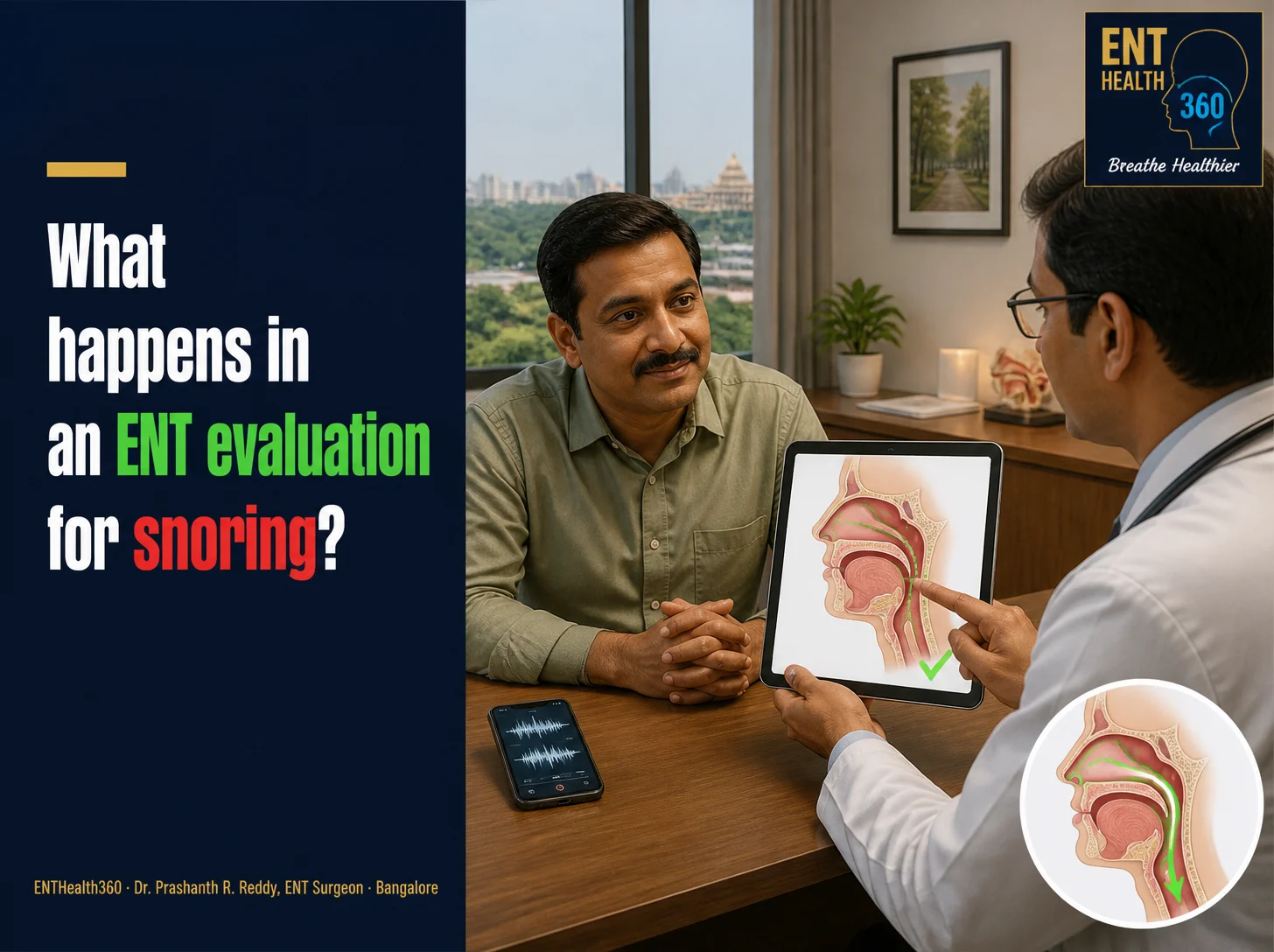
A sleep history, an examination of the nose, mouth and throat, and usually a nasal endoscopy. A CT scan may be advised. Together they show where the airway narrows and guide treatment.
Can snoring be treated without surgery?
Often, yes. Weight loss, side-sleeping, avoiding alcohol at night, treating nasal blockage, mouth guards and CPAP all help selected people. Surgery is considered when a specific narrowing is found.
References
- Chung F, Abdullah HR, Liao P. STOP-Bang Questionnaire: a practical approach to screen for obstructive sleep apnea. Chest. 2016;149(3):631-638.
- Benjafield AV, Ayas NT, Eastwood PR, et al. Estimation of the global prevalence and burden of obstructive sleep apnoea. Lancet Respiratory Medicine. 2019;7(8):687-698.
- Ishii L, Roxbury C, Godoy A, Ishman S, Ishii M. Does nasal surgery improve OSA in patients with nasal obstruction and OSA? A meta-analysis. Otolaryngology–Head and Neck Surgery. 2015;153(3):326-333.
Related reading: All symptom checklists · Snoring treatment options compared · CPAP vs snoring surgery · Is your nose the real reason behind your snoring?
About the author
Dr. Prashanth R. Reddy is a Senior Consultant ENT Surgeon in Bengaluru (MS ENT; Fellowship in Rhinoplasty, Seoul; MBA, IIM Bangalore) with decades of practice. He sees patients at Sakra World Hospital, Marathahalli and at the ENTHealth360 clinic in Koramangala. His practice focuses on nasal causes of headache, snoring and sleep-disordered breathing.
For educational purposes only. Not a substitute for medical advice. Please consult a qualified ENT specialist.
General patient education. An individual consultation is needed to assess your symptoms and treatment options.