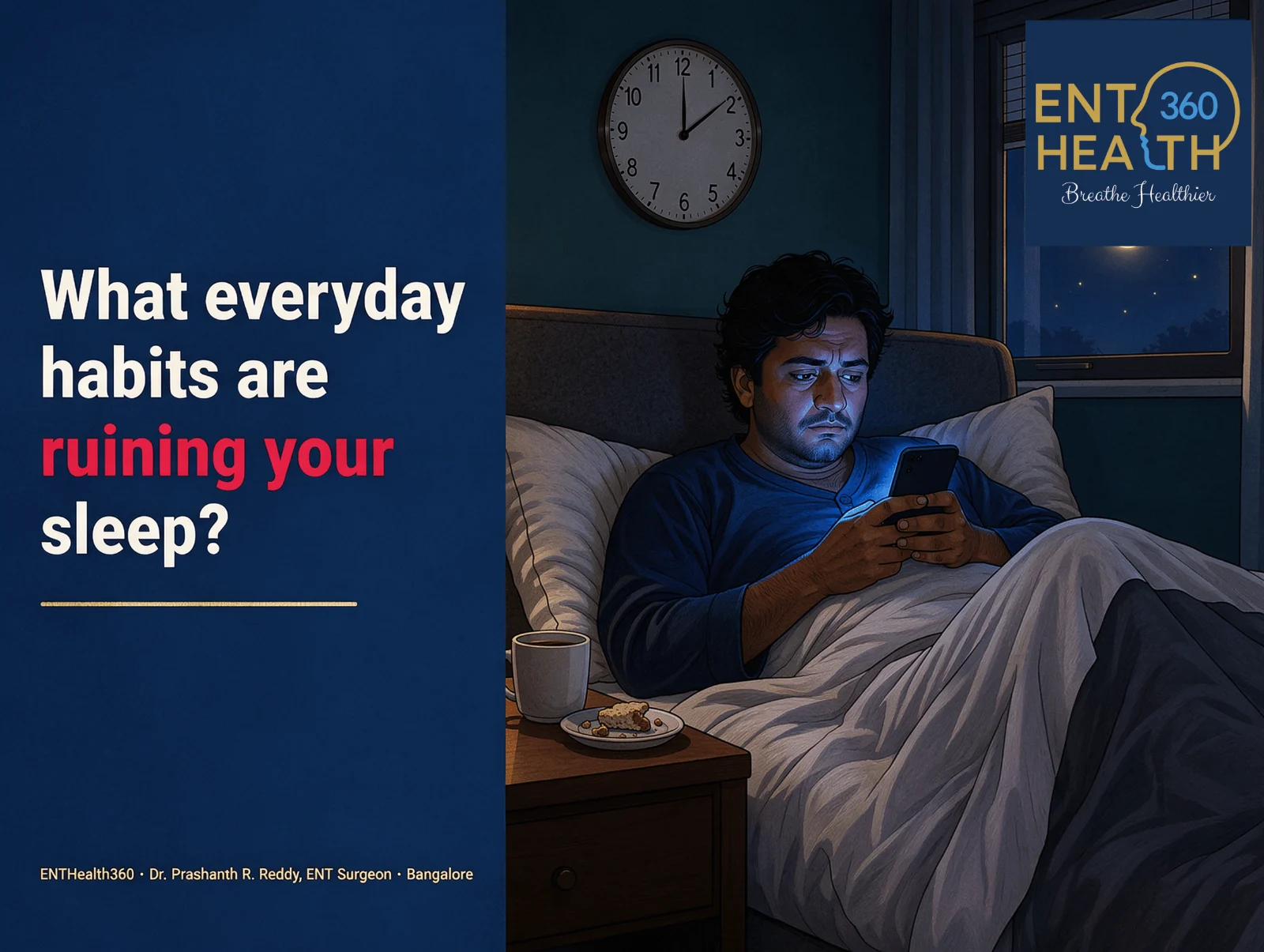
Short answer: The most overlooked sleep-wreckers are mouth breathing from a blocked nose, late heavy dinners, an alcohol "nightcap", cold dry AC air and an irregular wake-up time. Many people blame stress when the real problem is how they breathe at night. If you snore, wake with a dry mouth or still feel tired after 7 to 8 hours, see an ENT specialist for an evaluation.
Top 3 habits most people miss
- 👃 Mouth breathing at night: a blocked nose pushes you to breathe through your mouth. Your throat dries, snoring starts and sleep becomes light and broken.
- 🍛 A late heavy dinner: lying down within 2 to 3 hours of a big meal lets acid creep up. Night cough, throat clearing and the 3 a.m. wake-up often follow.
- 🍷 The nightcap: alcohol helps you fall asleep, but it relaxes the throat muscles, makes snoring and sleep apnea worse, and breaks up the second half of the night.
The full list
- Mouth breathing from a blocked nose
- A heavy meal within 2 to 3 hours of bed
- Alcohol at night
- Cold, dry AC air, which dries and swells the nose
- Caffeine after 2 p.m. (it stays in your system for hours)
- Screens in bed, which delay sleep
- Sleeping on your back if you snore
- A different wake-up time on weekends ("social jet lag")
- Long or late afternoon naps
- Living with a blocked nose for months
Quick check: is your breathing the hidden problem?
- I snore
- I wake with a dry mouth
- I get morning headaches
- I feel tired after 7 to 8 hours of sleep
- My nose blocks at night
If two or more apply, your breathing may be the issue, not your habits. See an ENT specialist for an evaluation of your nose and airway.
A simple bedtime routine that helps
- Rinse your nose with saline before bed.
- Raise your head slightly on a pillow.
- Finish dinner 2 to 3 hours before bed.
- Keep the AC at a comfortable temperature, or add a humidifier.
- Wake up at the same time every day, weekends included.
When to see an ENT specialist
See an ENT specialist if you have loud snoring, pauses or gasping in sleep, morning headaches, a blocked nose most nights, or tiredness that does not improve with better habits. A nasal endoscopy and, when needed, a CT scan show whether the nose, tonsils, palate or tongue base is narrowing your airway.
FAQs
Can a blocked nose really affect sleep quality?
Yes. Mouth breathing makes sleep lighter and more broken, and it makes snoring worse.
Is alcohol good for sleep?
It can help you fall asleep, but it disturbs deeper sleep and relaxes the throat, so snoring and breathing pauses can increase.
How long before bed should I eat?
Ideally 2 to 3 hours, especially if you have reflux.
When should I worry about tiredness?
If you feel tired most days despite enough hours in bed, or you snore loudly or gasp at night, see an ENT specialist for an evaluation.
Related reading
- Why does my nose block when I lie down?
- Is snoring a sign of sleep apnea?
- How to stop snoring
- Snoring and sleep apnea care in Bengaluru
About the author
Dr. Prashanth R. Reddy is a Senior Consultant ENT Surgeon in Bengaluru with decades of experience. MS (ENT), Fellowship in Rhinoplasty (Seoul), MBA (IIM Bangalore). Founder, ENTHealth360. Consults at Sakra World Hospital, Marathahalli, and in Koramangala.
General patient education. An individual consultation is needed to assess your symptoms and treatment options.