Short answer: Obstructive sleep apnea (OSA) is a condition in which the throat repeatedly narrows or collapses during sleep, causing pauses in breathing, drops in oxygen and frequent brief awakenings. It leads to unrefreshing sleep and daytime tiredness, is linked with heart and metabolic problems, and is very treatable once diagnosed with an ENT evaluation.
Key takeaways
- OSA means repeated blockage of the upper airway during sleep.
- It is common but often goes undiagnosed for years.
- Untreated OSA is linked with high blood pressure, heart disease, stroke, diabetes and accidents.
- Treatments such as CPAP, oral devices and targeted surgery can help many people.
What happens in the body during obstructive sleep apnea?
In OSA, the soft tissues of the throat collapse inward during sleep and block airflow, even though the chest keeps trying to breathe.
When we sleep, the muscles that keep the throat open relax. In people with OSA, the airway is narrow or floppy enough to close partly (a hypopnoea) or fully (an apnoea) for ten seconds or more. Oxygen levels fall. The brain senses this and triggers a brief arousal, which tightens the muscles and reopens the airway, often with a snort or gasp.
This cycle can repeat many times an hour. Doctors measure it as the apnoea–hypopnoea index (AHI), the number of events per hour of sleep, which grades OSA as mild, moderate or severe.
What are the symptoms and risk factors of OSA?
Symptoms show up both at night and during the day, and risk factors are a mix of body shape, anatomy and habits.
Common symptoms
- Loud, regular snoring with pauses, choking or gasping
- Waking unrefreshed, with morning headaches or a dry mouth
- Daytime sleepiness, poor concentration and irritability
- Waking at night to pass urine
Common risk factors
- Excess weight and a larger neck
- Nasal obstruction from allergy, a deviated septum or swollen turbinates
- Enlarged tonsils or a small, set-back jaw
- Increasing age, male sex and menopause
- Alcohol, sedatives and smoking
Children can have OSA too, most often due to large tonsils and adenoids.
What can you do at home to lower your risk?
Lifestyle steps can reduce the severity of OSA in some people, but they should go alongside medical evaluation.
- Work towards a healthy weight with regular exercise.
- Avoid alcohol and sedatives in the evening.
- Sleep on your side if symptoms are worse on your back.
- Treat a blocked nose; saline rinses can help during Bangalore's dusty, pollen-heavy months.
- Keep regular sleep timings and stop smoking.
If you are very sleepy during the day, avoid driving until you have been assessed.
How are breathing, sleep and energy connected here?
OSA is a clear example of how night-time breathing shapes daytime energy.
Each breathing pause triggers a stress response and a small awakening. Deep sleep and dream sleep, which the brain and body need to recover, are repeatedly cut short. The result can be low energy, slower thinking and mood swings, even after a long night in bed.
Broken sleep also affects hormones that control appetite and blood sugar. When OSA is treated, many people report clearer mornings, better focus and more energy for work, exercise and family. Some also find weight and blood pressure easier to manage, though results vary.
How does nose breathing support energy and BMR?
Your basal metabolic rate (BMR) is the energy your body burns at rest to keep the heart beating, the brain working and cells repairing. Your cells make that energy using oxygen, so how well you breathe matters.
Nose breathing helps in two ways:
- Warm, moist, filtered air. The nose warms, humidifies and filters each breath before it reaches the lungs. Conditioned air is gentler on the airway lining, which matters in Bangalore's air-conditioned offices and traffic dust. Mouth breathing skips this step and can leave the throat and airways dry.
- Nitric oxide from the sinuses. The paranasal sinuses continuously make nitric oxide (NO), a natural gas. When you breathe in through your nose, small amounts of this NO travel to the lungs, where studies suggest it may help widen tiny blood vessels and improve oxygen uptake. Mouth breathing largely bypasses it.
Nose breathing does not "boost" your BMR. That is set mainly by muscle mass, age, body size and hormones such as thyroid. But comfortable nasal breathing by day, and undisturbed breathing at night, support efficient oxygen supply and deeper sleep, which your body needs to use energy well and recover.
A simple check: sit quietly and breathe through your nose with your mouth closed for two minutes. If that feels difficult, or one side is always blocked, it is worth having your nose examined.
When should you see an ENT?
See an ENT for an evaluation if you have possible signs of OSA, especially with other health conditions.
- A partner notices you stop breathing or gasp in sleep
- Loud snoring most nights
- Daytime sleepiness despite enough sleep
- High blood pressure, diabetes, heart rhythm problems or a past stroke
- A child with loud snoring, mouth breathing or restless sleep
Seek urgent medical care if you fall asleep while driving, or have chest pain, severe breathlessness or confusion at night.
How does an ENT evaluate and treat it?
Diagnosis is confirmed with an ENT evaluation, and treatment is chosen based on severity and where the airway narrows.
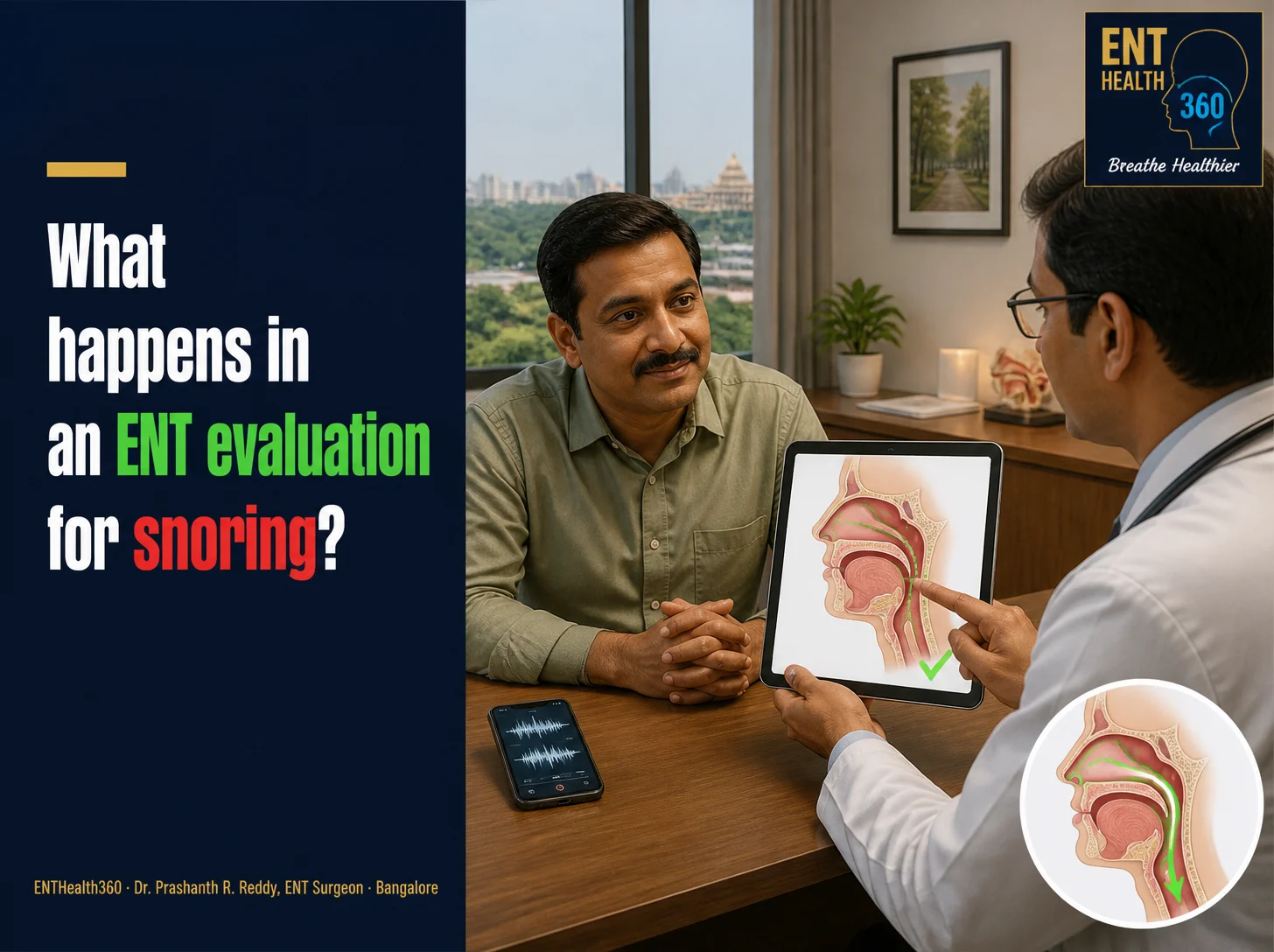
An ENT examines the nose, palate, tonsils, tongue base and jaw. Nasal endoscopy shows the inside of the nose and upper throat. An ENT evaluation checks where the airway narrows and guides treatment.
Treatment options may include:
- CPAP, a machine that keeps the airway open with gentle air pressure
- A custom oral appliance for mild to moderate OSA
- Weight management and positional therapy
- Treating nasal blockage to improve breathing and CPAP comfort
- Surgery on the nose, palate, tonsils or jaw for selected people
The right option depends on the cause, severity and your preferences.
Frequently asked questions
Does nose breathing give me more energy? It does not add energy by itself, but it delivers warm, humidified air and sinus nitric oxide to the lungs, which may help oxygen uptake. Together with better sleep, that supports the energy your body uses at rest (BMR) and during activity.
Is obstructive sleep apnea the same as central sleep apnea? No. In obstructive apnea, the airway is blocked. In central apnea, the brain does not send the signal to breathe. They are treated differently.
Can OSA go away? Some people improve significantly with weight loss or after treatment of a specific cause, such as large tonsils. Others need ongoing treatment.
Is OSA dangerous if untreated? It is linked with high blood pressure, heart disease, stroke, diabetes and accidents. Getting diagnosed and treated may lower these risks.
References
- Lundberg JO, Farkas-Szallasi T, Weitzberg E, et al. High nitric oxide production in human paranasal sinuses. Nature Medicine. 1995;1(4):370-373.
- Lundberg JO, Settergren G, Gelinder S, et al. Inhalation of nasally derived nitric oxide modulates pulmonary function in humans. Acta Physiologica Scandinavica. 1996;158(4):343-347.
- Keck T, Leiacker R, Heinrich A, Kühnemann S, Rettinger G. Humidity and temperature profile in the nasal cavity. Rhinology. 2000;38(4):167-171.
About the author
Dr. Prashanth R Reddy is an ENT surgeon at ENTHealth360, Bangalore (MS ENT; MBA, IIM Bangalore; Seoul Rhinoplasty Fellowship), seeing patients at Sakra World Hospital, Marathahalli and in Koramangala. His practice focuses on how breathing affects sleep, energy and everyday performance.
Related reading: Why am I always tired even after 8 hours of sleep? · Why do I wake up tired every morning?
For educational purposes only. Not a substitute for medical advice. Please consult a qualified ENT specialist.
General patient education. An individual consultation is needed to assess your symptoms and treatment options.